Sports
ACL injury - assessment and conservative care
ACL evaluation, trial evidence for non-operative care, complications and prevention.
48 questions
3 source pages
1 images
Images appear with the first question taken from each source page — tap a question to open it.
Q1What is the X-ray finding of an ACL tear?▸
- Segond fracture on X-ray = ALL avulsion
- Associated with ACL tear 75-100% of the time
Q2What are the sagittal MRI findings of an ACL tear?▸
- Discontinuity/waviness of fibres on T2
- Abnormal orientation (too flat compared with Blumensaat's line)
- PCL buckled
- Anterior translation of the tibia
Q3What are the coronal MRI findings of an ACL tear?▸
- Discontinuity of fibres
- Bone bruise in the LFC (middle 1/3) and lateral tibial plateau (posterior 1/3)
- Effusion
Q4What is the axial MRI finding of an ACL tear?▸
- Fluid at the intercondylar notch = empty notch sign
Q5What are the physical examination findings of ACL deficiency?▸
- Palpate the bony prominence; feel step off bilaterally
- Pivot shift (page, jerk, clunk)
- IR + valgus anterolaterally subluxes the tibia
- Flexing the knee changes the ITB from extensor to flexor and reduces the tibia
Q6Why examine the collateral ligaments at 30 degrees of flexion?▸
- At 30 degrees of flexion the capsule and cruciate ligaments relax
- This allows isolated assessment of the collateral ligaments
Q7What injuries are associated with an acute ACL tear?▸
- Lateral meniscal tear in 54% of acute ACL injuries
- Unhappy triad = ACL + MCL + medial meniscus
Q8What is the anatomy and function of the anterolateral ligament (ALL)?▸
- Origin: anterior and distal to the femoral attachment of the LCL
- Insertion: Gerdy tubercle on the tibia
- Contributes to tibial internal rotation stability
- Failure causes rotational instability; treated by ALL reconstruction or LET
Q9What is the biomechanical difference between ALL reconstruction and LET?▸
- ALL - non-isometric (tight in extension, slack in flexion), allowing physiological internal rotation at 90 degrees flexion
- LET (modified Lemaire) - isometric, with a tendency to limit physiological internal rotation at 90 degrees flexion
Q10What are the results and downsides of the STABILITY trial (AJSM 2020)?▸
- Adding LET to single bundle ACLR in young high-risk patients results in a statistically significant, clinically relevant reduction in graft rupture and persistent rotatory laxity at 2 years
- Downside: more pain and worse outcome scores in the first 3-6 months
- Slower return to sport
- Long-term studies suggest increased risk of lateral compartment OA
Q11What are the indications for ALL reconstruction or LET?▸
- 2 of 3: Grade 2 pivot shift or greater
- Desire to return to high-risk/pivoting sport
- Generalised ligamentous laxity
Q12What is the location of the ACL?▸
- Intra-articular, extrasynovial - no haematoma formation; synovial fluid has a surfactant effect
- From the medial surface of the LFC (bifurcate ridge) to the anterior tibia, just anterior and between the intercondylar eminences
Q13What are the dimensions and composition of the ACL?▸
- ~33mm length, 11mm width
- 90% type 1 collagen, other type 3
Q14What are the anteromedial and posterolateral bundles of the ACL?▸
- AM bundle: more isometric, tight with the knee in flexion, controls AP translation more
- PL bundle: tight in extension, controls rotation more
Q15What is the blood and nerve supply of the ACL?▸
- Blood supply: middle geniculate artery
- Nerve supply: posterior articular branch of the tibial nerve
Q16What is the function of the ACL?▸
- Provides 85% of the stability preventing anterior translation of the tibia
- Secondary restraint to valgus and varus stress and tibial rotation
- 2200N load to failure
Q17What is the mechanism of an ACL injury and what causes locking?▸
- Non-contact pivoting injury
- Valgus + external rotation, partially flexed
- Landing with the knee in extension
- Cause of locking in an ACL tear: the stump
Q18What is the natural history of the ACL-deficient knee (Frank Noyes JBJS 1983)?▸
- 1/3 have no/minimal symptoms in ADL or recreational activity
- 60% had repeated injury and meniscal/cartilage injury within 2 years
- 1/3 give up sport
- 1/3 deteriorate and require surgical stabilisation
Q19When should ACL reconstruction be performed?▸
- Delay around 6/52
- Allow effusion and inflammation to subside
- Regain good ROM and good quadriceps control
- To avoid arthrofibrosis
Q20What factors determine whether to perform ACL reconstruction?▸
- Return to sports, especially pivot type
- Prevent second injury - cartilage and meniscus
- Theoretically reduces DJD, yet no concrete evidence (ACL deficiency puts more stress on the posterior horn of the medial meniscus)
Q21What are the graft options and their loads to failure?▸
- BPTB - 2600N, size 10mm
- Hamstring - 4000N, size 7-8mm
- Quadriceps tendon - 2500N, mainly for revision cases
- Return to sport/repeat injury and ROM/failure rate are the same for BPTB and hamstring
Q22What are the pros and cons of a BPTB graft?▸
- Pros: early healing (animal study), bone-to-bone -> faster rehab
- Cons: patella fracture (stellate) or PT rupture 0.5%, graft-tunnel mismatch
- Anterior knee pain (15%)/PFJ OA - cannot kneel; patellar baja from retropatellar fibrosis; some flexion contracture
Q23What are the pros and cons of a hamstring graft?▸
- Pros: high tensile strength, easier/smoother passage
- Cons: not used in generalised ligamentous laxity or complete MCL injury - do not jeopardise medial stability
- Saphenous nerve injury during harvest, premature harvest, knee flexor weakness, graft attritional rupture
Q24What are the problems with allograft and artificial grafts?▸
- Allograft: fresh frozen risks infection; irradiation weakens the graft; quality not as good, not enough supply
- Artificial: no incorporation, a lot of synovitis and pain, cannot absorb energy (stress-strain curve has no toe phase and is steep)
Q25What are the advantages of autograft versus allograft?▸
- Autograft: less immunogenicity, less disease transmission, faster incorporation, lower cost
- Allograft: saves harvesting time, bigger graft for revision, no donor site morbidity
- Grassi BJJ 2017: autograft has lower rates of postoperative laxity and fewer reoperations/complications; when irradiated grafts are excluded, outcomes are similar
Q26What do KT-1000 measurements show after ACL reconstruction?▸
- <3mm compared with the normal side is considered stable, and BPTB is more stable
- If the difference is <5mm, BPTB and hamstring show no difference
- Ligament has more elastin, is more viscoelastic and elongates less compared with hamstring
Q27Should single or double bundle ACL reconstruction be used?▸
- Meta-analysis: double bundle is better for rotational stability but clinical outcome is similar
- Prerequisite: footprint at least 11mm
- Freddie Fu CORR 2020: <14mm single, 14-18 controversial, >18 double
Q28What are the ideal properties of graft fixation?▸
- Strong enough to avoid failure
- Stiff enough to restore load-displacement response
- Secure enough to resist slippage under cyclic loading
Q29What are the types of suspensory and aperture fixation and their pros and cons?▸
- Suspensory: cortical (endobutton, staples, tie over post) or cancellous (transfix, rigidfix)
- Pros: more healing surface, more rigid (fixed at closed loop), adjustable length
- Cons: micromotion - bungee effect + windshield wiper effect -> tunnel widening
- Aperture fixation: interference screw (depends on friction, longer = more pull-out strength)
- Pros: fixation near the articular surface, less bungee effect; Cons: advancement of bone graft, graft/suture laceration, divergent -> less stability
Q30Which fixation is used in the femur, tibia and revision cases?▸
- Femoral: usually suspensory +/- double fixation
- Tibial: usually aperture +/- double fixation
- Revision: poorer bone quality -> double fixation
- Reverse thread in the femoral tunnel of the right knee: the graft moves anteriorly and causes laxity (the isometric point is more posterior)
Q31What are the key steps of ACL reconstruction?▸
- Low morbidity harvest of a biologically active graft
- Short arthroscopy time and prevent intra-articular injury
- Accurate identification of the tibial and femoral footprints
- Smooth passage of the graft through the tunnels
- Robust fixation and tensioning of the graft
- Appropriate rehabilitation
Q32Describe the operative details of ACL reconstruction.▸
- GA/SA with tourniquet; graft harvesting and preparation (preconditioning reduces stress relaxation)
- Femoral tunnel: anatomical footprint, as posterior as possible but prevent blow out, coronally at 9-10 o'clock if done on the right knee
- Tibial tunnel: anatomical footprint (centre 10-11mm in front of the anterior border of the PCL), trajectory <75 degrees from horizontal (55 degrees guide used)
- Fixation: femoral endobutton, tibial interference screw
- Graft tensioning: 40N with the knee at 20-30 degrees flexion
Q33What complications can occur according to time sequence?▸
- Intraoperative: graft harvest - BPTB patella fracture; hamstring infrapatellar branch of saphenous nerve injury, saphenous nerve injury, graft transection, contamination
- Intraoperative: tunnel malposition, graft fixation problems (interference screw laceration/divergence, endobutton blow out at lateral cortex), poor tensioning, injury to secondary stabilisers
- Postoperative: notch impingement (cyclops lesion around the tibial tunnel), stiffness/arthrofibrosis, infection, late patella fracture/anterior knee pain/patella tendon rupture (BPTB graft)
Q34Describe the phases of graft ligamentisation and healing.▸
- Early healing 0-6 months: inflammatory cytokines (IL6, TNF alpha, TGF beta, metalloproteinase 1 and 13) digest collagen; graft undergoes central avascular necrosis; maximum increase in anterior laxity at 6 months
- Proliferation 6-12 months: Revascularization from the synovium, infrapatellar fat pad and pseudoligamentum mucosum, increased expression of the VEGF; Repopulation by progenitor cells from the autograft, bone tunnel and seeding fibroblasts from the residual stump lay down type III collagen
- Maturation/ligamentisation >12 months: osseous integration by enchondral ossification; collagen remodelled to type I collagen
Q35What are the 4 zones of tendon-to-bone healing?▸
- Fibrous tissue surrounds the graft
- Collagen grows into the fibrous tissue
- Fibrocartilaginous tissue forms and then becomes bone
- This is fibrocartilaginous healing
Q36What are the phases of ACL rehabilitation?▸
- Phase 1 (postop 1 week) [ROM + ADL]: cryotherapy for swelling and pain, obtain ROM 0-90 especially full extension, immediate weight bearing
- Phase 2 (postop 2-8 weeks) [strengthening]: full ROM, isometric and isotonic exercise, commence close and open chain exercise
- Phase 3 (postop 8-16 weeks) [functional]: isokinetic and endurance, increase resistance of OC/CC exercise from 9 weeks, plyometric exercise, normal running from 13 weeks
- Phase 4 (postop 16-22 weeks) [sport specific + injury prevention]: Neuromuscle ex optimization, jumping, agility; return to sport when HQ ratio >0.8
Q37What are the principles of ACL rehabilitation?▸
- The cornerstone is ROM, strengthening, functional exercise and injury prevention, facilitating ligamentisation and graft healing
- Avoid excessive stress on the graft: initial closed chain (open chain: distal limb unsupported -> increases shear force by gravity)
- Eccentric quadriceps strengthening; isometric hamstring and quadriceps exercise
- Avoid isokinetic quadriceps or open chain exercise in the early post-op period
Q38How is a dropped graft managed intra-operatively?▸
- Retrieve from the floor within 15 seconds
- Remove all sutures; soak in saline
- Soak in 2% chlorhexidine
- Soak in triple antibiotics (gentamicin, clindamycin, polymyxin)
- Minimise sutures in the graft, consider monofilament sutures; longer antibiotics and more frequent follow-up
Q39What are the pros and cons of one-stage versus staged meniscus and ACL surgery?▸
- One stage pros: one GA
- Biological: drilling of tunnels provides MSC for meniscus healing
- Mechanical: restores a stable environment for meniscus healing
- Cons: contradictory rehab -> arthrofibrosis; for a locked knee go 2 stage (meniscus then early ACLR)
Q40What was the design of the study of operative versus conservative management?📷▸
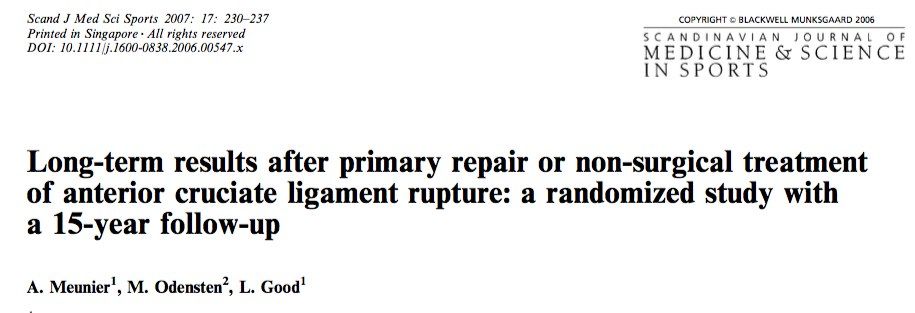
- 100 patients randomly assigned to operative (ACL reconstruction) or conservative management
Q41What were the key findings of the study?▸
- ACL reconstruction per se did not reduce risk of OA or improve outcome scores
- ACL reconstruction can reduce risk of 2nd meniscal injury
- Meniscal status is the most important predictor of OA
Q42What happened to the conservatively managed patients?▸
- 1/3 of conservative patients later received ACL reconstruction due to instability
Q43What are the intraoperative complications of ACL reconstruction related to graft harvest?▸
- Hamstring: premature harvest, deep MCL injury, hematoma, saphenous nerve injury
- BPTB: fracture (patella or tibia)
- Both grafts: dropped graft
Q44What complications can occur during tunnel placement in ACL reconstruction?▸
- MFC injury
- Lateral wall blowout
- Posterior wall blowout
Q45What complications can occur during graft passage in ACL reconstruction?▸
- Under-sized graft
- Over-sized graft
Q46What complications can occur during graft fixation in ACL reconstruction?▸
- Late button flip
- Screw breakage or slippage
- Screw divergence
- Graft laceration, advancement or rotation
- Screw protrusion into the joint
Q47What postoperative complications are related to ACL reconstruction?▸
- Cyclops lesion
- Arthrofibrosis
- Septic arthritis
- Prominent tibial screw
Q48How are postoperative complications of ACL reconstruction classified?▸
- Related to ACLR: cyclops, arthrofibrosis, septic arthritis, prominent tibial screw
- Not related to ACLR (listed as a separate category by the lecturer; no examples given in the notes)