Spine Non Trauma
Adult degenerative scoliosis classification
Degenerative adult scoliosis and SRS Schwab deformity classification tables
12 questions
3 source pages
2 images
1 fact-check flags
Images appear with the first question taken from each source page — tap a question to open it.
Q1Describe the X-ray findings in degenerative scoliosis.▸
- Convexity to the right at the mid lumbar spine with a rotational component
- Marked degenerative change at multiple facet joints; pedicles and endplate intact
- Need lateral + whole spine XR (coronal and sagittal balance), F/E XR, prone traction views for vertical instability, bending and fulcrum views
- MRI also required
Q2What are the causes of degenerative scoliosis?▸
- Osteoporotic collapse
- Spondylolisthesis
Q3What is the degenerative cascade of the spine?▸
- Disc degeneration with decreased water content and decreased disc height
- Buckling of ligaments, decreased stability
- Increased stress on facet joints -> osteoarthritis and facet hypertrophy
- Facet cannot resist shear -> anterior translation (especially with sagittal-oriented facets)
- Can cause spinal stenosis/deformity; some may auto-stabilize
Q4What is the management approach for degenerative scoliosis?▸
- Define the patient's complaint clearly; assess neurology, spinal stability, sagittal balance
- Osteoporosis treatment if related to osteoporotic collapse
- Decompression only: leg pain, minimal/no back pain, Cobb <30, <2mm subluxation, no thoracic hyperkyphosis, acceptable balance, poor premorbid
- Short fusion: back and leg pain, scoliosis <30, segmental instability, no significant global imbalance, extensive decompression
- Long fusion: back and leg pain, scoliosis >45, >2mm subluxation, significant global imbalance (determine UIV and LIV)
- Severe deformity with poor balance: corrective osteotomy + long fusion (high OT risk, outcome not guaranteed)
Q5How does de novo degenerative scoliosis differ from pre-existing/neglected scoliosis?▸
- De novo has less coronal deformity (less Cobb, less L4 tilt, less rotational deformity) but more sagittal pelvic malalignment
- Fewer vertebral segments involved; affects the lumbar spine
- Disc space wedging, osteoporotic collapse, less bone maldevelopment (pedicles)
Q6What is the rate and what are the risk factors for curve progression?▸
- 3 degrees per year
- Prior history of progression; unstable segment (asymmetrical disc degeneration, lateral disc wedging, >5mm lateral osteophyte difference)
- Cobb >30 degrees, lateral listhesis >6mm
- Intercrestal line through L4/5 disc or lower, rotatory subluxation, loss of lumbar lordosis
Q7What clinical question is the Bordeaux classification used to answer?📷▸
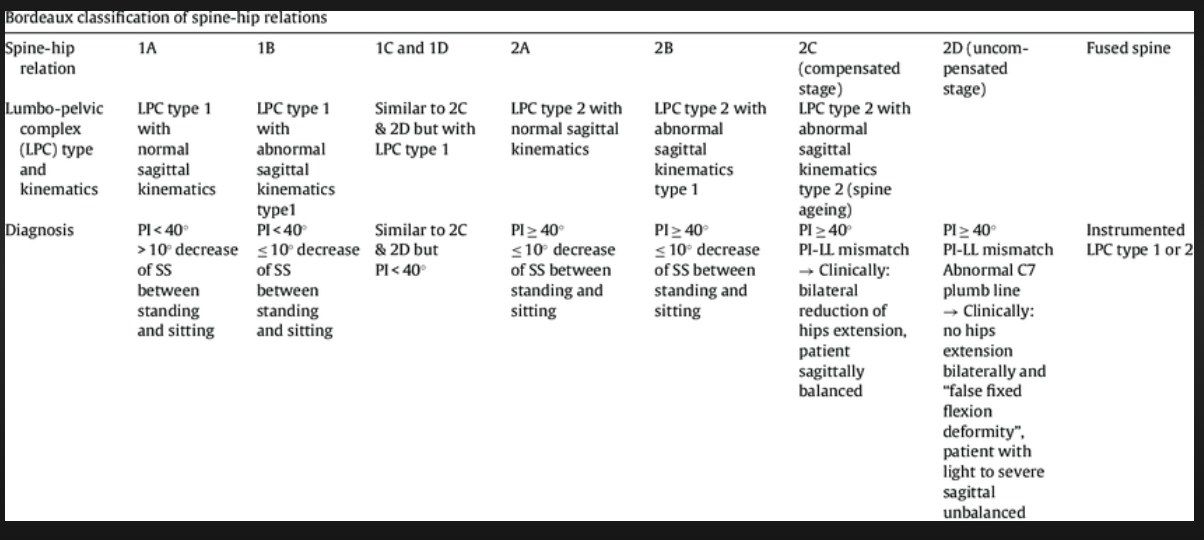
- How to decide acetabular position/implant in a patient with spinal deformity
Q8What determines the type in the Bordeaux classification?▸
- Type of lumbo-pelvic complex (LPC): type 1 = PI <40, type 2 = PI >40
- Then subclassified A/B/C/D
Q9How does the Bordeaux classification guide implant choice?▸
- Increasing constraint required for types B, C and D
- Based on LPC type: PI <40 (type 1) or PI >40 (type 2)
Q10What is the SRS (Schwab) classification used for?📷▸
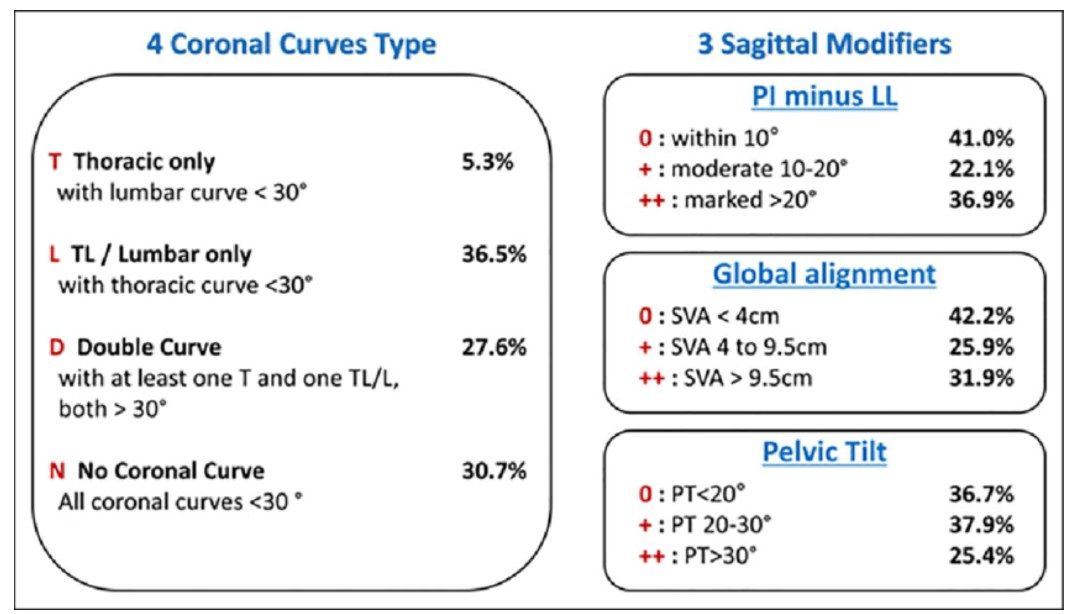
- Classification for adult spine deformity (Scoliosis Research Society)
- Includes parameters relevant to OLIF/degenerative scoliosis surgery
Q11What does the Ascani 1986 natural history study report for adult scoliosis?▸
- 3 degrees per year progression (per lecture notes)
- All curves increase after skeletal maturity
Q12What features indicate a poor prognosis in adult spine deformity?▸
- >30 degree Cobb angle
- >30% apical rotation
- 6mm lateral listhesis
- Poor quality bone
Fact check
Ascani 1986 Spine natural history study: adult scoliosis progresses 3 degrees per year — mismatch with cited source — Ascani 1986 reported an average progression of 0.4 degrees per year after skeletal maturity; most curves progress at less than 1 degree per year, though larger curves progress faster — source