Spine Non Trauma
Craniovertebral junction and C1-C2 fixation
Open mouth views for basilar invagination; C1-C2 fusion and screw fixation landmarks
12 questions
4 source pages
1 images
Images appear with the first question taken from each source page — tap a question to open it.
Q1Which lines are used to assess basilar invagination on this section?▸
- Fishgold's digastric (Biventer) line - connects the digastric grooves on the undersurface of the skull, just medial to the mastoid processes
- Fishgold's bimastoid line - connects the tips of the mastoid processes
Q2What are the normal measurements for Fishgold's digastric line?▸
- Odontoid tip normally projects 11 mm below the line
- Atlanto-occipital joint normally projects 12 mm below the line
- Basilar invagination is present when the atlanto-occipital joint projects at or above this line
Q3How is Fishgold's bimastoid line interpreted?▸
- Odontoid process should be <10 mm above this line
- More than 10 mm above the line indicates basilar invagination
Q4What is the use of the open mouth view in assessing C1/2 instability and basilar invagination?▸
- Open mouth C-spine XR looks for rotatory instability
- Rule of Spence: >8mm = TAL incompetence
- Controlled flexion/extension views to see if the deformity is reducible
Q5Describe the Gallie fusion technique for C1/2.▸
- Interspinous bone graft with sublaminar wiring around the posterior arch of C1 and wiring over the C2 spinous process
- Fusion rate 75%fusion (poor rotational stability)
- Requires post-operative external fixation
Q6Describe the Brooks and Jenkins fusion.▸
- Modification of Gallie to overcome rotational deficiency
- Bilateral interlaminar grafts with bilateral sublaminar wiring (C1 and C2)
- Fusion rate 93%
- Also requires post-operative external fixation
Q7What screw-based options are available for C1/2 fusion?▸
- Transarticular screw - supplemented with Gallie wiring; stable
- Screw-rod structure - stable and allows reduction
- OC fusion
Q8What are the main categories of C1/2 fusion techniques?▸
- Wiring: Gallie; Brooks and Jenkins
- Transarticular screw (supplemented with Gallie wiring) - stable
- Screw-rod structure - stable, allows reduction
- OC fusion
Q9What are the entry landmarks for a transarticular screw (Magerl technique)?▸
- Axial: 10 degree medial
- Entry point 3-4mm cranial to the C2/3 joint
- Midpoint of the pars mediolaterally
Q10What is the sagittal trajectory of the Magerl transarticular screw?▸
- 50 degree cephalad
- Passes through the posterior 1/3 of the C1-2 joint
Q11What is the entry site for a C2 pedicle screw?📷▸
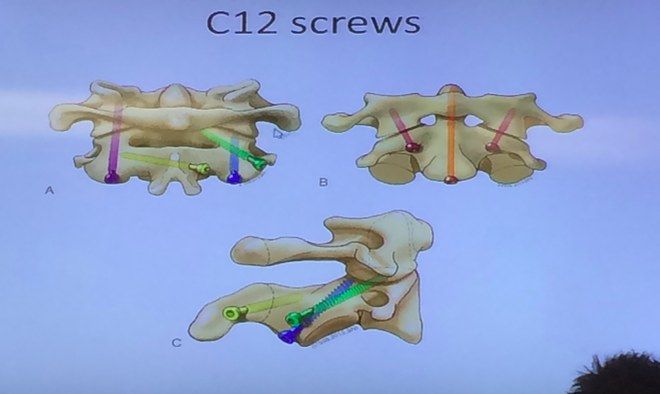
- Cranial leading edge of the C2 lamina
- Midpoint of the pars mediolaterally
- Starting point 2mm lateral to this midpoint
Q12What is the trajectory of a C2 pedicle screw?▸
- 30-45 degree convergent
- Directed cranially