P and O
Lower limb orthoses
Definition and purpose of orthoses, foot dorsum coverage and UCBL inserts
26 questions
5 source pages
3 images
Images appear with the first question taken from each source page — tap a question to open it.
Q1What is an orthosis and what are the ideal characteristics?▸
- Device externally applied or attached to a body segment that facilitates or improves function by supporting, stabilizing, correcting or compensating for deformity or weakness
- Ideal: biomechanically effective, free of pressure, light weight, adjustable
- Ideal: cosmetically acceptable, easy to don and doff, cheap and durable
Q2How is an orthosis classified and described?▸
- Corrective (tend to be hard): limit joint motion, stabilize flexible deformities
- Accommodative (tend to be soft): shock absorption, accommodate fixed deformities
- Describe by joint/region it encompasses, corrective or accommodative, static or dynamic, material
Q3What are the functions of an orthosis and the mechanism of an AFO?▸
- Control angulation (hinged knee brace); control translation (PCL brace)
- Control axial force (weight relieving caliper); control line of GRF (lateral wedged shoes for cavus, GRFAFO)
- AFO mechanism: 3 point fixation (control moments about a joint, e.g. MCL); 4 point fixation (control translation, e.g. PCL); GRF
Q4Compare thermosetting and thermoforming plastics.▸
- Thermosetting: Usually laminated using layers of fabric and monomer resins with catalyst, heat, vacuum/pressure; cannot reheat and remould; durable; usually used in prosthesis
- Thermosetting fabrics: fiberglass, nylon, carbon fibre, Kevlar; monomers: epoxy, polyester, polyurethane
- Thermoforming: can be reshaped after reheating; high temp softens at 120-190 degrees (polypropylene, copolymer, polyethylene)
- Medium temp plastozote; low temp orthoplast soft at <80 degrees, directly moulded on patient (hand splints)
Q5What are the types of AFO and their indications?▸
- Solid: protection of ankle; anterior entry GRFAFO for knee recurvatum; prevent equinus in flaccid knee/ankle; suppress spasticity; trim line anterior to malleolus
- Posterior spring leaf for footdrop; trim line posterior to malleolus; prevents plantarflexion in swing/heel strike, allows dorsiflexion in stance
- GRAFO (posterior entry) for crouch gait with weak gastrocnemius/quadriceps and failure of knee extension-ankle plantarflexion couple; mid patella to MT; contraindicated in high tone
- Hinge for medial-lateral unstable ankle; trim anterior to malleolus; still allows dorsiflexion
- Tone reducing AFO for spastic tone; wraps foot, extends under toes; spastic inhibition bar + ML foot support
Q6Compare GRAFO and three point pressure AFO.▸
- GRAFO: stance only (needs ground contact); related to shoe design/interface; joint control proximal to AFO
- GRAFO: decreases safety (uneven ground, malalignment); Increase efficiency (increase ROM)
- 3 point: swing and stance; independent of shoe design/interface; joint control within AFO
- 3 point: increases safety (stability in all planes); decreases efficiency (less ROM)
Q7What are the parts of an ankle foot orthosis (AFO)?▸
- Calf shell: proximal anterior support, size of posterior support, trim line relative to malleolus
- Strap (calf/heel-retaining)
- Hinge
- Shoe insert: degree of coverage at foot
Q8What are the uses of a solid AFO?▸
- Protection of the ankle (ML, prevent plantarflexion)
- Anterior entry GRFAFO for knee recurvatum
- Standing: prevents excessive plantarflexion; at heel strike GRF posterior to ankle COR produces a flexion moment at the knee
- Prevent equinus in flaccid knee and ankle
- Suppress spasticity (prevent sudden ankle dorsiflexion during terminal stance with clonus --> better toe off)
- Trim line anterior to malleolus; no hinge
Q9How does the GRAFO (posterior entry) work?▸
- Indication: crouch gait with weak gastrocnemius and quadriceps with failure of the knee extension-ankle plantarflexion couple
- Static accommodative orthosis of high temp thermoforming plastic from mid patella to MT
- Uses Newton's third law to alter the GRF by controlling distal joints to alter the proximal joint
- Prevents excessive tibial anterior translation during ankle rocker with a rigid anterior tibial shell
- Prevents excessive ankle DF with a toe plate and riding ankle in neutral
- Keeps GRF anterior to the knee, creating an extension moment; stabilises knee and decreased quad workload
- Contraindicated in crouch gait due to high tone
Q10What are the principles of a tone reducing AFO?▸
- For patients with spastic tone
- Well protection of whole foot and ankle; wraps around medial and lateral side and extends distally under the toes
- Prevent stimulation that will trigger increase tone over lower limb
- Spastic inhibition bar + ML foot support --> maintain STJ at stance phase --> no extensor activation
- Rigid shell --> proprioceptive feedback --> stimulate ankle dorsiflexion at swing phase
Q11What are the features of the shoe upper?▸
- Height - high for ankle protection
- Closure
- Throat (= opening)
- Toe box (reinforcement) - stiffens anterior part of upper
Q12What are the features of the shoe sole?▸
- Additional inner sole --> deformity adaptation
- Shank (reinforcement) - longitudinal support between in and out sole; decreases load to climber's feet in an ascent
- Heel under anatomical heel
Q13What are the effects of a high heel and what is a heel counter for?▸
- High heel --> TA contract --> increase hallux valgus, hammer toes, metatarsalgia
- Heel counter stiffens posterior part of upper at anatomical heel
- Heel spur: snugly fit to heel to decrease heel abrasion
Q14What are the three point pressure principles?▸
- Pressure = total force/area
- Sum of forces and bending moment = 0
- Lever arm: increase distance of load from joint --> increase moment arm --> decrease load needed for a given torque
Q15Describe the weight relieving caliper (KAFO).📷▸

- Proximal circumferential brim moulded like a femoral prosthesis socket
- Medial and lateral uprights shaped to the patient's LL: it allows the weight to bypass the LL to be transferred to the shoe
- Bar lock at knee; adjustable bars for length; leather straps at mid thigh and mid leg
- Aims: Providing stability; Correcting/ preventing deformity; relieve weight bearing, relieve pain
- Mainly for NM weakness (polio, CP)
Q16What are the components of a hinged KAFO?▸
- Thigh shell - ischial bearing, anchors into thigh for security/rotational control; cannot control pistoning
- Knee axis single or multi; flexion control - lock (drop lock safest, most durable; barlock auto locks in extension but poor valgus and varus control) or free (posterior offset)
- Deformity control (knee cap): sagittal pretibia/supracondylar pad; frontal calf shell extension
- Medial + lateral uprights; solid AFO +/- custom moulded insole
Q17How do ring lock and bar lock knee joints work?▸
- Ring lock (drop lock): actively push down to lock; requires sufficient finger power
- Barlock (Swiss lock): spring loaded release bar; semi auto, auto locks at knee extension
- Sitting/manual lifting up of bail to unlock uprights --> knee flexion
Q18What is the posterior offset knee joint and what does it require?▸
- No locking
- Requires quad power grade 3 or above
- Orthosis COR posterior to knee COR
- Knee flexion at swing/sitting; active knee extension locks orthosis
Q19What are B Joseph's principles of orthosis?▸
- Leave as many joints as possible free
- As light as possible
- Contact areas between orthosis and limb should be as large as possible
- Attempt to discard the orthosis by the time child is skeletally mature
Q20What are the components of a reciprocal gait orthosis (RGO)?📷▸
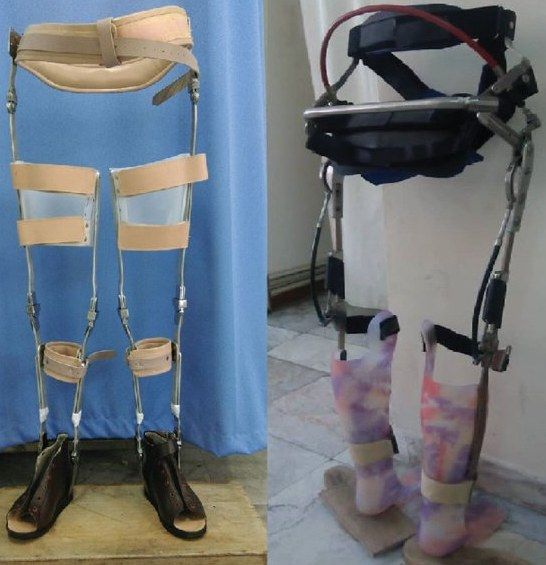
- Pelvic and thorax straps
- Isocentric bar/cables connect 2 hips - lock limb at stance, allow limb flexion at swing
- Hip and knees manual locking
- Solid AFO
Q21How does the RGO produce gait?▸
- Limb advancement by torso rotation
- Cable tightened at swing
- 3 way linkage (torso-hip-knee): movement at one side --> contralateral side locks at extension, preventing torso collapse
- Weight shift at double support --> cable loose --> allows contralateral advancement
- Manual cable loosening for sitting
Q22What keeps the torso erect in an RGO and why is it needed?▸
- Pelvic and thorax straps
- Compensates for weak hip extensors
Q23What is an HKAFO and how does the patient mobilise?▸
- Components: pelvic +/- thoracic band, hip joints, lateral uprights, KAFO
- Mostly standing
- Locomotion: swing to/swing through gait
- Needs hand support
- Very energy consuming
Q24What is a UCBL insert?📷▸
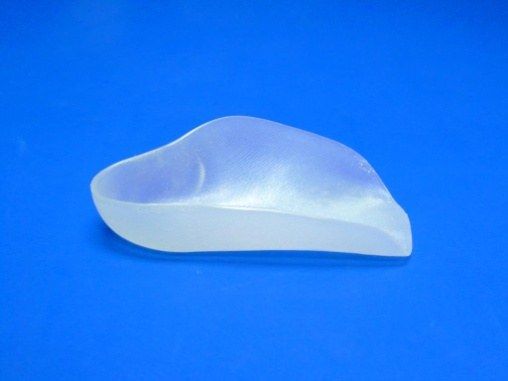
- Type of corrective, static orthosis
- Rigid plastic insert with total contact design to stabilize flexible foot deformity
Q25What are the design characteristics of a UCBL insert?▸
- Heel cup encompasses the heel and midfoot
- Medial calcaneal grip merges with contour of the foot arch
- Fabricated over a cast of the foot held in maximal manual correction
Q26What force system does a UCBL insert use?▸
- 3 point force system to control forefoot abduction
- Grip on sustentaculum tali, lateral forefoot control and medial arch support