P and O
Prostheses - types and components
Definition of a prosthesis, limb prostheses, knee joints and terminal devices
33 questions
4 source pages
1 images
Images appear with the first question taken from each source page — tap a question to open it.
Q1What is a prosthesis and how is it classified by structure?▸
- Artificial device externally applied to replace function or appearance of part of the body
- Exoskeleton: soft contoured foam + hard outer shell - durable, hard shell, heat resistant
- Endoskeleton: metal frame + soft covering - light, can exchange socket, adjustable
Q2Compare quadrilateral and ischial containing (CAT-CAM) sockets.▸
- Quadrilateral: intentionally nonanatomical shape for soft tissue locking; narrow AP, wide ML; posteromedial platform for ischial bearing
- Quadrilateral disadv: cannot control abduction (wide ML), compensatory trendelenberg lurch; adv: comfortable sitting
- CAT-CAM: narrow ML, no posterior platform; groove contains ischium/rami --> bony lock (ramus bearing), rotational stability
- CAT-CAM: more anatomic - Distributes the proximal and medial concentration of forces more evenly
- CAT-CAM: allows 10 degrees adduction (stretch gluteus medius); Allows 5degs of flexion to stretch the gluteus maximus, increase hip extension strength for propulsion; more stable, less energy consuming
- CAT-CAM cons: bony lock discomfort/ulcers at the adductor region
Q3What is the modified design (NSNA) / Marlo anatomical socket?▸
- Normal shape, normal alignment socket combining quadrilateral and ischial containing concepts
- Narrow ML to control abduction; high lateral to contain GT; posterior platform for ischium like quadrilateral
- Better ROM; smaller bony lock, less discomfort
Q4What suspension systems are available for a prosthesis?▸
- Differential pressure (suction) - best fit/proprioceptive feedback, for mature limb; wrap or pull bag, seal-in liners, one-way valve
- Mechanical: liners with Velcro strap or pin-lock design
- Belt: total elastic suspension (neoprene), Silesian belt, pelvic belt
Q5What is choke syndrome and how is phantom limb pain managed?▸
- Choke syndrome: venous outflow obstruction of residuum from narrow proximal socket + empty distal space; prevent with total contact sockets
- Phantom limb pain: pain felt in the amputated limb; treat with anti-depressants, NSAIDs, increased prosthesis use, TENS, sympathetic nerve block
Q6How is an amputee assessed in clinic?▸
- Amputation related: wound condition, bone impingement, contracture, neuroma, phantom limb sensation/pain
- Prosthesis related function: can patient activate movement, walking aids, distance, stairs, ADL
- Prosthesis related complication: impingement, abrasion; assess wear
Q7How are prosthetic knee joints classified?▸
- Knee joint mechanism: stable in stance, smooth swing, allow unrestricted motion for sitting and kneeling
- Axis: monocentric (single axis) or polycentric (multiple axis)
- Primitive control (all constant friction): constant friction, manual locking, stance control, single cadence 4-bar polycentric
- Advanced control (all variable friction): fluid (pneumatic/hydraulic), microprocessor
Q8What are the primitive knee control mechanisms and their trade-offs?▸
- Constant friction (paediatric): durable, reliable; fixed cadence, stability in stance depends on alignment
- Manual locking (geriatric): locked, stable knee; affects gait efficiency, may need circumduction/ hip hiking
- Stance control (weight activated clutch-lock): easy swing, stable stance; difficulty shifting weight to sound limb when sitting
- Single cadence 4-bar polycentric: flex when loaded on forefoot, lock when loaded on heel; inherently stable; reduce energy dissipation by decreasing the magnitude of muscle activity; shortens for toe clearance; better sitting cosmesis
Q9What are the advanced knee control mechanisms and their disadvantages?▸
- Fluid (pneumatic or hydraulic) control: cadence response changes knee flexion resistance via a piston mechanism
- Disadvantages: heavy, more expensive, need servicing
- Microprocessor control
Q10What is the pilon and how do exoskeleton and endoskeleton pilons differ?▸
- Pilon connects the socket to the terminal device
- Exoskeleton pilon: transmits load via a rigid external structure; more durable; heavier; cannot adjust length
- Endoskeleton pilon: transmits load via an internal strut covered with foam; can adjust length
Q11What is the terminal device and how is it classified?▸
- Most distal part of the prosthesis; provides shock absorption, adapts to uneven surfaces, stablise knee, reduce limb length during swing
- Classified by energy storing and articulating
- Includes SACH, single axis/poly axis, dynamic response foot
Q12What stump-related complications occur with prostheses?▸
- Dermatological: contact dermatitis, blister, callosity
- Fitting problem: too tight/too loose
- Phantom limb sensation
Q13What dynamic movement complications occur with a prosthesis?▸
- Gait cycle problems
- Pistoning
- Malalignment
Q14What are the features of a transknee amputation relevant to prosthesis use?▸
- End bearing surface
- Long lever arm
- Stable suspension by metaphyseal flare
- Use a 4 bar knee joint to proximalise the COR of the knee
Q15What are the components of a below-knee prosthesis?📷▸
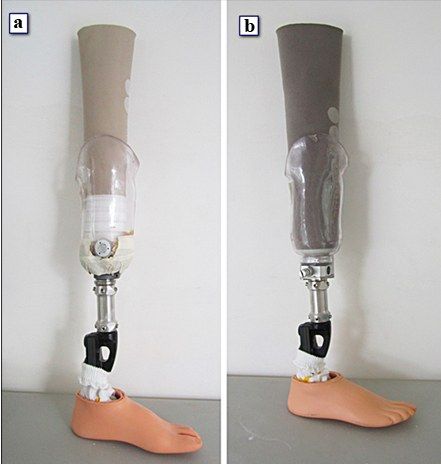
- Socket - interface between stump and prosthesis; transfers load and protects stump (inner soft liner + outer hard shell)
- Suspension - attachment mechanism for energy transfer and control
- Pilon - restores length (endoskeleton or exoskeleton)
- Terminal device - most distal part; energy storing or non-energy storing
Q16Compare patellar tendon bearing and total contact sockets.▸
- Patellar bearing (PE foam, pelite): residual limb not in contact with bottom; problem of movement within distal socket
- Total contact (urethane/silicone gel): uniform distribution of pressure; disadvantage - volume control challenging
Q17What are the pressure tolerant and pressure sensitive areas in a BKA socket?▸
- Tolerant: patella tendon, medial tibial flare, anterior compartment, gastrocnemius, fibular shaft --> add build-ups/convexities
- Sensitive: tibial crest and tubercle, distal fibula and fibular head, peroneal nerve, hamstring tendons --> reliefs/concavities
Q18What are the suspension options for a BKA prosthesis?▸
- Differential pressure (negative atmospheric pressure, surface tension, muscle contraction) for total surface bearing; secure, best proprioception and ROM
- Differential pressure prerequisite: stable stump volume, good skin, precise fit, good cognition
- Mechanical: sleeve; shutter lock (pinlock) - needs daily washing and good hand function; strap for hyperextension (e.g. polio) - pistoning
- Hinge (thigh corset) - max stability and shared weight bearing but bulky, pistoning
- Anatomic supracondylar wedge +/- suprapatellar extension - for short stump <5cm
Q19What are the pros and cons of supracondylar/suprapatellar suspension?▸
- Adv: short stump <5cm; increased contact area (supracondylar ML, suprapatellar AP); durable, economical, less maintenance
- Disadv: decreased knee ROM; local pressure at femoral condyles; requires good hand dexterity
Q20How does suction suspension compare with other suspension systems?▸
- Relies on negative atmospheric pressure, surface tension and muscle contraction
- Usually for total surface bearing sockets; secure, best proprioception, best ROM
- Suction slightly > pin/shuttle lock, and 3 times supracondylar/straps
Q21What terminal devices can be used in a BKA prosthesis?▸
- Divided into energy storing and non energy storing
- SACH
- Single axis
- Multiaxis
- Elastic keel (Safe heel)
- Dynamic response
Q22Compare single axis constant friction and manual locking knee joints.▸
- Constant friction: simple, durable, light, cheap; less control, decreased stability, limited flexion
- Manual locking: more stability in standing; need circumduction and hip hitch for foot clearance; must unlock to sit
Q23What is the weight activated stance control (safety) knee?▸
- Force sensitive drum brake/clutch lock
- Pros: versatile stability (adjustable housing); prosthetic length shortens for swing clearance
- Cons: more parts needing servicing; slower walking and smaller steps due to friction; difficult on stairs
Q24What are the pros and cons of a polycentric (4 bar linkage) knee?▸
- Instant centre moves anterior and posterior to GRF, changing alignment stability and producing flexion or extension moment
- Pros: stability at heel strike/early stance; Reduce energy dissipation by decreasing the magnitude of muscle activity; prosthesis shortens in swing; better voluntary knee flexion control; better sitting cosmesis
- Cons: heavier than single axis; needs active knee extension moment in stance to prevent buckling; poor durability
Q25What are the pros and cons of fluid control/hydraulic knee joints?▸
- Pros: variable cadence
- Cons: weight, cost
Q26What is the knee extension-ankle plantarflexion coupling?▸
- Occurs in midstance/ankle rocker as CoG progresses posterior to anterior
- Purpose: decrease quadriceps work to maintain knee extension for energy conserving gait
- Soleus (biarticular) contracts, slows tibial forward progression and keeps CG anterior to knee --> extension moment
- Rigid lever then propulsed forward by concentric hamstrings, glut max and gastrosoleus
Q27What are the components and indication of a SACH foot?▸
- For low demand patients
- Compressible cushioned foam heel simulating plantarflexion (3 densities: soft, median, hard)
- Solid ankle block for stability
- Wooden rigid keel for midstance stability
- Weight: medium
Q28What are the pros and cons of the SACH foot?▸
- Pros: cheap and durable, large variety of heel height, reliable, less maintenance
- Cons: bad for uneven ground; limited DF due to rigid heel; no propulsion/push off at terminal stance
- Cons: fixed cadence; overloads the non-amputated foot
Q29What is the elastic keel (SAFE) foot?▸
- Elastic keel = stationary attachment flexible endoskeleton (SAFE), a.k.a flexible keel foot - non-articulated
- Similar to SACH with a polyurethane section 45 degrees at sagittal plane to mimic the subtalar joint
- Internal keels permit triplanar movement and easy rollover, yet stiff and stable for stance and propulsion
- Disadvantage: ML instability
Q30What are the features of a single axis articulated foot and who is it used in?▸
- Two rubber bumpers allow some passive DF/PF; adjustable bumpers add to knee stability and allow rapid PF
- Used in AKA only (not BKA as too heavy)
- DF bumper assists push off; weight: heavy
- Cons: not cosmetic; moving parts may loosen and become noisy; debris; increased maintenance and weight; less durable; does not adapt to uneven ground
Q31How do multi-axis and energy storing feet differ?▸
- Multiple axis (heavy) adds inversion/eversion: good on uneven ground and shock absorption; less stability on smooth surfaces, increased weight and maintenance, poor durability
- Dynamic response: flexible heel, sagittal split, posterior projection of heel; allows variable cadence
- Mechanism: energy stored during heel strike re-used to spring back during push off; reduces energy expenditure; expensive
- Microprocessor foot: sensors (angle, accelerometers, gyroscopes, torque) adjust to various needs
Q32Compare the Flex and Seattle prosthetic feet.▸
- Flex: very light; lightweight, ML stability, vertical jumping allowed
- Flex cons: high cost, complex fabrication and alignment, difficult heel height changes
- Seattle: heavy; dynamic response, improved cosmetic appearance
- Seattle cons: increased weight and cost
Q33What are the design features of a dynamic response (energy storing) foot?▸
- Flexible heel for push off
- Sagittal split for inversion and eversion
- Posterior projection of the heel for heel strike
- Articulated vs non-articulated
- Allows variable cadence walking