Trauma
Upper limb surgical exposures
Anterior approach to shoulder internervous plane, anterior approach to arm, Kocher approach.
16 questions
3 source pages
2 images
Images appear with the first question taken from each source page — tap a question to open it.
Q1What are the indications for the anterior approach to the shoulder?📷▸
- Trauma
- Infection
- Tumour
Q2How is the patient positioned for the anterior shoulder approach?▸
- GA, beach chair position, head turned to the other side
- Sandbag under the scapula
- Xray available
Q3What are the landmarks and key steps of the anterior approach?▸
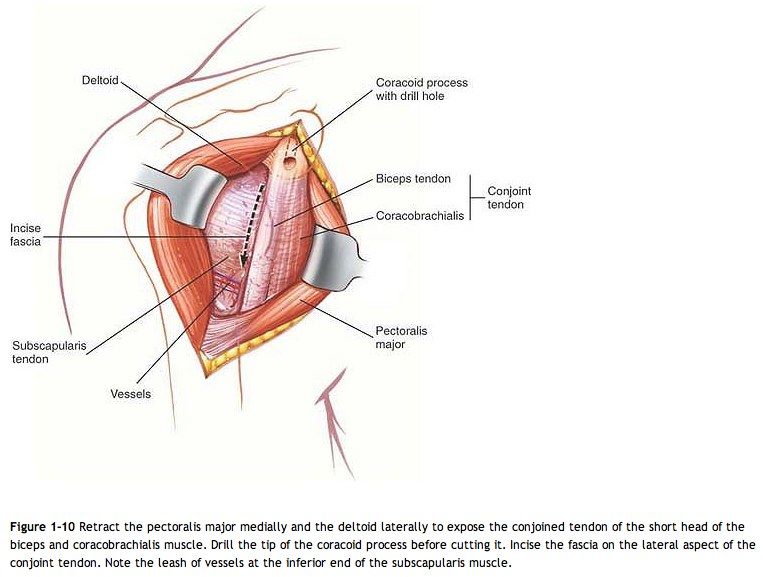
- Landmarks: coracoid, deltopectoral groove
- Find the cephalic vein and retract it laterally
- Plane between deltoid and pectoralis; clavipectoral fascia
- Stay lateral to the conjoint tendon, careful with medial retraction
- Subscapularis tendon - find NV beneath; externally rotate arm and incise longitudinally
Q4What is the internervous plane of the anterior shoulder approach?▸
- Between the axillary nerve supplying deltoid
- And the pectoral nerve supplying pectoralis
Q5What structures are at risk in the anterior shoulder approach?▸
- Cephalic vein
- Musculocutaneous nerve
- Brachial plexus
- Axillary nerve and vessels
Q6What is the anaesthesia, positioning and preparation for the anterior approach to the arm?▸
- GA
- Supine with the arm abducted
- Xray available
Q7What are the landmarks for the anterior approach to the arm?▸
- Coracoid process
- Deltopectoral (DP) groove
- Lateral border of biceps
Q8Where is the skin incision made in the anterior approach to the arm?▸
- Skin incision along the lateral border of the biceps
- Then incise the fascia
Q9What are the key steps and structures at risk in the proximal part of the anterior approach to the arm?▸
- Find the internervous plane (INP)
- Beware of the anterior humeral circumflex artery
- Incise lateral to the PM (pectoralis major) insertion +/- detach it
- Stay lateral to the biceps
Q10What are the key steps and structures at risk in the distal part of the anterior approach to the arm?▸
- Find the plane between biceps and brachialis
- Beware of the musculocutaneous nerve (MSC)
- Midline split of brachialis with the elbow flexed
Q11What is the internervous plane of the Kocher approach and which nerves are at risk?📷▸
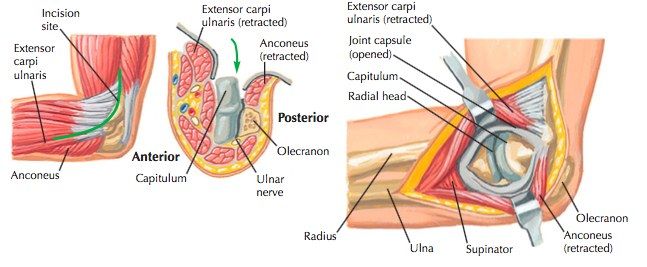
- Between ECU (PIN) and anconeus (radial nerve)
- Danger: PIN and radial nerve
Q12What procedures is the Kocher (posterolateral) approach used for at the elbow?▸
- Radial head - excision/ORIF/replacement
- LCL surgery
- Coronoid surgery
Q13What are the landmarks, patient position and incision for the Kocher approach?▸
- Landmarks: lateral epicondyle, radial head, olecranon
- 5cm incision from lateral epicondyle to radial head (curved or straight)
- GA, supine with arm board, tourniquet
Q14Describe the superficial dissection of the Kocher approach.▸
- Incise the fascia in line
- Distally find the plane between ECU and anconeus
Q15How is the PIN protected during the Kocher approach?▸
- Pronate the arm to turn the PIN away from the field
- Do not place retractors around the radial neck
- Do not dissect anteriorly (radial nerve over the anterolateral capsule)
- Do not dissect distal to the annular ligament; split proximal fibers of supinator, staying on the posterior cortex of the radius, away from the PIN
Q16What are the capsular cautions and limitation of the Kocher approach?▸
- If LCL intact: keep 1cm anterior to the crista supinatoris for the capsular incision
- If LCL torn: longitudinal capsular incision
- Stay at the midline of the radiocapitellar joint
- Cons: cannot extend distally