Hip
Periprosthetic infection - prevention and treatment
Theatre design, infection rates, difficulty of eradication and antibiotic choice
25 questions
4 source pages
2 images
2 fact-check flags
Images appear with the first question taken from each source page — tap a question to open it.
Q1How do you reduce total joint replacement infection rate pre-operatively?▸
- Patient selection; medical optimization (HbA1c <7)
- Screen for active infection (UTI, tinea pedis, LL ulcer, MRSA, dental caries)
- MRSA carrier: nasal decolonization with mupirocin 2%
- Preop skin cleansing with chlorhexidine (WHO, ICM, CDC)
- Same day admission to a clean ward
Q2What intra-operative measures reduce infection risk?▸
- Theatre design: HEPA filter, exponential airflow (at least 20x air exchange per hour), room-in-room
- Limit traffic and personnel
- Systemic prophylaxis within 1hr of skin incision
- Impermeable drape and gown, body exhaust system
- Iodine impregnated drapes (NICE)
- Antibiotic-loaded cement, haemostasis, watertight closure
Q3What intra-operative soft tissue and planning measures reduce infection risk?▸
- Decrease soft tissue trauma
- Avoid prolonged procedure with meticulous preop planning
Q4What post-operative measures reduce infection?▸
- Antibiotic coverage to 24 hours (Wilson and Savati: infection reduced from 11% to 1%)
- No drain
- Optimize preop Hb to minimize the need for postop transfusion
- Minimise dressing changes
Q5What prophylactic antibiotic is used and what is the dose?▸
- Cefazolin 2g 2 hours before skin incision, extra 1g if operation >4 hours
- Bactericidal against Streptococcus and S. aureus, good tissue penetration
Q6What were the infection rates in the Lidwell MRC trial?▸
- Clean air 1.7%
- Antibiotics 0.85%
- Antibiotics + clean air 0.4%
- Antibiotics + clean air + body exhaust suit 0.2%
Q7How is a theatre divided into zones?▸
- 4 zones: outer, clean, aseptic, disposal
- Outer = rest of hospital
- Clean = reception to theatre door
- Aseptic ends at entry of the anaesthetic room
- Disposal zone
Q8What are the environmental requirements of a theatre?▸
- Temperature 22 degrees; radiant warming blankets (bearhugger shown to increase infection rate)
- Humidity 40-60%
- Light without shadow - minimum 40,000 lux at incision site
Q9How does theatre ventilation decrease infection?▸
- 95% of SSI are from airborne infection
- Two components: pressured air and clean air
Q10What is plenum (positive pressure) ventilation?▸
- 15-20x air changes/hour
- Effective at <35 CFU/m3
Q11What is laminar flow ventilation?▸
- Parallel flow lines, uniform velocity, single direction (horizontal or vertical)
- 200-400 air change/hr
Q12What is exponential airflow in theatre ventilation?▸
- Inverted trumpet flow
- Vertical flow then radially directly outwards
- Prevents entrainment
Q13What does HEPA filtration remove?▸
- Filters particles >0.5 microns with 99.997% efficiency (newer HEPA filters >0.1 micron)
- Smallest bacteria 40 microns; coronavirus 0.125 microns (the droplet, not the virus itself)
Q14How is theatre air monitored?▸
- Measured by colony forming units (CFU)/m3, sampled every 3 months
- Passive monitoring: settle plate
- Active monitoring: volumetric Casella slit sampler, 30L/min air through sampler, grow in 37C for 2 days
Q15What is the definition of ultraclean air?▸
- <20 CFU/m3 in the periphery of the theatre
- <10 CFU/m3 in the centre of the theatre
Q16What is the literature evidence for laminar flow?▸
- Charnley 1972: deep infection reduced from 7% to 0.5%
- Lidwell 1982: non-clean air 3.4%, clean air 1.7%, antibiotics 0.85%, clean air + antibiotics 0.4%, + exhaust suit 0.2%
- Hooper NZ registry 2011 JBJS: laminar flow/space suits did not reduce revision for early deep infection
- BUT BJJ 2018 Thomas: ultraclean air still valid
- Other cited work: Bischoff 2017 Lancet and the Rillio trial
Q17What is the aim of theatre design?▸
- Decrease infection rate
- Provide optimal conditions for patient and staff
Q18Why is infection difficult to eradicate in an infected THR?📷▸
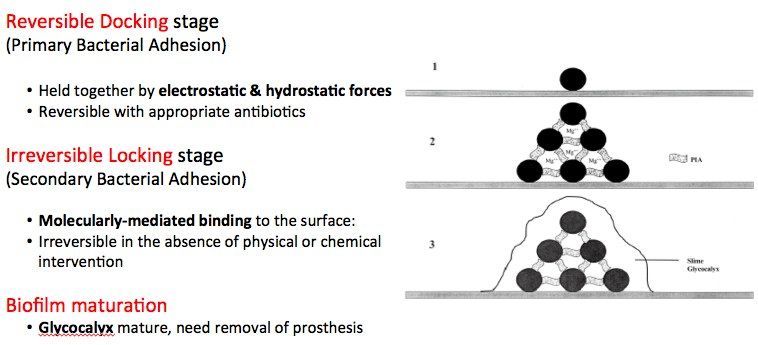
- Biofilm formation over the implant
- Biofilm is a structural community of bacteria encased in glycocalyx adhering to inert or living surfaces
- 3 stages: reversible docking / irreversible locking / maturation
- Acts as a physical and chemical barrier against the host immune system and antibiotics (prevents penetration, inactivation (opsonization) of drugs, acidic and anaerobic conditions)
Q19What are the steps of biofilm formation?▸
- Bacterial adherence
- Microcolony quorum formation
- Quorum sensing - bacterial load reaches a predetermined concentration
- Colony expresses biofilm; polysaccharide coating and proliferation
- Mature biofilm formation (4 weeks)
- Planktonic bacteria dissemination
Q20How does bacterial resistance arise?▸
- Spontaneous/sporadic mutation
- Horizontal gene transfer via conjugation, transduction, transformation or transmissible plasmid
Q21What are the mechanisms of antibiotic resistance?▸
- Drug inactivation or modification (e.g. beta-lactamase deactivation of penicillin G)
- Alteration of target site (penicillin binding protein in MRSA)
- Alternative metabolic pathway (sulfonamide)
- Active efflux of drugs
Q22What is the Coventry classification (1975)?▸
- Stage I: acute post-operative infection (<6 weeks) - contamination during operation or wound complication
- Stage II: delayed deep infection (6 weeks to 2 years) - deep seated with healed wound
- Stage III: late haematogenous infection (>2 years)
Q23What are the ideal properties of antibiotic-loaded cement?📷▸
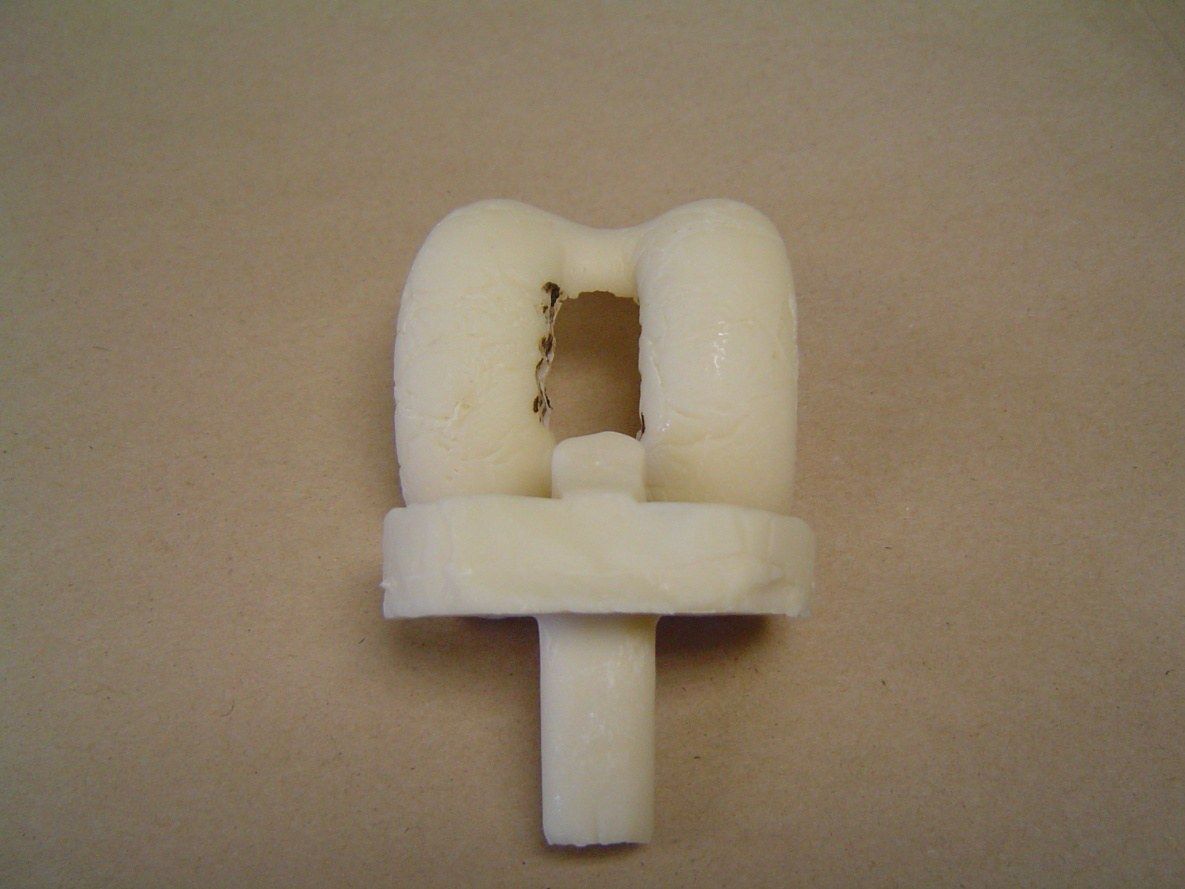
- Heat stable
- Good elution (low molecular weight)
- Broad spectrum
- Bactericidal
- Seldom allergic
- Available in powder form
Q24What is the technique for mixing antibiotic-loaded cement?▸
- No vacuum mixing - increases porosity and gives better elution
- Wait until set before insertion (stem micromotion allows easy removal)
- No drain
- Add antibiotic before mixing
Q25What is the elution profile of antibiotic from cement?▸
- Most antibiotic elution is highest in the first 24-72 hours after implantation
Fact check
Cefazolin 2g 2 hours before skin incision — timing incorrect and contradicts the same page's 'within 1hr' rule — Cefazolin 2g (3g if >120kg) is given within 60 minutes before skin incision; a 2-hour window applies to vancomycin/fluoroquinolone infusions — source
HEPA filters particles >0.5 microns with 99.997% efficiency — wrong particle size/efficiency benchmark — HEPA is rated at >=99.97% removal of particles at the most penetrating size of about 0.3 microns; smaller and larger particles are removed more efficiently — source