Hip
Aseptic failure - osteolysis, loosening and corrosion
Particle-induced osteolysis, aseptic loosening and mechanisms of taper corrosion
27 questions
4 source pages
1 images
Images appear with the first question taken from each source page — tap a question to open it.
Q1What are the Harris criteria for definite femoral loosening?▸
- Stem fracture, subsidence, cement fracture
- Loosening at the stem-cement interface
Q2What are the Harris criteria for probable femoral loosening?▸
- 100% cement-bone interface radiolucency
Q3What are the Harris criteria for possible femoral loosening?▸
- 50-100% cement-bone interface radiolucency
- Not present immediately post-op
Q4What are the reported percentages for the DeLee and Charnley zones?▸
- 3 zone: 94%
- 2 zone: 71%
- 1 zone: 7%
Q5What are the radiological signs of cementless acetabular loosening?▸
- >8 degrees change in opening angle
- 3mm translation
- Shedding of porous coating
- Halo around screw
Q6What are the features of bony ingrowth in the Engh classification?▸
- Cortical hypertrophy at stem tip
- Spot welding
- Proximal stress shielding
Q7What is the radiological feature of stable fibrous ingrowth (Engh)?▸
- Parallel line along the stem at the bone-implant junction
- Indicates stable fibrous ingrowth in the Engh classification
Q8What are the radiological features of an unstable cementless femoral stem (Engh)?▸
- Distal pedestal
- Calcar hypertrophy
- Divergent line
- Migration/subsidence
- Porous coating shedding
Q9What is osteolysis and what is its radiological definition?▸
- Histiocytic response to submicron wear debris - vicious cycle of bone resorption, debris generation and loosening
- Radiological definition: irregular radiolucent zone in the periprosthetic region >5mm
- Groin pain suggests cup loosening; thigh pain suggests femoral loosening
Q10Describe the pathway of particle-induced osteolysis.▸
- Particulate debris formation - submicron sized particles >10billion particles/gram
- Debris phagocytosed by macrophages
- Release of IL-1B, IL-6, TNFa, RANKL - upregulate RANKL on osteoblasts
- RANKL binds RANK on macrophages - differentiate into osteoclasts - bone resorption
- Prosthesis micromotion
- Particulate debris dissemination - build up hydrostatic pressure, spread through the effective joint space
Q11What is submicron debris and why is it significant?▸
- Particles <1 micrometer
- Travel into the effective joint space with joint fluid and trigger a biological reaction
- Phagocytosed by macrophages - cytokine release activates osteoclasts - osteolysis and loosening
- Determinants: volume, number, size and immune response of the particles
Q12What particle characteristics influence osteolysis?▸
- Size, morphology (elongated more active than round) and volume (critical 140mm3/yr)
- Particles 0.2-0.7 micron induce osteolysis
- Ceramic 0.7 micron, PE 0.5 micron, metal <0.1 micron
Q13What are the quoted wear rates for different bearings?▸
- MoPE 0.1mm/yr (100um)
- CoPE 0.05mm/yr (50um)
- MoM 0.005mm/yr (5um)
- CoC 0.0005-0.001mm/yr (0.5um)
Q14What is aseptic loosening and where do the particles come from?▸
- Failure of fixation - macromotion and micromotion at the implant-bone interface
- Inadequate initial fixation or particle-induced osteolysis; activated macrophages/osteoclasts are key
- Mode 1: femoral head and PE articulating surfaces
- Mode 3: third body wear, cement fragments
- Mode 4: cement-bone, cement-implant, bone-implant interfaces
Q15What is the effective joint space and how does osteolysis differ in cemented versus cementless fixation?▸
- All periprosthetic regions accessible to joint fluid and particulate debris by the pumping action of the joint
- Factors affecting the effective joint space: fixation, screw holes in shell
- Reduce by avoiding screw augmentation, cementing (Exeter centralizer), Circumferential proximal coated cementless stem, better liner locking
- Cemented: linear osteolysis over the cement-bone interface - subchondral plate formation around cement - early loosening as the whole rim is osteolyzed
- Cementless: focal expansile osteolysis - patchy bony ingrowth - osteolysis from peripheral gap extending into non-ingrown fibrous region - may fail catastrophically
Q16What are the causes/factors of osteolysis (implant, patient, surgical)?▸
- Implant: head size, choice of articulation, PE thickness
- Patient: BMI, activity level
- Surgical: malalignment causing edge loading/impingement, offset and soft tissue tension affecting JRF, third body, locking of modular parts
- Plus cementing technique
Q17How do macrophages respond to phagocytosed wear debris?▸
- 1. Secrete mediators (TNF alpha, IL-6, PGE2) that induce osteoblast proliferation/activation and RANKL induction
- 2. Differentiate directly into osteoclasts via the RANKL pathway
Q18What is the mechanism of taper corrosion in modular hip implants?📷▸
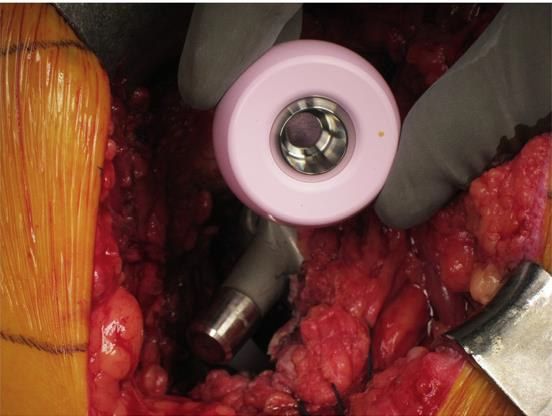
- Mechanically assisted crevice corrosion (MACC)
- Micromotion and shear stresses at the taper interface cause oxide film disruption, exposing fresh metal to oxygen-rich fluid
- Oxidation of underlying metal creates an acidic, low-oxygen crevice environment, destabilising the passive oxide film and increasing corrosion rate
Q19What factors are proposed to increase taper corrosion?▸
- Larger head size
- High offset stem
- Smaller taper design
- Taper cleaning
- Assembly force
Q20How do design factors minimise the risk of taper corrosion?▸
- Material: titanium allows higher pull-off and torsional strengths than cobalt chrome; mixed alloy tapers corrode more and have lower flexural rigidity
- Surface roughness
- Taper angle
- Taper mismatch: <7 deg half taper angle mismatch = self locking
- Short taper sits entirely within the bore, leading to edge loading
Q21What is the trade-off between short and long taper/neck designs?▸
- Short taper + small diameter with a trapezoidal neck gives more ROM than a large diameter, long taper with circular neck
- A short taper sits entirely within the bore, leading to edge loading
Q22How do surgeon factors minimise the risk of taper corrosion?▸
- Angle and force of impaction
- Avoid repeated impactions: single strike >6000N = 20cm drop with a 1.4kg hammer (Pennock J Arthroplasty 2006)
- Dry environment - avoid fluid contamination
- Femoral head size
- High offset stem causes more taper corrosion
Q23What is done at revision surgery for taper corrosion?▸
- Complete synovectomy
- Head and taper cleaned to remove corrosion debris
- Ceramic head used whenever possible to change the taper junction interface and remove the potential cobalt source
- Titanium adapter sleeve to prevent head fracture when placed against a damaged taper
Q24List the complications of total hip replacement shown on this section.▸
- Dislocation
- HO (heterotopic ossification)
- Infection
- DVT (deep vein thrombosis)
- Confusion
- Sciatic nerve palsy
Q25Which nerve palsy is listed on the source as a complication of total hip replacement?▸
- Sciatic nerve palsy - listed on the source; no further detail in the speaker notes
Q26Which complications listed on the source are thrombotic and neuropathic respectively?▸
- Thrombotic: DVT
- Neuropathic: Sciatic nerve palsy
Q27What does HO stand for in this complication list?▸
- Heterotopic ossification
- It is listed on the source; no further detail is given in the speaker notes