Hip
Hard on hard and ceramic bearings
Ceramic-on-ceramic and metal-on-metal bearings with their theoretical benefits
23 questions
5 source pages
1 images
Images appear with the first question taken from each source page — tap a question to open it.
Q1What does an SN curve show?▸
- Number of cycles leading to fracture at a specific stress
- Describes fatigue failure from finite-life to infinite-life fatigue
Q2What is fatigue failure?▸
- Failure due to repetitive loading at a stress less than UTS
- Plotted on the SN curve
Q3What is the endurance limit?▸
- Stress at which a material can withstand 10 million cycles without fatigue failure
- Divides finite-life from infinite-life fatigue
Q4What is fatigue strength/limit?▸
- Stress at which fracture occurs after a specified number of loading cycles
- Also called the fatigue limit
Q5What fracture and fatigue types are described on the SN curve?▸
- Brittle fracture
- Fatigue fracture
- Creep fracture
- Low cycle fatigue and high cycle fatigue
Q6What are the theoretical benefits of an all-poly tibial component?▸
- More even distribution of weight bearing stresses
- Same amount of tibial resection allows a thicker PE
- Reduction in potential polyethylene deformity caused by creep
- Less tibial bone resection - large metaphyseal area to share stresses
Q7What is the evidence for all-poly versus metal-backed tibial components?▸
- KSSTA 2017 Longo systematic review
- No significant difference in outcome scores
- High revision and complication rates in all poly
Q8What are the benefits of a zirconium oxide ceramic-coated femoral component?▸
- Zirconium oxide ceramic coating on a zirconium metal alloy component
- More scratch resistant
- Less wear debris production
- Safe in nickel sensitivity
Q9How is the zirconium oxide ceramic coating manufactured?▸
- Zirconium alloy heated in air
- Oxygen diffuses into the alloy
- The surface transforms into ceramic
Q10Describe the X-ray findings in this ceramic-on-ceramic THR.▸
- Cementless THR with ceramic head and ceramic liner
- Liner is improperly seated
- Edge loading between liner and metal back increases the chance of catastrophic failure
Q11In an asymptomatic patient with an improperly seated ceramic liner, what do you offer and why?▸
- Offer exchange of the liner even with no symptoms
- Edge loading between liner and metal back increases the chance of catastrophic failure
Q12What are the advantages of a ceramic-on-ceramic bearing?▸
- Decreased wear due to surface properties: low surface roughness, wettability (allowing fluid film formation) and hardness
- Biologically inert - no increase in serum metal ion or local reaction
Q13What are the disadvantages of a ceramic-on-ceramic bearing?▸
- Brittle with no plastic deformity - edge loading from a malpositioned cup causes catastrophic failure
- Stiff - catastrophic failure debris causes significant third body wear after revision
- Squeaking
Q14What ceramic material characteristics reduce the risk of fracture?▸
- Choose ceramic with smaller grain size and less porosity
- Choose a later generation of ceramic, e.g. Biolox delta with alumina, zirconia and yttria to prevent zirconia phase transformation
- Strontia increases toughness
Q15What are the OT precautions in a CoC bearing to prevent fracture?▸
- Ensure no debris and no protruded screw head - ceramic is sensitive to abrasive wear
- Accurate positioning of the ceramic liner to prevent edge loading
- Minimal hammering - brittleness of ceramic can cause catastrophic wear
Q16What are the pros of ceramic-on-ceramic bearings?📷▸
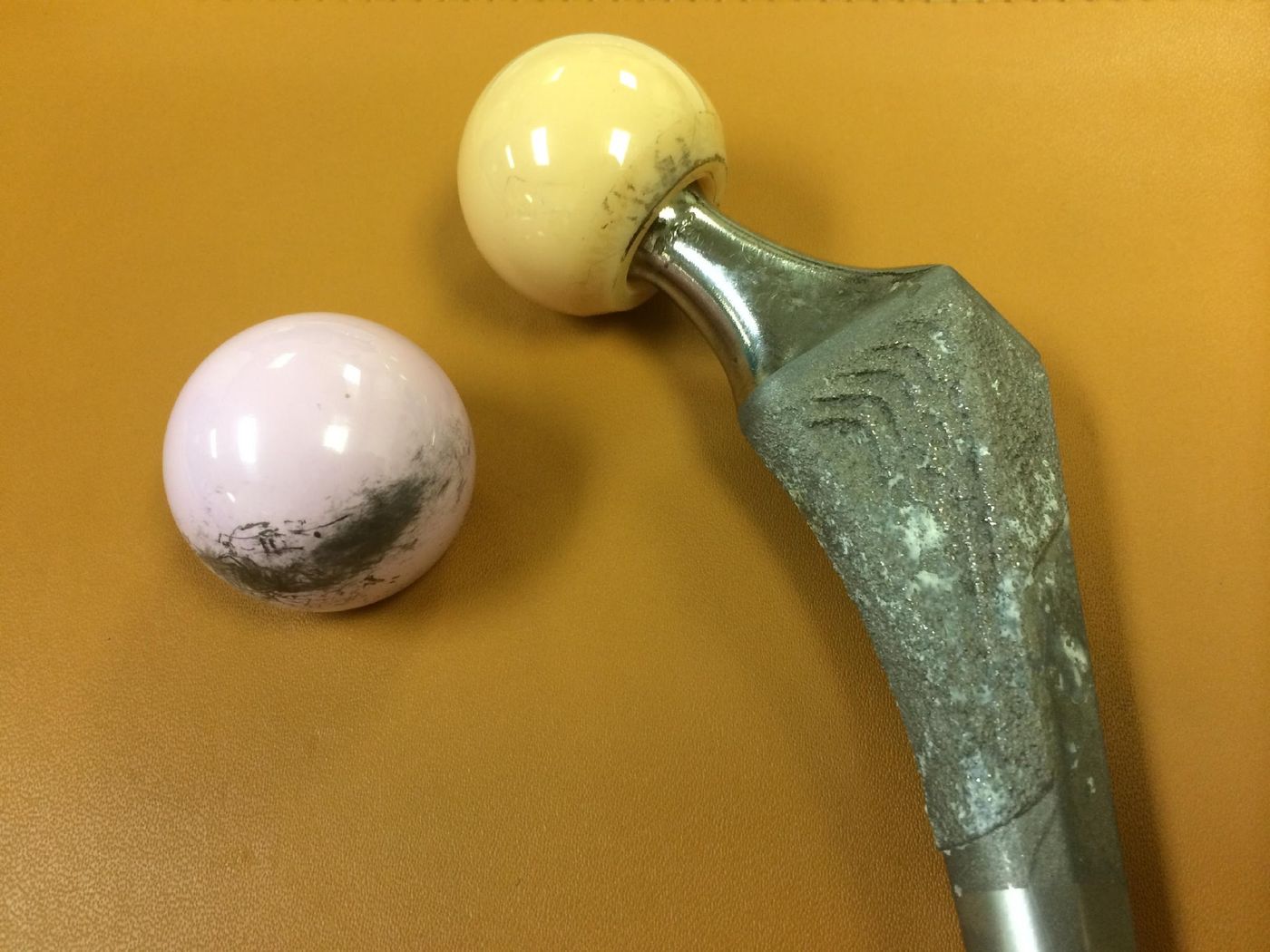
- Tribological properties - hard, wettable, low coefficient of friction
- Biocompatible and inert
- No corrosion
Q17What are the cons of ceramic-on-ceramic bearings?▸
- Not ductile, notch sensitive - fracture leads to difficult revision
- Squeaking
- Need metal shell, decrease head size and stability
- Limited neck length options - limits hip offset and increases impingement
Q18What causes squeaking in ceramic-on-ceramic bearings and who is affected?▸
- Usually in tall, heavy patients
- Impingement leading to lever range wear with stripe line formation
- Poor tension
- Failed locking mechanism
- Third body
Q19What are the two wear patterns in ceramic-on-ceramic bearings?▸
- Polar wear - impingement at end range motion; femoral neck levers out, top of head against acetabular rim
- Peripheral wear (stripe wear) - microseparation during swing phase, inferior head impingement on rim, heel strike, reduction, superior head impinges
Q20What do the colours pink and orange indicate for ceramic bearings?▸
- Pink = 4th generation
- Orange = 3rd generation
Q21What is the problem with zirconia and how is it controlled?▸
- Zirconia is a metastable ceramic (monoclinic, tetragonal and cubic phases)
- Temperature, humidity and stress cause tetragonal to monoclinic phase transformation with a volume change
- Phase transformation toughening resists crack growth, but uncontrolled transformation is disastrous
- For this reason, yttrium is added to stabilize the tetragonal phase of zirconium
Q22What is phase transformation toughening?▸
- Stress causes tetragonal to monoclinic transformation with a volume change
- Generates a compression stress field at the tip of a propagating crack, giving crack growth resistance
- If improperly controlled, the volumetric transformation has disastrous consequences
Q23How can the fracture rate of ceramic bearings be decreased?▸
- Alumina with strontium increases toughness (elongated grains act as a barrier to deflect subcritical cracks)
- Yttrium added for stabilisation
- Smaller granules by hot isostatic pressing (HIPing)
- Higher purity and decreased porosity