Hip
Polyethylene wear and wear reduction
Eccentric liner wear, wear debris and methods to reduce bearing wear in arthroplasty
24 questions
4 source pages
2 images
Images appear with the first question taken from each source page — tap a question to open it.
Q1Describe the modes of failure of a bipolar constrained liner.📷▸
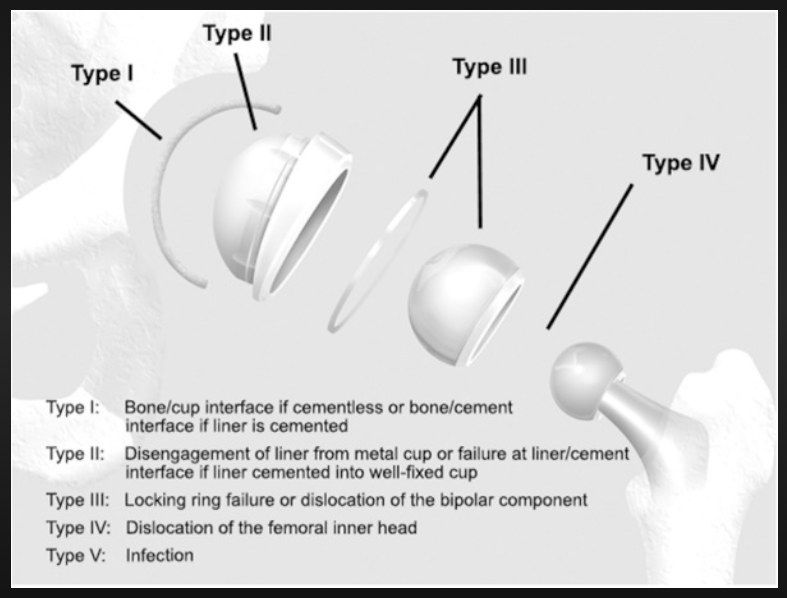
- Type I: bone/cup interface if cementless, or bone/cement interface if the liner is cemented
- Type II: disengagement of the liner from the metal cup, or failure at the liner/cement interface if cemented into a well-fixed cup
- Type III: locking ring failure or dislocation of the bipolar component
- Type IV: dislocation of the femoral inner head
- Type V: infection
Q2If the liner is cemented, at which interfaces can failure occur?▸
- Type I: bone/cement interface (compared with bone/cup interface when cementless)
- Type II: liner/cement interface if cemented into a well-fixed cup
- Type II also includes disengagement of the liner from the metal cup
Q3What is wear and what is it proportional to?▸
- Progressive loss of a bearing substance caused by mechanical or chemical action
- Proportional to friction and inversely proportional to lubrication
Q4What is McKellop's classification of wear?▸
- First mode: between the two bearing surfaces intended by the designer
- Second mode: wear through
- Third body: cement debris and loose bone
- Modularity: at the trunnion interface
Q5How can first mode wear be reduced? (volumetric wear = sliding distance x load / hardness)▸
- Reduce load (weight, activity; increase offset and medialize cup to decrease JRF; correct cup orientation to avoid edge loading)
- Reduce sliding distance (head size)
- Increase hardness, reduce roughness, improve PE intrinsic properties (manufacturing, conformity, thickness)
Q6What are the patient, implant and surgeon factors in wear?▸
- Patient: BMI, activity level
- Implant: head size, articulation material, PE thickness, PE manufacturing
- Surgeon: implant position and alignment, soft tissue tension, cup and trunnion locking, cement debris
Q7How can friction be reduced and lubrication improved (lambda ratio)?▸
- Aim for fluid film lubrication - a thin layer of lubricant separating the bearing surfaces
- Lambda ratio = fluid film thickness / asperities
- Increase film thickness: bearing wettability, large head for entrainment velocity (but higher frictional torque = friction x radius), radial clearance 90-200um
- Decrease asperities: hard material, low coefficient of friction
Q8What is the Stribeck curve used for?▸
- Sommerfeld parameters: x axis = viscosity x speed / load, y axis = coefficient of friction
- Shows transition from boundary to mixed to fluid film lubrication
- Load distribution over the bearing surface also affects film thickness
Q9What is tribology and what is the friction equation?▸
- Tribology = science dealing with the interaction between surfaces in contact and the consequences of that interaction
- Friction = load between surfaces x coefficient of friction (F = uL)
- Friction is independent of surface area and speed
- Depends on roughness of the two surfaces and the presence of lubrication
Q10What coefficient of friction values are quoted?▸
- Knee 0.005-0.02
- Hip 0.01-0.04
- Metal on PE 0.02
- Metal on metal 0.8
Q11What is aseptic loosening?📷▸
- Failure of fixation leading to macromotion and micromotion at the implant-bone interface
- Due to inadequate initial mechanical fixation or biological loss of fixation secondary to particle-induced osteolysis
Q12What is osteolysis?▸
- A histiocytic response to wear debris
- Causes bone resorption and resultant implant loosening
Q13What is wear?▸
- Progressive loss of a bearing substance caused by mechanical or chemical action
Q14What are the mechanisms of wear?▸
- Abrasive: asperites on the hard bearing carve ridges into the soft bearing (cheese grater effect)
- Adhesive: opposing asperites of two surfaces bond with each other to form a junction; the junction is held by intermolecular bonds and generates friction. If the bonds are stronger than the cohesive strength of the weaker material, the weaker material is sheared off
- Fatigue: cyclic loading below the ultimate tensile load but above the endurance limit leads to small cracks in subsurface; propagation leads to delamination of surface
- Erosive (third body): extraneous material enters the interfacial region
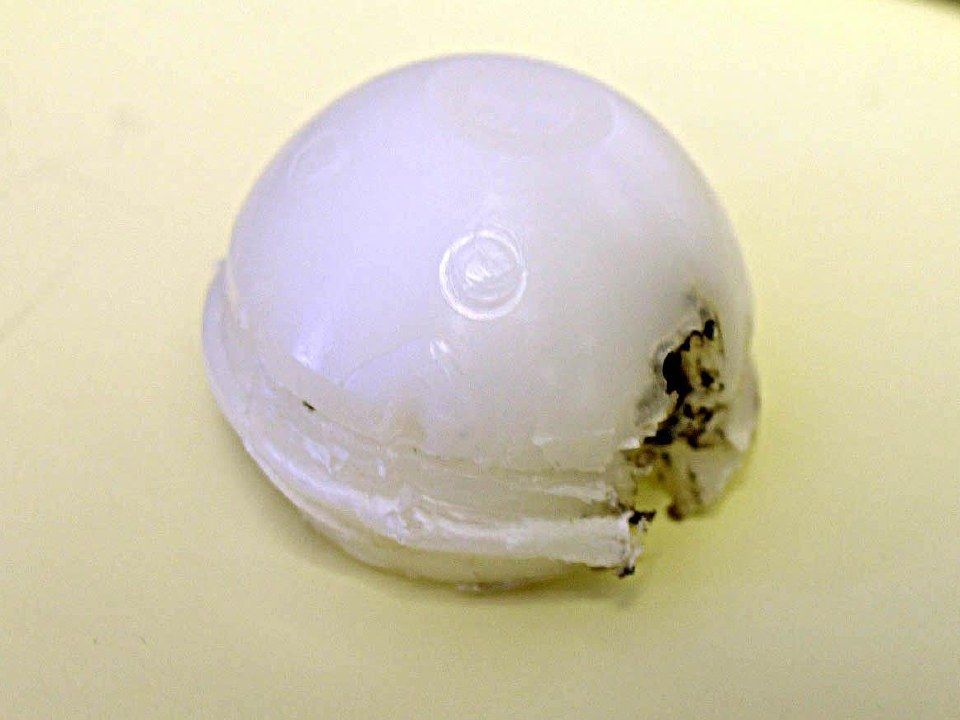
Q15Why might an explanted PE cup show eccentric wear?▸
- Aseptic loosening
- Infection
- Recurrent dislocation
Q16How do stress shielding, osteolysis and infection differ radiologically?▸
- Stress shielding - round off
- Osteolysis - punched out
- Infection - endosteal scalloping + periosteal reaction
Q17What features are seen on an explanted total knee polyethylene liner?▸
- White bands of subsurface delamination and fatigue cracking
- Yellowing as a result of oxidation
Q18What are the mechanisms of wear seen in the removed TKR polyethylene liner?▸
- Burnishing (polishing) - combination of adhesive and abrasive wear, generates submicron particles
- Scratching - abrasive wear
- Pitting - fatigue wear from repetitive tensile and compressive surface stresses
- Third body wear (embedded debris)
- Creep (surface deformation) - if severe, may indicate severe malalignment
Q19What is wear in the context of TKR?▸
- Removal of material from two surfaces under load due to the sliding motion between them
- Proportional to friction and inversely proportional to lubrication
Q20Why is fatigue wear important in TKR?▸
- TKR is not conforming - point loading and shearing stress in PE
- Repetitive cycling causes fatigue failure below UTS
- TKR functions above the endurance limit and below UTS
- PE mechanical properties/manufacturing matter most (strength, fatigue resistance, vita E, thickness)
Q21How can wear in TKR be reduced?▸
- First mode: reduce load, restore mechanical alignment to avoid edge loading, soft tissue balancing (coronal and F/E gaps)
- Implant design: bearing conformity (PS or mobile bearing)
- Second mode: proper locking mechanism or monobloc tibial component
- Third body: remove cement debris and loose bone
- Modularity: tight trunnion fitting, minimal fluid at interfaces
Q22What patient, implant and surgeon factors affect wear in TKR?▸
- Patient: weight, activity level
- Implant: conformity, material, PE thickness and manufacturing
- Surgeon: soft tissue balance, mechanical axis, coupling of PE and modular components, implant position, third bodies
Q23What is the Lambda ratio and what determines the quality of lubrication in TKR?▸
- Aim for fluid film lubrication - a thin layer of lubricant separating the bearing surfaces
- Lambda ratio = fluid film thickness / asperities
- Increase film thickness: bearing wettability, lubricant viscosity, radial clearance (Sommerfeld parameters)
- Decrease asperities: hard material, low coefficient of friction
Q24What is the evidence for computer navigation and robotic-assisted TKR?▸
- Navigation: most mid/long-term studies show no substantial functional benefit
- Recent Aus JR: small advantage, especially in younger patients - small reduction in revision for loosening
- Robotics (BJJ 2018 Kayani): less pain, improved early functional recovery, reduced time to discharge