Hip
Taper junction and constrained implant concepts
Modular taper mechanics and designs that constrain or unconstrain motion
21 questions
3 source pages
2 images
1 fact-check flags
Images appear with the first question taken from each source page — tap a question to open it.
Q1What is a Morse taper?▸
- Trunnion (stem) and bore (head) - a cone in a cone
- Some mismatch between the cones allows an interference fit
- Impaction expands the bore walls and causes cold welding (van der Waals force)
Q2What material factors affect Morse taper performance?▸
- Titanium allows higher pull-off and torsional strengths than cobalt chrome
- Mixed alloy tapers corrode more and have lower flexural rigidity
- Surface roughness also affects performance
Q3Describe the taper angles of the C taper and the V40 taper.▸
- C taper 12/14; V40 has 8% less taper length and 20% lower surface area
- Both have a 5 degrees 40' (5.67 degree) taper angle
Q4What is the critical locking angle of a Morse taper?▸
- <7 degrees half taper angle mismatch = self-locking
Q5What taper geometry gives more ROM, and what is the downside of a short taper?▸
- Shorter taper + small diameter with trapezoidal neck gives more ROM than a large diameter long taper with circular neck
- A short taper sits entirely within the bore, leading to edge loading
Q6What surgeon factors affect Morse taper fixation?▸
- Angle and force of impaction
- Repeated impactions - single strike of >6000N (20cm drop with 1.4kg hammer, Pennock 2006)
- Fluid contamination - dry environment preferred
- Femoral head size
Q7What is the difference between positive and negative taper mismatch?▸
- Female head angle > trunnion angle = proximal contact (positive mismatch)
- Female head angle < trunnion angle = distal contact (negative mismatch)
- Cannot mix head and neck of different brands
Q8What produces the side bearing stability at a Morse taper?▸
- Taper angles differ between the spigot and the bore, creating an angle mismatch
- This causes integration between the two tapers
- A smaller angle difference between male and female components gives a high level of stability
Q9Why can head and neck of different brands not be mixed?▸
- Taper angles and geometry differ between manufacturers
- Cannot mix head and neck of different brands
Q10What are the features of a PCL-retaining knee design?📷▸
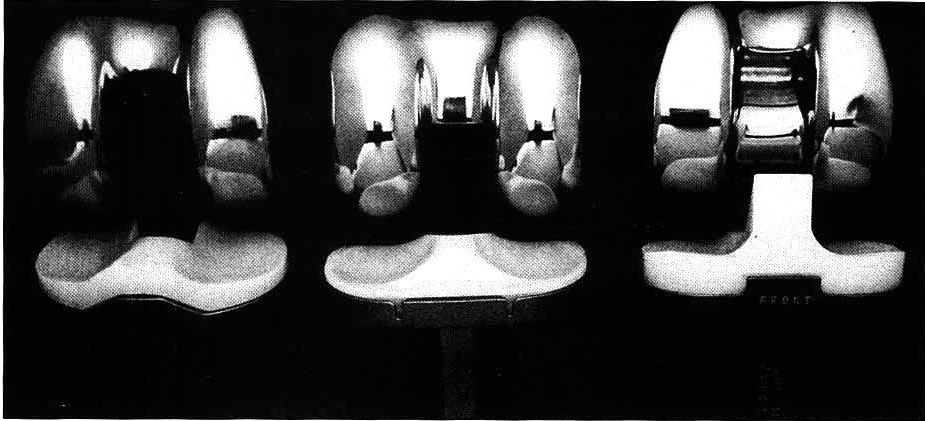
- Tibia box leaves space for the PCL (notch)
- Tibia insert has space for the PCL
- Relatively flat and not conforming to the femoral component
- Asymmetrical on the tibia insert - must differentiate the side
Q11What are the contraindications to a PCL-retaining knee?▸
- Inflammatory arthritis
- PCL injury
- Patellectomy
Q12What are the advantages of a PCL-retaining knee?▸
- Better flexion
- Better proprioception
- Preserves bone stock
- Preserves joint line level
- PCL takes some varus/valgus stress otherwise transferred to the bone-implant junction
Q13What are the disadvantages of a PCL-retaining knee?▸
- Difficult to balance
- PCL may not function afterwards - failure gives 40% decrease in rollback (paradoxical roll forward)
- Flat PE - low contact area, high contact stress, point contact, seesaw effect, wear
- Mayo 3907 TKRs, 10 year survivorship 91%
Q14What is the sacrificing (total condylar) design - features, advantages and disadvantages?▸
- Symmetrical femoral component; insert no cam and post, conformed
- Advantages: preserves bone; technically easier than CR knee
- No rollback, poor range
- High conformity - large contact area, low contact stress but abrasive/adhesive wear - PE particles
- Dislocation/subluxation if gaps not balanced
- Insall 215 TKRs, 21 year 91 % success
Q15What is the stabilizing (posterior-stabilized) design - mechanism and advantages?▸
- Controlled rollback by cam-post mechanism; better conformity than PCL-retained
- Advantages: easier to balance, less point loading/fatigue wear, no reliance on PCL, better exposure in revision/deformity
- Disadvantages: more constraint - loosening at bone-implant interface, reduced ROM, more bone loss, post wear, raised joint line
- Insall 2036 metal-backed, 14 year 98 % success
Q16What complications are associated with the stabilizing design?▸
- Patellar impingement from thicker PE and joint elevation
- Patella clunk, jump cam, posterior dislocation
- Peg wear and fracture
- More bone cut in the femur; more constraint increases stress at the prosthesis-bone interface
Q17What is the survivorship difference between PCL-retaining and stabilized designs (Australian joint registry, 15-year revision)?▸
- Minimally stabilized 6.0
- PS 7.2
- Medial pivot 6.2
- CR > medial pivot > PS
Q18What is the principle of a rotating platform knee design?📷▸
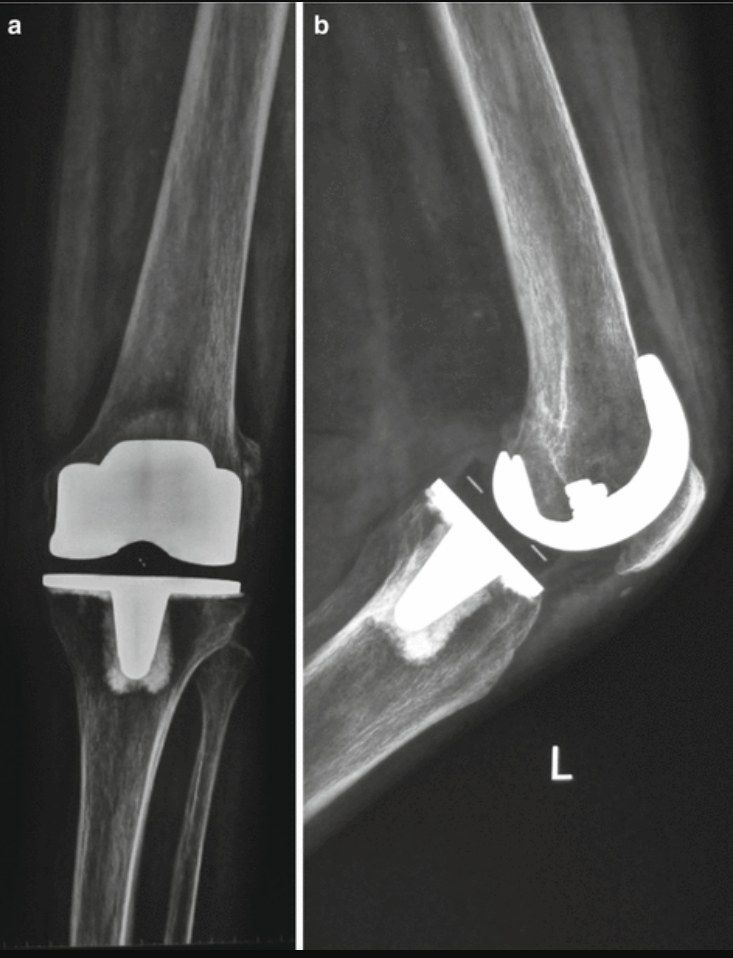
- Uncouples flexion/extension from axial rotation - less stress on the fixation interface, longer survival
- Solves the kinematic conflict: more conformity means less wear but less ROM and more implant-bone stress
Q19What are the pros of a rotating platform?▸
- Decreased stress to bone-cement/cement-implant interface
- PE and femoral component can be made more conformed
- Rotation occurs through the PE and tibia tray
Q20What are the cons of a rotating platform?▸
- If the gap is not well balanced - PE spin out
- Backside wear
Q21What other rationale supports the rotating platform and what is the evidence?▸
- Restore normal knee kinematics of posterior rollback + medial pivot
- KSSTA 2019 Park: no difference in midterm clinical or radiological results
Fact check
Morse taper: taper angle 2-12' — garbled/incorrect angle — The original Morse taper is 2 degrees 50 minutes; orthopaedic tapers generally range 5-18 degrees (e.g. 12/14 taper 5 degrees 40 minutes) — (medium confidence) — source