Hip
Implant biomaterials - basic science
Polyethylene, ceramic and cobalt-chrome alloy properties used in hip implants
36 questions
6 source pages
1 images
Images appear with the first question taken from each source page — tap a question to open it.
Q1What materials are listed under AJR basic science for hip arthroplasty?▸
- PE (polyethylene)
- Cement
- Metal
- Ceramic
Q2What are the key THR implant design features listed under AJR basic science?▸
- Stem
- Cup design
- Morse taper
Q3What modes of fixation are listed for THR implants?▸
- Cementless
- Cemented
Q4What complications of THR are listed under AJR basic science?▸
- Infection
- Wear
- Osteolysis
- Dislocation
- Protrusio
- DVT
Q5Define biomaterial.▸
- Non-viable material used in a medical device
- Intended to interact with biological systems
Q6What are the basic requirements of a biomaterial?▸
- Inert, non-allergic
- Mechanically sound
- Special properties (e.g. bioabsorbable)
- Cheap to manufacture
Q7Define biocompatibility.▸
- Ability of a material to perform with an appropriate host response
- In a specific application
Q8What is forging?▸
- Original heated material with coarse grain structure + pressure impaction
- Causes plastic deformation and recrystallization
- Forms new fine grain (reduce flaws in material)
Q9What is polyethylene and how is it structured?▸
- Thermoplastic polymer of long hydrocarbon chains (C2H4)n of ethylene monomers held by covalent bonds
- Molecular weight 3-5 million Daltons
- Two phases: disorganised amorphous and organised crystalline
- Formed by addition polymerization and sintering (addition = breaking covalent bond; condensation = byproduct)
Q10What are the advantages and disadvantages of polyethylene?▸
- Advantages: tough, ductile, resistant to wear (low coefficient of friction)
- Disadvantage: susceptible to abrasion (not hard)
- Thermoplastic - cannot autoclave
- Anisotropic, weak in tension
Q11What happens to polyethylene on irradiation?▸
- Irradiation generates free radicals
- In the presence of O2: oxidative degradation -> chain scission -> reduced fatigue strength (brittle) -> delamination
- In the absence of O2: cross-link
- Other fates: recombination and unsaturation
Q12What is UHMWPE and how does it wear in TKR?▸
- Each molecule contains > 200,000 units of ethylene; molecular weight 3-5 million
- Better static mechanical properties due to crystalline phase: high ultimate stress, ductile, reduces fatigue crack propagation
- In TKR (less conforming, point loading) it wears by fatigue - functions above the endurance limit on the SN curve
Q13What are the effects of highly cross-linked polyethylene?▸
- High dose irradiation (5-15 Mrad) in an oxygen-free environment
- Cross-linking limits mobility of chains in amorphous regions -> less creep
- Improves wear, surface hardness and stiffness; smaller, fewer PE particles
- But worse static properties: tensile strength, yield stress, ductility, fatigue strength, fracture toughness
Q14What is the evidence for highly cross-linked PE?▸
- THR: SICOT 2020 Langlois - reduction in revision rate; Australian registry 6 vs 12%, better < 55yo; Swedish and NZ agree
- TKR controversial: JBJS 2020 Partridge - no difference at 12 years
- Australian registry: HXLPE lower revision than CPE at 10 years (5.8 vs 3.6%)
Q15How is polyethylene manufactured?▸
- Condensation polymerization and sintering (Ziegler process): ethylene gas polymerised into PE resin powder at low temperature and low pressure using titanium chloride catalyst
- Sintering: heating and pressurising powder causes atomic diffusion to form a homogenous solid
- Fabrication +/- machining: ram bar extrusion (calcium stearate) / direct compression mould / sheet compression mould / isostatic moulding
- High dose irradiation (5-10 Mrad) in inert gas for cross-linking
- Thermal treatment: annealing < 137 or remelting at 137 (fewer free radicals but mechanical property affected; optimal crystallinity 45-60%)
- Additive vitamin E; mechanical compression (anisotropic); sequential irradiation/annealing; 2-MPC photoinduced graft polymerisation for hydrophilicity
- Sterilisation (2.5 MRad irradiation, gas plasma or ethylene oxide); storage under vacuum/argon/nitrogen
Q16What is the difference between direct compression moulding and ram bar extrusion?▸
- Direct compression moulding is better than ram bar extrusion - less linear and volumetric wear (Bankston CORR 2005)
- Ram bar extrusion uses calcium stearate -> risk of non-consolidation of the centre of the bar
- Cutting a ram bar stretches the amorphous phase -> more susceptible to radiation -> more free radicals
Q17What is the effect of thermal treatment on polyethylene?▸
- Promotes recombination of free radicals caused by radiation
- Annealing (< 137): potential for oxidation and osteolysis
- Remelting (137): eliminates free radicals in both crystalline and amorphous phases but affects mechanical properties more
- Optimal crystallinity 45-60%
Q18What are the intrinsic factors affecting PE wear?▸
- (1) PE manufacturing process: direct compression moulding reduces volumetric/linear wear (no calcium stearate); high dose irradiation in inert gas; thermal treatment; additives; packaging/storage
- (2) Conformity: more conforming reduces fatigue wear (increases adhesive and abrasive wear but less fatigue wear)
- (3) PE thickness > 8mm (including metal back; Bartel et al: 4-6mm without metal back) reduces fatigue
Q19What are the pros and cons of ceramic bearings?▸
- Pros: low coefficient of friction (0.11-0.12), hard, wettable, inert, corrosion resistant
- Cons: brittle, notch sensitive, anisotropic thus position sensitive -> edge loading and fracture with catastrophic failure; difficult revision
- Cons: squeaking (painless); limited head size and neck length options; expensive
Q20What is the fracture rate of ceramic bearings?▸
- 0.013 to 1.1%
- Biolox delta 0.2%
Q21How is ceramic manufactured and what affects its strength?▸
- Mix powder and water -> pressed in prefabricated cast -> sintering -> hot isostatic pressing (HIP) -> finishing
- Porosity affected by sintering time; grain size affected by particle size
- Strength inversely proportional to porosity and grain size
Q22Describe the generations of ceramic.▸
- 1st: alumina oxide sintered in air; long sintering -> large grain size and impurity -> reduced strength
- 2nd: Yttria stabilized tetragonal zirconium for toughening, phase change absorbs fissure energy; Ca + Mg decrease grain size
- 3rd: HIP after sintering to reduce grain size, limit grain boundaries, increase purity
- 4th: alumina matrix composite - 82% alumina, 17% zirconia, 0.3% chromium, 0.6% strontium; chromium improves hardness, strontium platelets deflect cracks
Q23What are the causes of ceramic liner fracture and how do you avoid it?▸
- 4 Ms: malposition, mishandling, instability (microseparation), manufacturing
- Avoid: 4th generation ceramic, correct bore-trunnion match, improved surface finishing
- Surgically: no debris, good fit (liner and trunnion), no malposition, no hammering or trial with ceramic liner, good soft tissue balance
Q24How do you revise a ceramic fracture?▸
- Pre-op: revise asap, avoid weight bearing, confirm proper implant position
- Intra-op: thorough debridement and extensive synovectomy
- Avoid further damage of metal component during removal of ceramic component and protect it after removal; prepare to revise metal component if grossly damaged
- Clear all debris from taper and shell before implanting new ceramic
Q25What are the limitations of ceramic head and neck options?▸
- Head size limited - ceramic-on-ceramic must be placed within a metal shell
- Small head: less stable, less fluid film
- Limited neck length options -> limits hip offset and increases impingement
Q26What is oxidized zirconium?▸
- Metallic alloy with a ceramic surface
- Resistant to abrasion and brittle fracture
- Undetectable nickel ions
Q27What are the special wear patterns of a ceramic head?▸
- Stripe wear
- Polar wear with impingement (levering effect)
- Peripheral wear without impingement - microseparation during swing phase and relocation during stance phase
Q28What is HIP and what is sintering?▸
- HIP: gas pressure applied isostatically at high temperature to enhance sintering and produce dense bodies
- Sintering: powder product becomes a strong dense ceramic body with heating and pressure, removing voids between particles
- Heating is below melting point
Q29What is the composition of cobalt chrome?📷▸
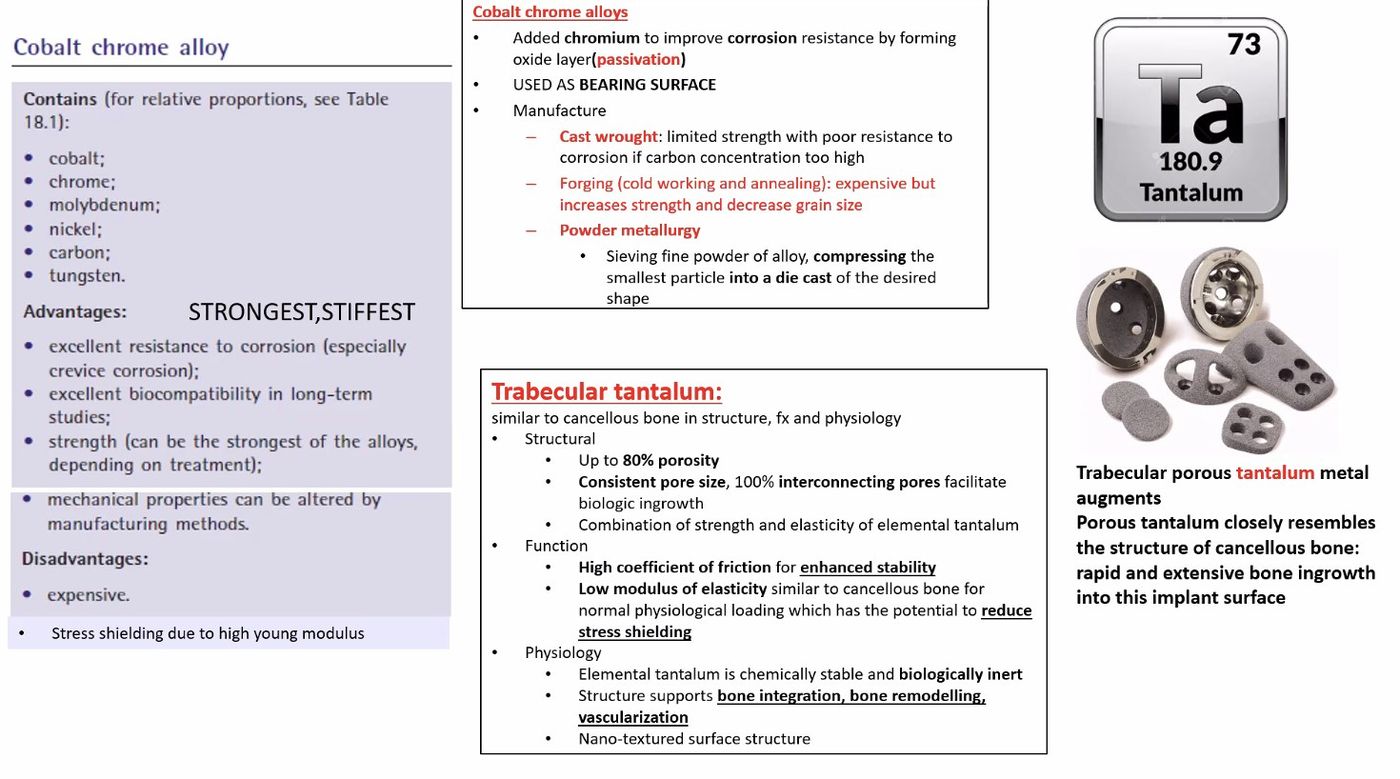
- Cobalt 61%, chromium 20-30%, molybdenum 6-10%, plus nickel, carbon and tungsten
- Young's modulus 210
- Better corrosion profile than stainless steel but susceptible to galvanic corrosion compared with titanium
Q30What is the composition of 316L stainless steel?▸
- Iron 62%, chromium 18%, molybdenum 3%, nickel 16%, carbon 0.03%
- L = low carbon
- Young's modulus 190
Q31What is the composition of titanium alloy 6Al4V?▸
- Titanium 89%, aluminium 6%, vanadium 4%, others 1%
- Young's modulus 100
- Vanadium toxicity -> newer reiterations contain niobium and zirconium
Q32How are the properties of metals classified?▸
- Surface: hardness, wettability, finishing
- Mechanical: stress-strain curve, endurance limit, viscoelasticity
- Biological property
- Manufacturing property
Q33What are the features of 316L stainless steel?▸
- 3% molybdenum reduces pitting and crevice corrosion; 16% nickel stabilises FCC lattice -> ductility, fatigue strength, toughness
- Low carbon < 0.03%: carbon forms compound with chromium improving corrosion resistance but decreasing stiffness
- Less hard than chromium, smooth, low wettability; stiff, high tensile strength, tough, ductile
- Relatively biocompatible, readily available, cheap; stress and crevice corrosion -> stress corrosion cracking
- Used in metal plating and screws
Q34What are the features of cobalt chrome?▸
- Smooth finishing, hard; stiff, strong, tough; biocompatible
- Resistant to wear and corrosion
- Used for joint replacement articulating surfaces
- Problem of stress shielding
Q35What are the features of titanium?▸
- More elastic (lower Young's modulus, similar to bone) -> less stress shielding as a femoral stem
- Ductile; low wear resistance (poor hardness) and notch sensitive
- Biphasic precipitation -> more fatigue resistance
- Biocompatible; excellent corrosion resistance due to self-passivating oxide layer
Q36What are the features and uses of tantalum?▸
- Osteoconductive property, biocompatible
- Stiffness similar to bone
- Used as a coating surface
- Rod most used in core decompression