Hip
Bone cement - composition and strength
PMMA cement constituents and the factors that determine its mechanical strength
15 questions
2 source pages
1 images
Images appear with the first question taken from each source page — tap a question to open it.
Q1What is PMMA and how does it work?▸
- Grout, not glue - no adhesive property; fills voids for load transfer or local antibiotic delivery
- Forms a stable static mechanical bond by interdigitation into cancellous bone
- Preferred in osteoporotic bone (deep penetration) and irradiated bone
- Brittle, strong in compression, weak in tension, notch sensitive and viscoelastic
Q2What are the uses of PMMA cement?▸
- Fixation of arthroplasties
- Kyphoplasty to stabilise a vertebral compression fracture
- Cement spacer in total joint infections
Q3What are the components of bone cement powder and liquid?▸
- Powder: PMMA polymer; initiator benzoyl peroxide
- Powder: radio-opacifier 10% barium sulphate or zirconium dioxide
- Powder: antibiotic tobramycin or gentamycin (10% maximal -> vancomycin 4g in 40g cement)
- Liquid: MMA monomer; catalyst N,N dimethyl-P-toluidine
- Liquid: stabiliser hydroquinone to avoid premature polymerisation; colourant
Q4Define dough time, working time and setting time.▸
- Dough time: start mixing until not sticky
- Working time: not sticky until setting (50% max temperature)
- Setting time = dough + working time
- Phases: mixing -> stringy -> working -> hardening
- Rapid/vacuum mixing, increased temp/humidity, less monomer -> decreased setting time
Q5How do you improve the cement mantle?▸
- Fully controllable: vacuum mixing, mixing speed, antibiotic inclusion, insertion pressurisation (cement gun, cement restrictor), centraliser, stiff stem without stress riser
- Partially controllable: canal prep to minimise blood and fat inclusion; broach to leave 2mm cancellous bone proximally; pulsatile lavage; brush and dry; adrenaline gauze/H2O2; suction
- Aim: interdigitating, homogenous, uniform cement mantle
Q6What is bone cement implantation syndrome?▸
- Monomer leakage on pressurisation -> vasodilatation and cardiosuppression
- Triad: desaturation, hypotension, arrythmia
- Donaldson classification: Grade 1: SpO2 <94%/fall in SBP 20%; Grade 2: SpO2 <88%/fall in SBP 40%/unconsciousness; Grade 3: requiring CPR
- Prevention: increase O2 at cementation, medullary lavage, meticulous haemostasis, do not inject before dough time
Q7How does cement viscosity affect its use?▸
- Viscosity = internal friction of the fluid; mainly a concern in THR (TKR is pressurised easily)
- Low viscosity: better interdigitation into cancellous bone but cannot stop bleeding; poorer clinical result in THR (less effective marrow displacement, haemodynamic backflow)
- High viscosity: may not be usable in a cement gun for medullary insertion
- Medium viscosity: usable with cement gun pressurisation and can stop bleeding; modified by temperature, humidity, mixing conditions; Simplex-P is medium viscosity
Q8What are the local and systemic complications of bone cement?▸
- Systemic: cardiopulmonary suppression, emboli
- Local: bone necrosis
- Systemic syndrome: bone cement implantation syndrome
Q9What is the pathophysiology of bone cement implantation syndrome?▸
- Monomer leakage into the bloodstream upon pressurisation -> vasodilatation and cardiosuppression
- Release of endothelial mediators, histamine and complement activation
- Mechanical blockage / multiple embolisation theory: high pressure during insertion + exothermic cement reaction -> cement expands; air and marrow contents embolise
Q10What are the risk factors and prevention of bone cement implantation syndrome?▸
- Patient: ASA 3-4, known pHT/IHD, osteoporosis; pathological fracture/fracture TOF, long stem
- Anaesthetic prevention: close monitoring and increase O2 at cementation; avoid volume depletion
- Surgical prevention: medullary lavage, vent tube, meticulous haemostasis
- Do not inject before dough time
Q11How do you classify the factors affecting cement strength?📷▸
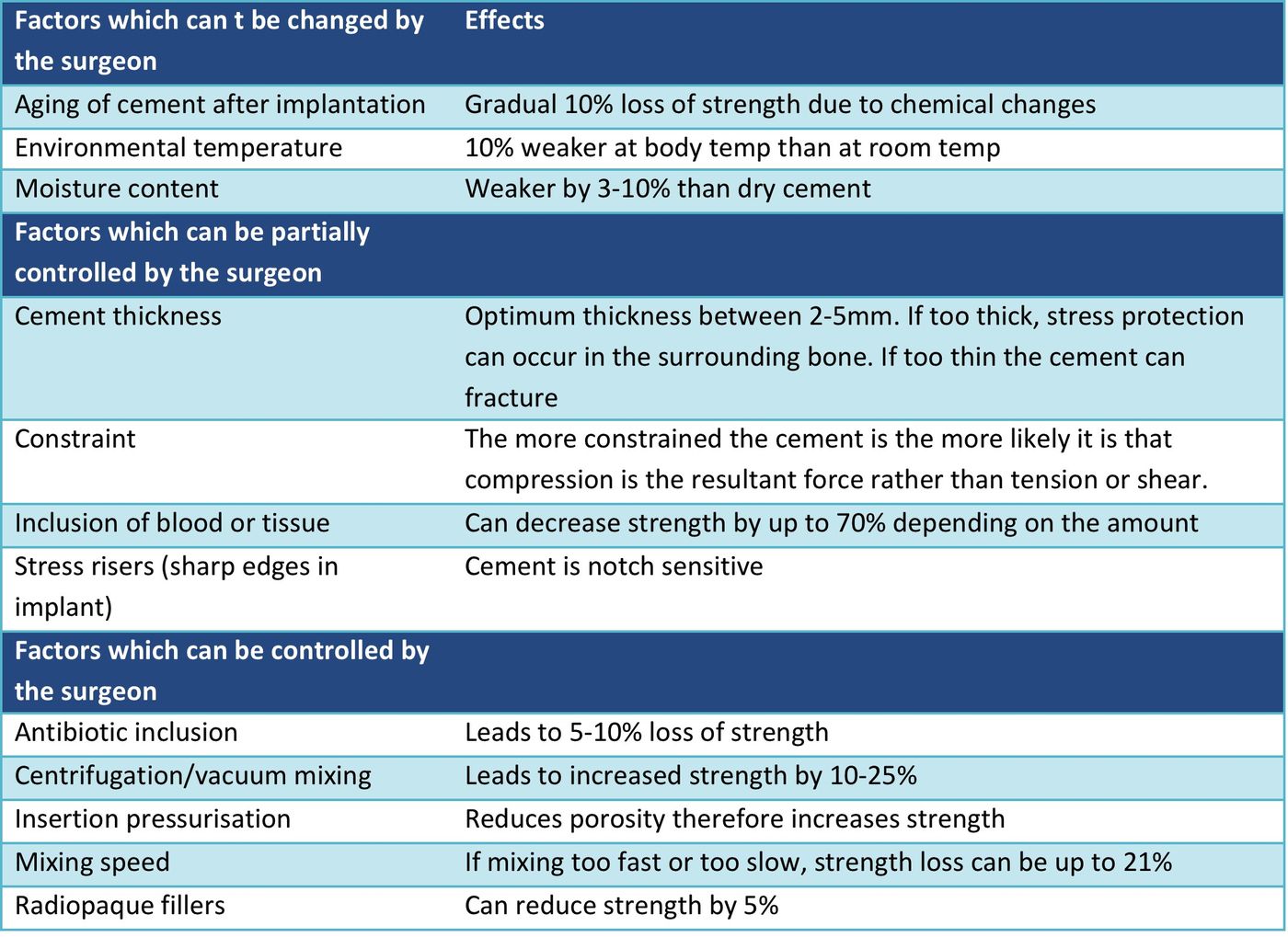
- Uncontrollable: cement change after implantation - aging, higher body temperature, moisture
- Partially controllable: canal preparation and achieving a well-shaped cement mantle
- Controllable: ingredients and how we prepare the cement
Q12What is good cementation?▸
- Uniform, homogenous and interdigitating cement mantle
- Plus a stiff and smooth stem
Q13How do you classify the cementing technique?▸
- By generation of cementation technique
- By radiological appearance of the cement mantle (Barrack classification)
- Generations: 1 thumbing; 2 canal preparation (rasping, brush, cement gun, cement plug); 3 porosity reduction (CPPV: vacuum mixing, pulsatile lavage, pressurisation, centraliser)
- 4th generation: proximal and distal centralisation, proximal pressurisation (Exeter polished surface - Taper lock effect by controlled subsidence)
Q14Describe the Barrack classification of the cement mantle.▸
- Grade A = medullary canal completely filled with cement (white out)
- Grade B = 0-50% radiolucency
- Grade C = > 50% radiolucency (C1 incomplete proximal cement; C2 mantle < 1mm)
- Grade D = 100% radiolucency / absence of cement distal to stem
Q15Which factors increase or decrease cement strength?▸
- Increase: optimal mixing speed, vacuum mixing (reduces porosity), pressurised insertion
- Increase: good canal preparation without blood, mantle at least 2mm thick without stress riser
- Decrease: additives - radio-opaque and antibiotic
- Decrease: cement aging, higher body temperature and moisture after implantation