Basic Science
Free body diagrams - applied biomechanics
Free body diagram technique applied to joint loading, including rotator cuff proximal humeral migration
10 questions
2 source pages
1 images
Images appear with the first question taken from each source page — tap a question to open it.
Q1Define joint reaction force, instant centre of rotation and centre of gravity.▸
- JRF: force generated within a joint in response to forces acting on the joint
- Instant centre of rotation: point about which a joint rotates
- Centre of gravity: just anterior to S2
Q2State Newton's laws and the definition of a Newton.▸
- First law: no net force = velocity constant
- Second law: F = ma
- Third law: equal and opposite reaction (F2 = -F1)
- 1 Newton = force to give 1 kg an acceleration of 1 m/s2
Q3Define vector, scalar, moment, work and energy.▸
- Vector: quantity with direction and magnitude; scalar: no direction
- Moment (torque) = force (perpendicular) x distance
- Work = force (vector parallel to displacement) x distance
- Energy = ability of an object to perform work
Q4What are the assumptions of free body analysis at a joint?▸
- Static equilibrium and rigid fulcrum (bone)
- Frictionless joint and no antagonist muscle action
- Simple hinge lever, force in a single direction, line of action at the muscle centre
Q5How can you reduce the joint reaction force at the hip?▸
- Reduce body weight
- Body tilt (antalgic gait tilts towards the painful side to reduce the BW moment arm)
- Contralateral stick
- Increase the abductor moment arm
- Ipsilateral suitcase helps the abductors
Q6Give the lever class for shoulder, elbow, hip, ankle, MTPJ and spine.▸
- Shoulder 3, elbow 3
- Hip 1, spine 1
- Ankle 1 (or 2 if the MTPJ is the fulcrum)
- MTPJ 2
Q7What is the advantage of a class 3 lever?▸
- Larger range of movement
- Hence seen in the upper limb
Q8Which free body diagram exercises are listed on this section?▸
- Draw FB diagrams of the ankle/MTPJ/knee/hip/shoulder/elbow/spine
- Show with a FB diagram how RSA helps deltoid function
- Explain with a FB diagram why kneeling increases PFJ pressure
- The notes list these as exercises but give no answers
Q9Why does the humeral head migrate proximally in rotator cuff arthropathy?📷▸
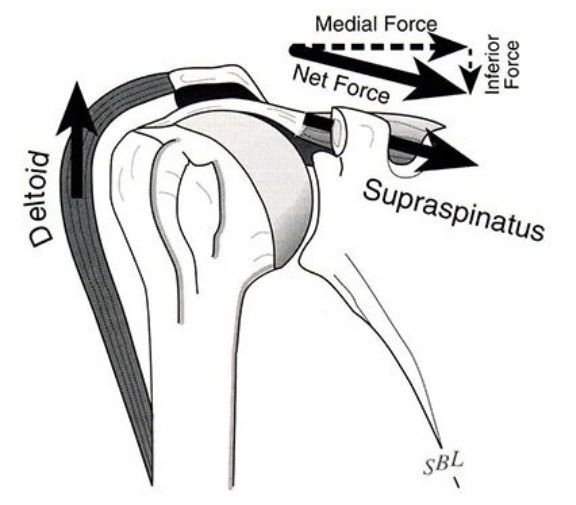
- Loss of supraspinatus and loss of downward coupling
- Excessive upward pull of the humerus
Q10On the free body diagram, which force becomes unopposed once the cuff fails?▸
- The deltoid's upward pull on the humerus
- Normally balanced by the cuff's downward coupling force, so its loss causes proximal migration of the humeral head