Elbow
Elbow arthroplasty implant designs
Named implant systems for elbow arthroplasty: Coonrad-Morrey, Souter radial head and GSB III
13 questions
3 source pages
3 images
Images appear with the first question taken from each source page — tap a question to open it.
Q1Describe the Coonrad-Morrey total elbow prosthesis.📷▸
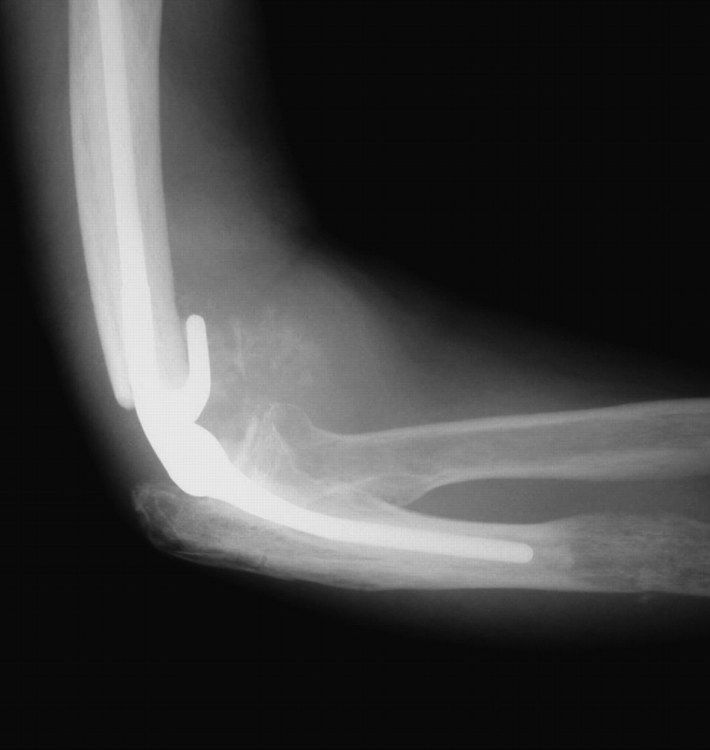
- Titanium alloy (Ti6Al4V)
- Cemented, linked, semi-constrained with a floppy hinge
- Floppy hinge allows varus/valgus so load is distributed to soft tissue
- Displacement force of the humeral implant is anterior
Q2What is the role of the anterior flange and bone graft in the Coonrad-Morrey prosthesis?▸
- Bone graft increases rotational stability and shares torsional forces, protecting the bone-cement-implant interface
- Controls posterior displacement
- Allows thickening of bone stock at the site of maximal stress
Q3What is the survivorship of the Coonrad-Morrey prosthesis?▸
- Highest survivorship for RA
- 92.4% at 10-12 years
Q4What are the indications/contraindications and approach for total elbow replacement?▸
- Indications: RA, complex distal humerus fracture in the elderly, OA
- CI: infection, Charcot, young and active patient needing heavy lifting
- 15cm incision just lateral to the medial epicondyle and medial to the tip of the olecranon
- Bryan-Morrey approach (elevate triceps with periosteum of olecranon and proximal ulna, ulnar nerve transposition)
Q5Describe the surgical steps of total elbow replacement.▸
- Humerus: remove midportion of trochlea to enter canal; remove trochlea/capitellum level with epicondylar margins, preserve supracondylar columns; rasp canal
- Ulnar: remove tip of olecranon to enter canal, serial rasping
- Insert ulnar first (align center of ulnar component with centre of greater sigmoid fossa), then humerus; first generation cementation technique
- Articulate by placing the axle; autograft at anterior flange; preserve radial head if possible
Q6What are the postoperative restrictions after total elbow replacement?▸
- Post op need immobilization (locked in 30 deg elbow flexion for 4 weeks)
- Life-long weight lifting limit 10 lbs
Q7Compare linked, unlinked and semi-constrained total elbow replacements.▸
- Linked fully constrained: loosening; indication marginal bone stock and stability
- Semi-constrained (Coonrad-Morrey): sloppy/floppy hinge, load distributed by soft tissue; anterior flange decreases posterior migration and rotation
- Unlinked (unconstrained): unstable; prerequisite good soft tissue tension and bone stock
- Semi-constrained (Souter): deep groove for stability; short humeral stem (stirrup) decreases rotational stress; RA laxity causes anterior tilt of humeral stem
Q8Describe the Souter total elbow prosthesis.📷▸
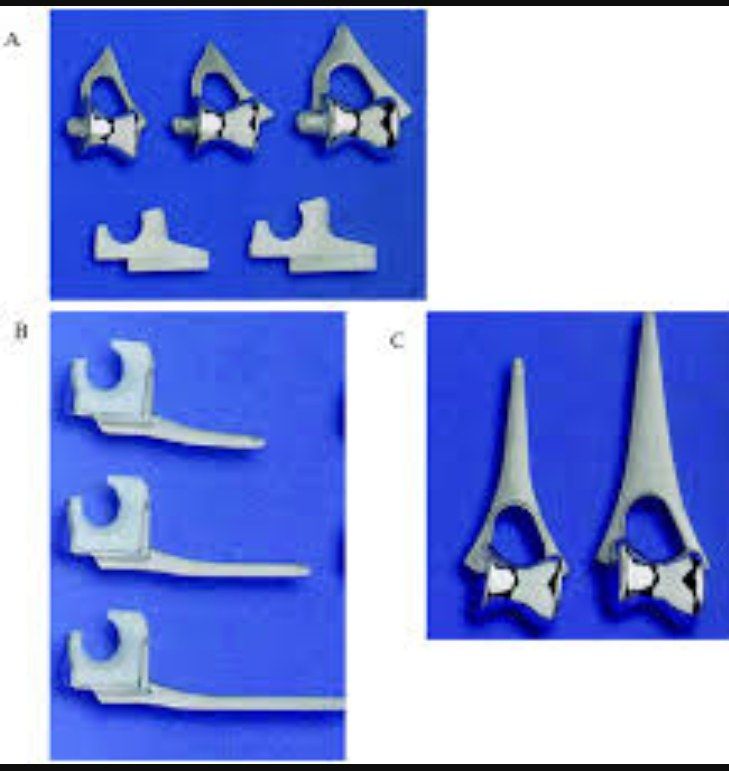
- Cemented, unlinked, semi-constrained
- Broad metallic plate acts against deforming force
Q9What is the advantage of the short humeral stem in the Souter prosthesis?▸
- Maintains humeral bone stock
Q10What design features improve stability in the Souter prosthesis?▸
- Deep groove for better stability
- Ulnar stem made of UHMWPE
Q11What is the linkage mechanism of the GSB III total elbow prosthesis?📷▸
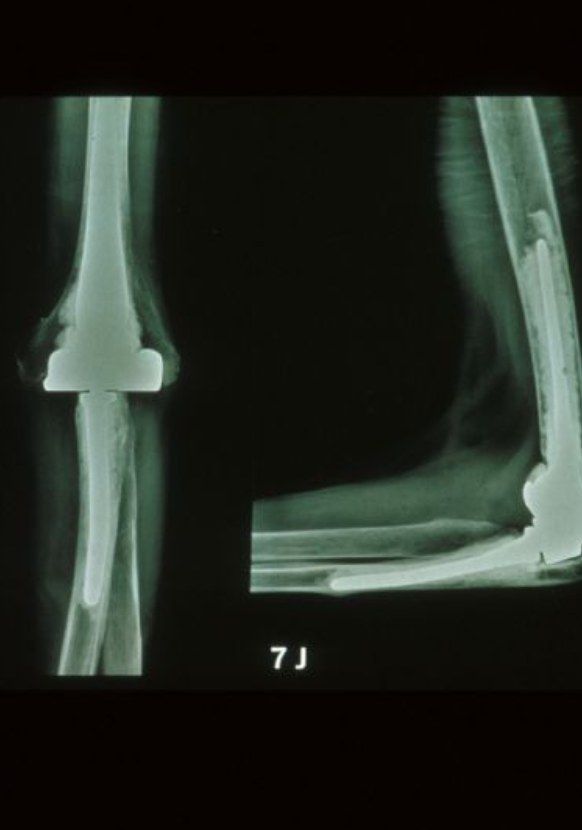
- Linked semi-constrained with a floppy hinge
- Large joint surface on the humeral component
Q12How does the GSB III resist deforming forces?▸
- Flange on the condyle acts against deforming force
- Difficult in RA patients with deformed anatomy
Q13What is the complication of the GSB III prosthesis?▸
- Dislodged component