Elbow
Total elbow replacement
Indications, designs, surgical technique and outcomes of total elbow arthroplasty
7 questions
1 source pages
1 images
Images appear with the first question taken from each source page — tap a question to open it.
Q1What is the functional range of the elbow and the anatomy of the distal humerus?📷▸
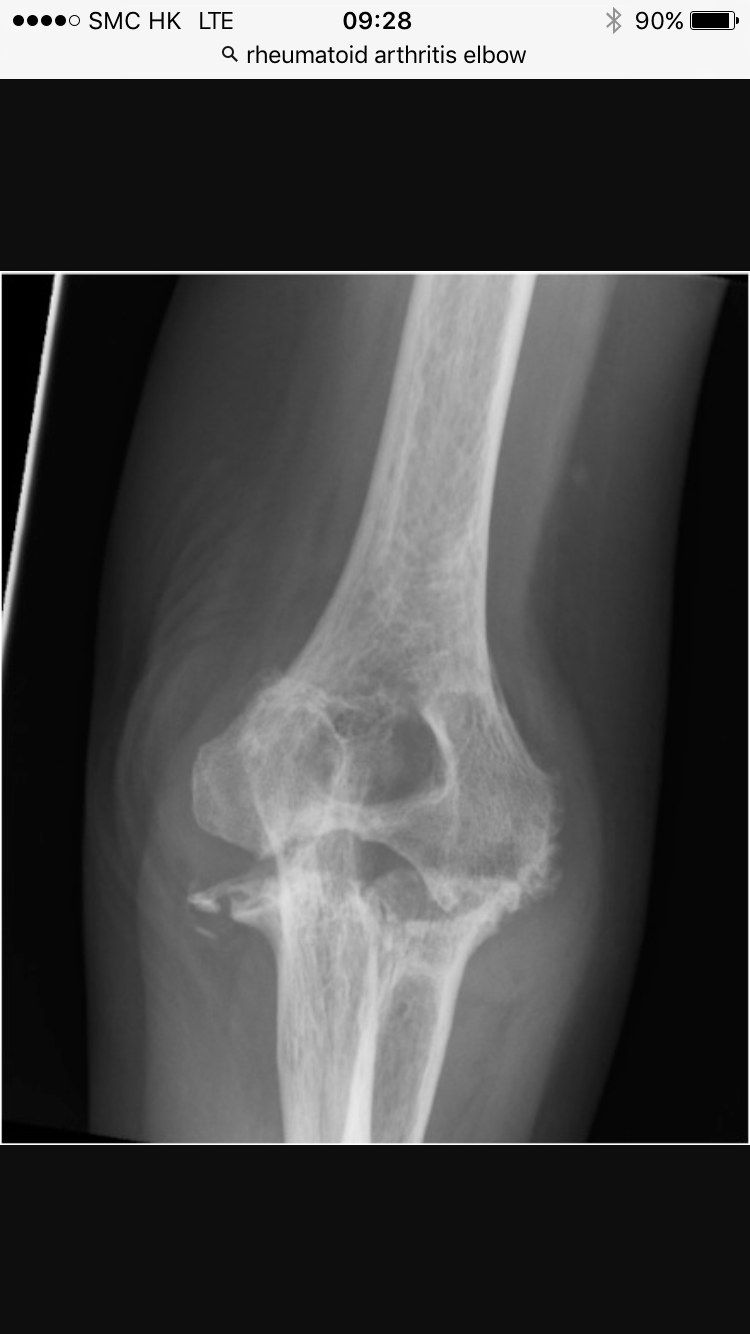
- Elbow functional range: F/E 30-130, S/P 60/40
- Distal humerus: 30 degrees flexion, 5 IR, 5 degrees valgus
Q2What is the differential diagnosis of elbow arthritis?▸
- Primary OA
- Post-traumatic arthritis
- RA
- Infection
Q3What are the problems in the RA elbow and describe the Larsen classification.▸
- Problems: osteopenia, ligamentous laxity with instability, contracture
- Larsen 1: swelling + osteoporosis; 2: mild joint space narrowing + erosion; 3: significant joint space narrowing
- Larsen 4: advanced erosion and laxity, subchondral bone breaching; 5: ankylosis
Q4Describe the operations available for the RA elbow.▸
- Synovectomy - indications: pain, PIN compression by synovitis; prerequisite: stable, F/E combined >90
- Radial head excision - for painful rotation, PIN compression from radial head synovitis; cons: valgus instability, caput ulnare
- Ulnohumeral distraction interpositional arthroplasty (tensor fascia lata)
- TER (total elbow replacement)
Q5What are the problems and operations in OA elbow?▸
- Problems: hard bone, osteophytes, capsule contracture, loose bodies
- Arthroscopic debridement (CI: previous ulnar nerve transposition)
- OK (Outerbridge-Kashiwagi) procedure
- Ulnohumeral distraction interposition arthroplasty; TER
Q6How is elbow arthroscopy performed?▸
- Patient selection (CI: previous ulnar nerve transposition, severe trauma with distorted anatomy, scarring); GA; supine/prone/lateral decubitus
- Distend the joint through the lateral soft spot (olecranon, LE, radial head) with 20ml NS before placing portals
- Anterior portal in elbow F90, posterior portal in slight flexion; open portal under direct vision
- 1st portal supine: distal anterolateral (1cm anterior and distal to LE); anteromedial 2cm proximal to medial epicondyle, anterior to intermuscular septum
- Post-op: immobilise in extension for 1 day, physio, CPM
Q7What are the complications of elbow arthroscopy?▸
- Portals: persistent drainage, fistula
- Nerves: radial (most at risk), PIN, median, ulnar, antebrachial cutaneous nerves
- Soft tissues: compartment syndrome
- Contracture