Hand Soft Tissue
Polydactyly and mirror hand
Preaxial and postaxial polydactyly classification, and ulnar dimelia of the hand
14 questions
3 source pages
3 images
Images appear with the first question taken from each source page — tap a question to open it.
Q1What is the likely diagnosis and Wassel type in this patient, and which findings support it?📷▸
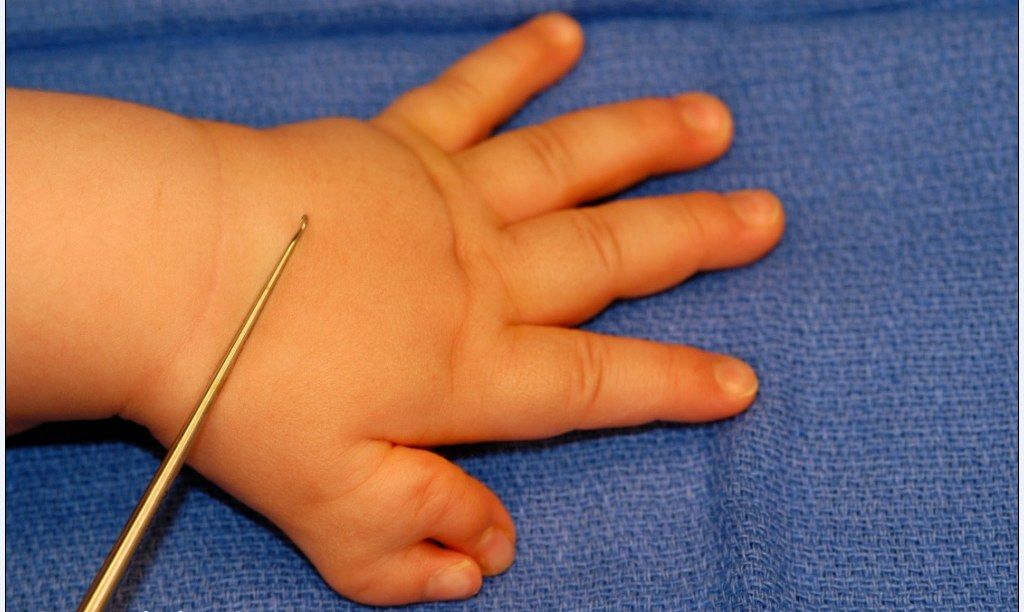
- Paediatric left hand preaxial polydactyly
- Radial thumb is small but has a complete nail, distal phalanx and suspected IPJ
- First webspace contracted
- Likely type IV (commonest; IPJ seen in 47%); next most common type 2
Q2What history is taken in preaxial polydactyly?▸
- Age, other abnormalities, hand function
- Family history (FHx)
Q3What are the local examination findings to document in preaxial polydactyly?▸
- LSW APB
- Length, size, webspace, alignment, position, bifurcation
- MSSSV: mobility, sensibility, strength, stability, vascularity
- Check for other systemic diseases (usually sporadic)
Q4What radiological classification systems are used for preaxial polydactyly and what does Hung's classification describe?▸
- Wassel classification on XR
- Hung's classification: 4 subgroups of type IV
- Hypoplastic 12%, ulnar deviated 64%, divergent 15%, convergent 9%
- Convergent is the most complex and most likely to have residual deformity
Q5Which systemic conditions are associated with type 7 preaxial polydactyly?▸
- Holt-Oram syndrome, Fanconi anaemia, Blackfan-Diamond anaemia
- Imperforate anus, cleft palate, tibial defects
- Usually sporadic; type 7 is the type commonly associated with these syndromes
Q6What is the management and timing of surgery?▸
- Parental counselling: incidence 1 in 1000
- Offer operation at 1 year old (less anaesthetic risk, before thumb function fully develops)
- Goal: single mobile stable thumb that is cosmetically acceptable
- Reconstruct according to Lister parameters: length, stability, position
Q7What is the treatment by Wassel type?▸
- 1-2: modified Bilhaut-Cloquet (ablate radial thumb + RCL reattachment) - reduce nail ridging, less scar, less growth disturbance; disadvantage lig laxity (ligament laxity)
- 3-6: resection + reconstruction
- 7: small - excision + ligament reconstruction; large - fusion
- Excise the radial thumb if the remaining thumb is ~80% of the contralateral
Q8What are the six steps of ablation and reconstruction and the possible complications?▸
- Isolate NV bundle and collateral ligament (osteoperiosteal sleeve from the deleted thumb)
- Reconstruct the joint surface (obliquity, enlargement, osteotomy, reduction, chondroplasty), then reattach collaterals
- APB preservation and reattachment; EPL, FPL realignment; 1st webspace reconstruction
- Complications: bone (late angular deformity), joint (instability, stiffness), soft tissue (scar, abnormal tendon excursion), cosmesis (ridged nail, size, narrowed 1st web)
Q9What is postaxial polydactyly and what genetic conditions are screened for?📷▸
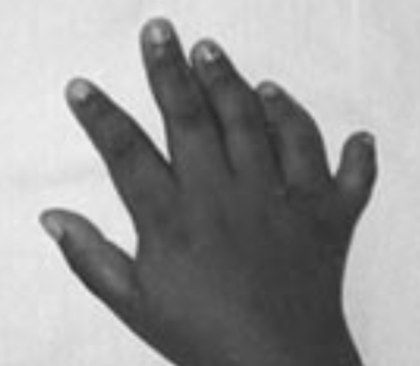
- Too high SHH activity at the ulnar limb bud
- 10x more common in African Americans (AD)
- Thorough genetic workup (chondroectodermal dysplasia or Ellis-van Creveld syndrome EVC gene, AR, 'six-fingered dwarfism')
Q10What is the aim and timing of surgery for postaxial polydactyly?▸
- Aim is mainly cosmesis
- Timing: 1 year old
Q11How is postaxial polydactyly treated by type?▸
- Type A - well formed digit: reconstruction (preserve radial digit, reattach ulnar digit soft tissue and muscle)
- Type B - rudimentary skin tag (vestigial): tie off before 1 year
Q12What is ulnar dimelia (mirror hand)?📷▸
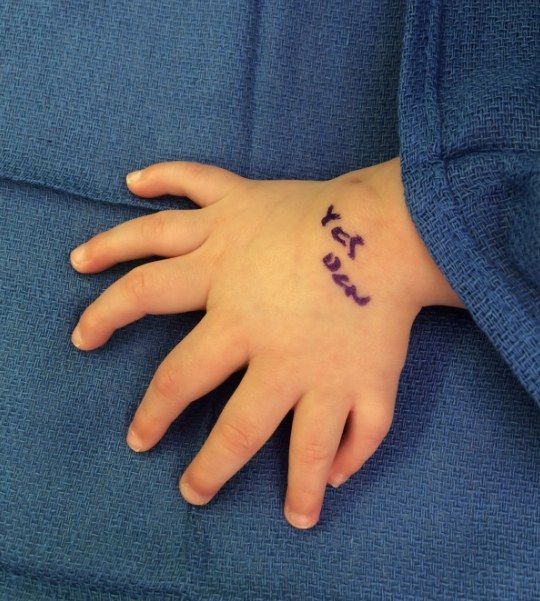
- Very rare
- Absence of the radial ray, duplication of the ulnar carpal, metacarpal and phalanx bones, and symmetric polydactyly
- Swanson classification type III
Q13What neurovascular anomalies can accompany ulnar dimelia?▸
- Duplication of the ulnar nerve
- Duplication of the ulnar artery
- Abnormal arterial arches, shortening of the radial nerve, absence of the radial artery
Q14What are the two types of ulnar dimelia?▸
- Type 1: one lunate and one trapezoid bone, one index finger
- Type 2: two lunate and two trapezoid bones, two index fingers