Hand Soft Tissue
Amputation, fingertip injury and replantation
Digit amputation, fingertip tissue loss, replantation, local flaps and acquired amputation deformity
42 questions
7 source pages
1 images
Images appear with the first question taken from each source page — tap a question to open it.
Q1What does the clinical photo show?▸
- Wounds over the thumb, index and middle fingers with mottling
- Another open wound over the palm --> possibility of an exit site
Q2Define a high-pressure injection injury and describe its pathogenesis.▸
- Puncture of the epidermis by a jet of fluid/air under pressure
- Usually the index finger of the non-dominant hand
- Pressurised fluid passes through skin; kinetic energy dissipates in hand soft tissue
- Microscopic destruction --> vascular occlusion; skin degloving + soft tissue necrosis
Q3What history and examination findings are important in an injection injury?▸
- Mechanism of injury; nature of fluid (oil or water based), volume injected, force of injection
- Time of injury; age, premorbid status, dominance; patient expectations
- PE: compartments, NV status
Q4What is the management and outcome of a high-pressure injection injury?▸
- Debridement (non-viable skin, subcutaneous fat, fascia, muscle/tendon, bone; Debride til punctate bleeding; may need multiple surgeries)
- Compartment release
- Broad spectrum antibiotics
- Outcome: increase amputation if attend >10 hrs post injury
Q5What are the clinical photo findings and injury characteristics?▸
- Left hand with multiple finger amputations at the level of the middle phalanx, amputated parts retrieved
- Distal amputation = distal to FDS insertion
- Likely a clean cut injury with no gross contamination
- Distally I do not see any ribbon sign or red line sign signifying an avlusion type injury (i.e. no ribbon sign or red line sign, which signify an avulsion injury)
Q6How do you initially manage an amputation and preserve the amputated part?▸
- ATLS; AMPLE history including smoking, hand dominance, job requirements and how the stump was preserved
- Rule out other injuries, stabilise patient, good storage of amputated part, Clinical photos: moist dressing to the proximal stump, IV antibiotics, tetanus
- Part: remove contamination, wrap in moist gauze (NS or lactated Ringer), place in sealed plastic bag, then bag in ice water bath
Q7What factors determine whether to replant?▸
- Injury: mechanism, level, timing
- Patient: age, smoker, comorbidities, hand dominance, demand
- Amputated part: storage
- Indications: child, above wrist, multiple fingers, thumb; relative indication: zone 1
Q8What are the contraindications to replantation?▸
- Crush injury/mangled, severe contamination, segmental injury
- Warm ischaemic time limits: finger 12/24, wrist 6/12
- Single digit especially index finger, zone 2
- Polytrauma / poor premorbid status
Q9What is the operation setup and order of replantation?▸
- Warm OT room, GA, 2 teams
- Order: thumb, long, ring, little, index (1,3,4,5,2)
Q10Describe the sequence and technique of replantation.▸
- Sequence: BE FAN V (bone, extensor, flexor, artery, nerve, vein) then skin; allow 1 cm shortening
- Artery first: earlier revascularisation and decrease cold ischemic time, washes out metabolic waste, Easier to identify and repair vein (not collapsed); downside = more blood loss
- Technique: remove adventitia to avoid unfolding into lumen, remove clot, cut sharp, heparin saline injection, Approximation of intima with 10/0 nylon interrupted
Q11How do you induce flow intra-operatively during replantation?▸
- Systemic: warmth, blood pressure, dependent position, correct metabolic abnormalities
- Local: no tourniquet, relieve tension/pressure, resect to normal, flush lumen (heparin saline 10U in 1ml), papaverine
Q12How do you monitor a replant and distinguish arterial from venous failure?▸
- Warm environment (26 degrees); hydration (hypervolemia), pain relief, anxiolytic (Thorazine), aspirin; NO smoking, caffeine, vasoconstrictive agents
- Monitor 5/7 days: colour, CR, turgor; skin temp (drop 2C in 1 hr / <30 degrees) is most reliable; pulse oximeter
- <12 hours = usually arterial (persistent vasospasm, pale): remove bandage, dependent position, heparin 3000-5000U, stellate ganglion block, re-explore in 6 hrs, needle prick on nail
- >12 hours = venous congestion/thrombosis (ruborous): remove bandage, elevate, heparin soaked gauze, medicinal leech (hirudin 8-12 hrs, need antibiotics), reoperate
- Always assess environment and patient first when a replant fails
Q13What are the late complications and functional results of replantation?▸
- Late complications: stiffness (tenolysis) 50%, bone and nerve problems
- Results: universal cold intolerance, usually 50% function, 10mm 2PD
- Factors most predictive of digit survival: mechanism of injury and ischemia time
Q14How does management differ for proximal amputations and ring avulsion injuries?▸
- Proximal: debridement + fasciotomy, arterial shunt, BAVNM with shortening (digit <1cm, hand 1.5cm, forearm 2-4cm); fixation with K-wire or ex-fix
- Post-op: compartment syndrome, reperfusion --> renal failure
- Ring avulsion (Urbaniak): I adequate circulation = soft tissue repair; II inadequate circulation = revascularisation if bone/tendon/nerve intact; III complete degloving/amputation = amputation
- Index finger can be considered for ray amputation at the MC neck level
Q15How is the nerve managed in replantation?▸
- Aim: protective sensation (<15mm 2PD)
- Median and ulnar nerve gap <2cm: nerve/ vein conduit
- Gap >2cm: delayed nerve graft, or tendon/nerve transfer for a motor nerve
- Donor nerve: sural, MACN
Q16How do you assess a fingertip injury?📷▸
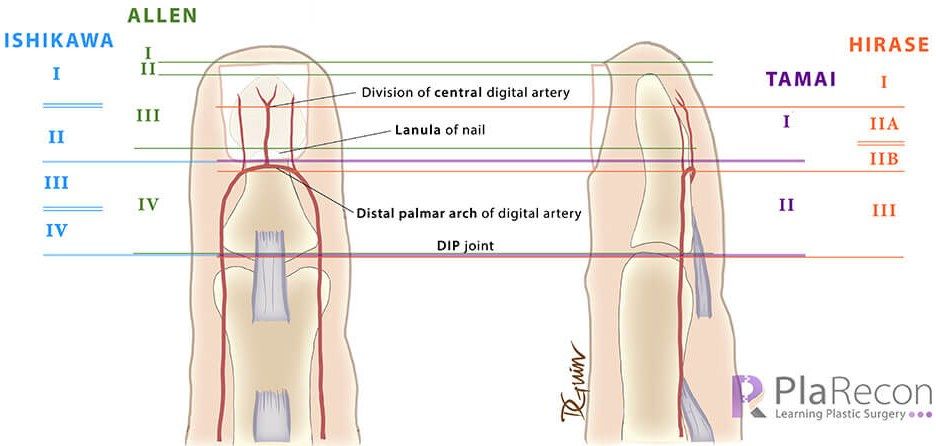
- Is bone exposed?
- Pattern/orientation (e.g. volar oblique); flexor or extensor involvement; contamination
- Allen's classification: distal to nailbed, distal to distal phalanx, distal to lunula, distal to DIPJ
- Also Tamai and Ishikawa classifications
Q17What history and examination are needed for a fingertip injury?▸
- History: mechanism (avulsion, crush, sharp laceration), premorbid status, smoking, hand dominance, expectation and rehab motivation
- PE: check flexor and extensor function
- Digital Allen test
Q18What are the goals and reconstruction ladder for fingertip injuries?▸
- Goals: function (sensate, durable tip, bone support for nail growth), Appearance: cosmesis, Time: early return to work, minimise hospital stay
- Consider wound factors (pattern, level, size), patient factors, surgeon expertise
- Follow reconstruction ladder: heal by secondary intention (3-5 weeks)
- Reamputation
- Reconstruction (graft, local, regional, distant pedicle, distant free)
Q19What factors guide flap design?▸
- Donor site
- Texture / colour / volume
- Hairiness
- Sensation
Q20What is the reconstruction ladder and how are flaps classified?▸
- Ladder: secondary healing -> primary closure -> skin graft (partial/full) -> local flap -> regional flap -> free flap
- By location: local, distant, free
- By blood supply: random, axial
- By composition: cutaneous, fasciocutaneous, myocutaneous, osteocutaneous
Q21What are the prerequisites and indications for island flaps in fingertip reconstruction?▸
- Prerequisite: dual digital artery supply
- Indications: volar PP to DP large defect; heterodigital for a 2-4 cm thumb volar oblique defect
- Homodigital and heterodigital flaps are sensate; reverse homodigital is insensate; the heterodigital flap is from the Non opposing side of other finger
- Advantages: best axial pattern flap, single stage; disadvantages: technically difficult, loss of donor sensation
Q22What are the options for volar fingertip tissue loss?▸
- Same finger: homodigital flap (Joshi) - local pedicle flap based on one digital NV bundle; reverse homodigital (insensate)
- Different finger: cross finger (donor adjacent dorsal PP/MP, needs FTSG; insensate, contracture, skin mismatch) and heterodigital
- Same hand: thenar flap (H-shaped incision, <30 yo, IF to RF; adv skin match/good fat pad; disadv PIPJ contracture, donor hyperaesthesia, risk thumb digital NV)
- Distant: pec major type 5 flap (pectoral branch of thoracoacromial artery); Free: pulp transfer
Q23What are the options for dorsal/transverse and thumb tip tissue loss?▸
- Dorsal and transverse: volar VY / lateral VY flap (Kutler flap = bilateral VY); digital island flap if big
- Thumb dorsal: FDMA (Kite/Foucher) flap
- Thumb volar: Moberg advancement flap (defect <2cm, IPJ slightly flexed), heterodigital flap (ulnar side of M/F or R/F), FDMA flap
- Moberg: skin match and sensate; disadvantage is flexion contracture. Kite: skin mismatch for volar defect
- Moberg is only used in the thumb because of its isolated dorsal blood supply
Q24What are the options for proximal finger tissue loss?▸
- Dorsal: reverse crossfinger flap (only deep dermis and subcutaneous layer transferred)
- Proximal: axial flag flap (adjacent PP), cross finger flap, homodigital arterial flap, reverse homodigital arterial flap
Q25What are the complications of fingertip reconstruction?▸
- Insensate tip
- Hyperaesthesia
- Cold intolerance
- Hook nail
- DIPJ stiffness
Q26What factors are assessed when considering replantation in a zone 2 injury?▸
- Patient: hand dominance, smoker, functional status, medical comorbidity
- Finger: timing of injury, injury mechanism, site (which finger and level)
- Injury is an avulsion with avulsed flexor and extensor tendons, avulsed digital artery/nerve and exposed proximal phalanx
Q27What are the treatment options for an exposed proximal phalanx?▸
- Local flap to cover bone
- Ray amputation
- Replantation
Q28What are the pros and cons of replantation in a zone 2 PIPJ injury?▸
- Pros: maintain length, hopefully function
- Cons: prolongs surgery (higher chance of infection), failure of revascularisation, may need multiple surgeries/2nd reamputation
- Prolonged rehab and stiffness; tendon adhesion (may affect other finger motion as FDP share the same belly)
Q29What are the advantages of ray amputation?▸
- Quick operation, quick rehab
- Less stump impingement
- Cosmesis ok for ray amputation
Q30What is a jumping man flap used for?▸
- Planned skin incision for release of a 1st web contracture
- Triangular shaped skip flaps are transposed to increase length along the first web
Q31What is a Z-plasty?▸
- A transpositional flap using adjacent tissues near the incision to release a contracture
- Central limb is planned along the contracture, with two oblique wounds at 60 degrees to the main wound, same length and parallel
Q32How much length can a Z-plasty gain and what are the options for long contractures?▸
- Theoretical gain in length along the contracture = 1.73 (practically 1.5)
- Options: one large Z-plasty or multiple small Z-plasties
- Pros of multiple Z plasty is that the ‘width’ reduction is reduced and stress is less concentrated, but more technically demanding especially tip necrosis
Q33Describe the burn in the photo.▸
- Burn over the elbow extending to mid arm and forearm
- Assess whether it is circumferential
- Likely third degree (1st erythema, 2nd blister, 3rd waxy with no sensation)
Q34What is the systemic management of a burn?▸
- Rehydration
- Analgesics
- Prevent infection (antibiotics)
- Close monitoring
Q35What is the local management of a burn?▸
- Acute: consider escharotomy if circumferential --> emergency OT; dressing to prevent infection
- Definitive: coverage, prefer PTSG
Q36How does PTSG compare with FTSG?▸
- PTSG: can obtain a large graft, easier to take
- PTSG: more fragile, more contracture than FTSG
Q37What is the pathology and differential diagnosis of transverse deficiency?▸
- Ddx: constriction band, symbrachydactyly
- Patho: AER truncation
Q38Describe the prosthetic timeline for a child with transverse deficiency.▸
- 1st line: prosthesis
- 6-9 months: passive device
- 15-24 months: body power prosthesis
- >3 years: myoelectric
Q39What are the components of an upper limb prosthesis?▸
- Cable
- Figure 8 harness
- Socket
- Elbow hinge
Q40How does an above-elbow prosthesis operate?▸
- Elbow movement is activated when the shoulder extends and depresses
- Terminal device can lock the elbow first, then be activated by shoulder abduction and flexion
Q41How does a below-elbow prosthesis operate?▸
- Retraction of the shoulder opens the hand by cable
Q42What is the Krukenberg procedure and its indications/prerequisites?▸
- Convert the forearm into a pincer apparatus (pronator teres; radius and ulna function independently)
- Indication: bilateral + significant deficiency + reliance on tactile feedback (vision loss); no access to prosthesis
- Prerequisites: length >8cm; pronator teres power normal