Hand Bone
Distal radius fracture and DRUJ
Distal radius and ulna fractures, ulnar-sided wrist pain, DRUJ reconstruction procedures.
32 questions
3 source pages
2 images
Images appear with the first question taken from each source page — tap a question to open it.
Q1What do you assess on the AP and lateral X-ray of a distal radius fracture?📷▸
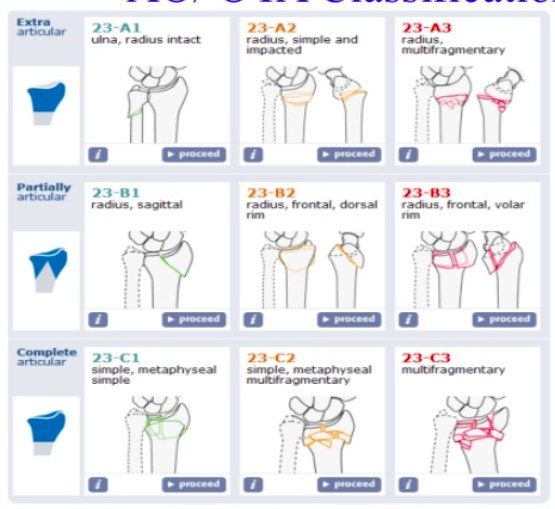
- AP: intra-articular (RCJ or DRUJ), comminution, radial height, radial inclination, ulnar styloid fracture
- Lateral: intra-articular, dorsal/palmar comminution, dorsal/volar tilt
- Beware soft tissue injury: TFCC, SL ligament (especially radial styloid fracture)
Q2What are the LaFontaine criteria for instability and what alignment is acceptable?▸
- LaFontaine (1989): >3/5 predicts displacement; age >60, intra-articular, dorsal comminution, ulnar styloid base fracture, dorsal tilt >20 degrees
- AO modification adds osteoporosis, initial displacement >1cm, shortening >5mm, palmar comminution
- Acceptable: radial height <3mm loss (normal 12mm), radial inclination <5 degrees loss (normal 23 degrees)
- Articular step <2mm; no dorsal tilt (normal 11 degrees volar tilt)
Q3Describe the AO classification of distal radius fractures.▸
- A: extra-articular (ulnar, radial simple, radial comminution)
- B: partial-articular (sagittal, dorsal, volar)
- C: complete articular (simple, metaphyseal comminuted, articular comminuted)
Q4Describe the Frykman, Fernandez and Melone classifications of distal radius fractures.▸
- Frykman: odd numbers for extra-articular (1), RCJ (3), DRUJ (5), both (7); even numbers add ulnar styloid involvement
- Fernandez: bending, shearing, compression, avulsion, explosion
- Melone: lunate impaction (= Fernandez compression); 4 fragments: shaft, radial, medial volar, medial dorsal
Q5How is a distal radius fracture acutely managed?▸
- CR under sedation (for pain relief and psychological relaxation) - not haematoma block - + slab
- History: need to ask age of menopause
- Treatment approach depends on patient and fracture factors
- Systemic: treat osteoporosis
Q6What is the definitive treatment of a 23-C2 distal radius fracture?▸
- Volar locking plate for absolute stability and stable fixation
- Screen DRUJ: stable = free mobilisation; unstable = splint for 3 weeks
- 2.4mm LCP in buttressing mode; modified volar Henry approach between FCR and radial artery; plate proximal to watershed line
Q7Describe the modified volar Henry approach and plating.▸
- Plane between FCR and radial artery; skin, subcut, FCR sheath and subsheath
- Split PQ; reduce fracture; +/- bone substitute
- Volar plate proximal to the watershed line
- Aim: anatomical reduction, stable fixation for early mobilisation
Q8What is the Soong classification?▸
- Grade 0: dorsal to the critical line
- Grade 1: volar to the critical line but proximal to the volar rim
- Grade 2: volar to the critical line and on or distal to the volar rim
Q9What is the evidence for treating fragility distal radius fractures and why is a chauffeur fracture unstable?▸
- Arora JBJS 2011: cast vs surgery >65, operation better grip strength but no overall clinical difference
- DRAFFT 1 (2019): K-wire vs volar locking plate no difference at 5 years; DRAFFT 2 (BMJ 2022): K-wire vs casting no difference at 12 months
- Chauffeur fracture: avulsion of the styloid by the RSC ligament, rupture of volar capsule and radiolunate ligament allows radiocarpal subluxation
- Brachioradialis insertion 17mm from the styloid tip, so no stabilising force
Q10What is the clinical presentation on this section?▸
- 22-year-old with ulnar-sided wrist pain
- Ulnar positive variance
- Type II ulnar styloid fracture (through the base)
Q11How is ulnar variance measured on a wrist X-ray?▸
- One line tangential to the distal ulnar articular surface, perpendicular to the shaft
- Another line tangential to the lunate fossa, perpendicular to the shaft
- The interval between the two lines gives the ulnar variance
Q12What are the consequences of positive ulnar variance?▸
- Ulnar impaction syndrome
- TFCC tear
- Ulnocarpal arthritis
- SL dissociation
Q13How are ulnar styloid fractures classified (Fernandez and Jupiter)?▸
- Type 1: distal to base
- Type 2: through base
- Type 3: proximal to base
Q14What is the comprehensive classification with Q modification for distal ulna fractures?▸
- Q1 styloid, Q2 simple neck, Q3 comminuted neck
- Q4 intra-articular, Q5 head + neck, Q6 meta-diaphyseal
Q15List the differential diagnosis of ulnar-sided wrist pain by tissue.▸
- Bone: ulnar styloid fracture, hook of hamate fracture
- Cartilage: chondral lesions
- Joint: pisotriquetral arthritis, wrist ganglion
- Tendon: ECU subluxation or tendinitis
- Ligaments: LT ligament injury, TFCC
- Nerve: ulnar nerve entrapment; artery: ulnar artery thrombosis
Q16Describe the traumatic types of the Palmer classification of TFCC injury.▸
- Traumatic tears are typed by location
- Central, ulnar, distal, radial
Q17Describe the degenerative stages of the Palmer classification of TFCC injury.▸
- A: TFCC wear/thinning
- B: wear/thinning + lunate/ulnar chondromalacia
- C: TFCC perforation + lunate/ulnar chondromalacia
- D: LT ligament perforation
- E: + ulnocarpal arthritis
Q18How is an acute TFCC tear initially managed?▸
- Conservative with splintage and NSAIDs
- Observe for 3 months
Q19What are the three aims of treating a chronic TFCC injury?▸
- 1. Decrease ulnocarpal loading
- 2. Treat the TFCC tear
- 3. Treat instability
Q20Chronic TFCC tear, no DRUJ arthritis, ulnar positive variance - what are the options?▸
- Wafer procedure
- Ulnar shortening
- TFCC debridement - leave a 2mm peripheral rim intact
Q21Why must a 2mm peripheral rim of TFCC be preserved during debridement?▸
- To avoid iatrogenic instability
Q22Chronic TFCC tear with ulnar negative variance - what are the options?▸
- Arthroscopic debridement
- Lunotriquetral ligament repair or debridement
Q23What are the options when there is DRUJ arthritis or instability with a chronic TFCC tear?▸
- Darrach
- Sauve-Kapandji (SK)
- Bower - TFCC has to be repairable or reconstructable
- Ulnar head replacement
Q24What is the Sauve-Kapandji procedure?📷▸
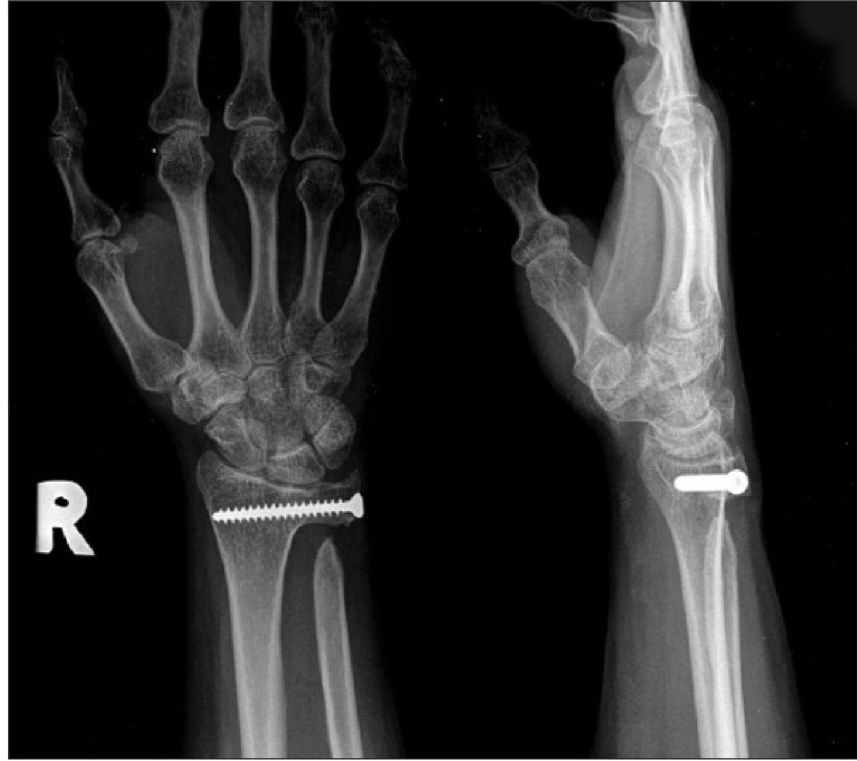
- DRUJ fusion with stump pseudoarthrosis 1cm proximal to the fusion
- Interposition of pronator quadratus
- Maintains ulnocarpal support (less ulnar translocation of carpus), mobile pronation/supination, good strength, better cosmesis than Darrach
- Indicated in the young, high demand patient, including RA
Q25What are the problems of the Sauve-Kapandji procedure?▸
- Proximal ulnar impingement
- Failed fusion, or fusion of pseudoarthrosis
- Heterotopic ossification
- Ulnar sensory branch neuritis
- Screw impingement over the far cortex causing iatrogenic DQV
Q26What is the Darrach procedure?▸
- Excisional arthroplasty from ulnar styloid to the level of the sigmoid notch
- Retain the ulnar styloid and its attached ligament
- Ulnar stump stabilised by interposed PQ, FCU/ ECU
Q27What are the complications of the Darrach procedure?▸
- Loss of ulnar carpal support leading to ulnar translocation of the carpus
- Grip weakness
- Ulnar convergence impingement
Q28How is the distal ulna stabilised to prevent convergence after loss of the DRUJ buttress?▸
- Pronator quadratus interposition
- Volar capsular flap
- ECU tenodesis - old distally based (tension depends on wrist position), new proximally based
- Alternative solution: ulnar head prosthesis
Q29Why is Sauve-Kapandji preferred over Darrach in young patients?▸
- Maintains ulnocarpal support -> less ulnar translocation of the carpus
- Mobile in pronation and supination
- Good strength
- Better cosmesis
Q30What is the general indication for the Sauve-Kapandji and Darrach procedures?▸
- Salvage procedures for DRUJ instability with arthritis
- Alternative is ulnar head replacement
Q31What are the benefits of the Darrach procedure?▸
- Improves ROM
- Relieves pain
- Good cosmesis
- Suited to the old, low demand patient
Q32Which muscles contract to cause ulnar convergence after loss of the DRUJ buttress?▸
- APL, EPB and PQ
- EPB arises from the radius, some APL from the ulna
- Convergence: 100% happen, 50% sx