Spine Paed
Neuromuscular and other scoliosis
Neuromuscular scoliosis and other secondary causes, with management by underlying condition.
12 questions
2 source pages
1 images
Images appear with the first question taken from each source page — tap a question to open it.
Q1What is the Lonstein and Akbarnia classification of neuromuscular scoliosis?▸
- 1: level pelvis (S curve)
- 2: pelvic obliquity (C curve)
Q2What is the deformity pattern in neuromuscular scoliosis and why?▸
- C curve
- Frontal: primary from erector spinae imbalance; secondary compensatory for hip adductor contracture
- Sagittal: most compensation for hip -> hyperlordosis
- TL/L more involved as more mobile; more listing; long fusion
Q3How is juvenile scoliosis classified and which group has a poorer prognosis?▸
- Early onset <5 years vs late onset >5 years
- <5 years has poorer prognosis due to thoracic insufficiency syndrome
Q4What is the management of neuromuscular/juvenile scoliosis?▸
- <20 degrees: observation
- Cobb 20-50: brace
- Cobb >50: growth modulation with growing rods or tether if growth potential remains
- If surgery/fusion, may need to consider adding anterior instrumentation
Q5What is juvenile scoliosis and how is it subdivided?📷▸
- Early onset (<5 years) vs late onset (>5 years)
- <5 years: poorer prognosis due to Thoracic Insufficiency Syndrome
- Juvenile scoliosis requires MRI
Q6How is juvenile scoliosis managed according to Cobb angle?▸
- Cobb <20 degrees: observation
- Cobb 20-50 degrees: brace
- Cobb >50 degrees: growth modulation with growing rods or tether if growth potential remains
- If fusion is needed, consider adding anterior instrumentation
Q7What is the natural history of infantile scoliosis and why is MRI needed?▸
- Most resolve spontaneously
- Most common curve: left thoracic (75%)
- MRI needed: 20% present with neuroaxial abnormalities and to rule out tethered cord
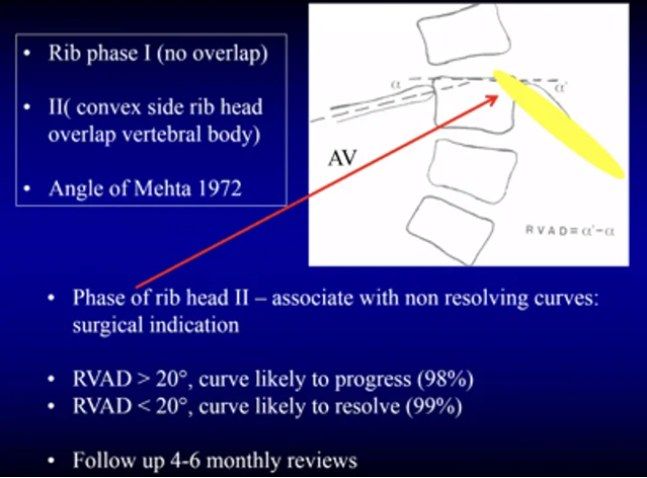
Q8What is the rib-vertebral angle difference (Mehta angle)?▸
- Angle between a perpendicular line from the apical vertebra endplate and the rib, comparing both sides
- Rib phase: overlap of rib and vertebral body (phase 2) = non-resolving curve
Q9What are the three predictors for infantile curve growth?▸
- Cobb >20 degrees
- Rib-vertebral angle difference (Mehta angle) >20 degrees
- Rib-vertebral overlap (rib phase 2)
Q10How is infantile scoliosis treated according to Cobb angle and RVAD?▸
- Cobb <25, RVAD <20: observation
- Cobb <35, RVAD >20: Mehta serial casting and bracing
- Cobb >50: surgery with VEPTR or growing rods
Q11What types of scoliosis are covered under 'other scoliosis'?▸
- Juvenile scoliosis
- Infantile scoliosis
- Congenital scoliosis
Q12What is the rib phase in infantile scoliosis and what does overlap mean?▸
- Rib phase is the overlap of the rib and vertebral body
- Overlap = rib phase 2 = non-resolving curve