Foot and Ankle
Forefoot arthritis and lesser metatarsal disorders
Hallux rigidus, Freiberg's infraction, Iselin apophysitis and bunionette deformity
16 questions
4 source pages
1 images
1 fact-check flags
Images appear with the first question taken from each source page — tap a question to open it.
Q1Describe the X-ray and clinical findings.▸
- Osteophytes at the dorsal side of the 1st MTPJ
- Clinically limited dorsiflexion: hallux rigidus
Q2What is the Coughlin staging of hallux rigidus?▸
- 1: mild pain with ROM
- 2: moderate pain with ROM
- 3: stiffness + pain with end ROM
- 4: stiffness + pain through ROM
- Grades 1-2: osteophyte; grades 3-4: joint space narrowing
Q3What are the conservative and joint-preserving options?▸
- Conservative: NSAID, Morton's extension stiff foot plate limiting toe dorsiflexion, high box/rocker bottom shoes
- Arthroscopic debridement/synovectomy for grades I-II
- Cheilectomy (also remove 25% of dorsal MT head) for grades I-II
- Dorsal closing wedge osteotomy for grades II-III
Q4What are the joint-sacrificing options and their problems?▸
- Fusion
- Interpositional arthroplasty
- Keller excision arthroplasty - problem is cock up deformity
- Arthroplasty
Q5Why is some valgus needed in fusion, and what is the evidence for fusion vs replacement?▸
- Valgus lessens the chance of IPJ arthritis
- JBJS Rev 2017 Stevens systematic review: arthrodesis is superior for clinical outcome and pain with fewer complications and revisions
- 20.9% loosening rate in the replacement group
Q6What is the pathophysiology of hallux rigidus?▸
- MT primus elevatus
- Degenerative change at the 1st MTPJ resulting in limited dorsiflexion
Q7What are the history and examination findings in hallux rigidus?▸
- Hx: pain on push off or forced dorsiflexion of the great toe
- Shoe irritation due to dorsal osteophytes compressing the medial dorsal cutaneous nerve (MDCN); metatarsalgia; bunion
- PE: swelling, dorsal bunion, antalgic supinated gait, grind test
- Grading depends on pain upon ROM, osteophyte size and joint space
Q8What is Freiberg's disease?▸
- Infarction and fracture of a metatarsal head
- Common in female adolescents and athletes
- Most commonly the second MT
- Thought due to microtrauma, stress overload, osteonecrosis
Q9How does Freiberg's disease present?▸
- Foot dorsum pain and swelling over the 2nd MTPJ on weight bearing
- Diagnosis is by X-ray and graded with Smillie's classification
Q10What is Smillie's classification?▸
- 1: normal X-ray, abnormal MRI (subchondral fracture)
- 2: collapse on the dorsal side of the articular surface
- 3: further collapse with bony projections on the medial and lateral head
- 4: collapse involving the whole head distorting anatomy
- 5: arthritic; grades 4-5 impossible to reconstruct
Q11What are the operative options for Freiberg's disease?▸
- Goal: pain relief + pressure relief
- Non-operative: activities modification, rest, NSAID, short leg cast, MT pad
- Early/salvageable: arthrotomy for loose body, dorsal closing wedge osteotomy, Shortening osteotomy to unload joint, Bone graft/ drilling
- Late/non-salvageable: DuVries arthroplasty (partial MT head resection + capsular interposition), excisional arthroplasty
Q12What is Iselin disease?▸
- Apophysitis of the base of the 5th metatarsal
- A benign and self-limiting condition
Q13How would you counsel a patient with Iselin disease?▸
- Reassure the patient: the condition is benign
- The condition is self-limiting
Q14What is the Coughlin classification of bunionette deformity?📷▸
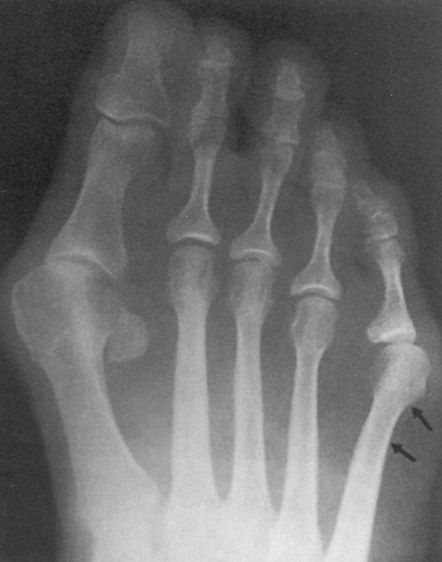
- Type I: large MT head or lateral exostosis
- Type II: congenital bowing with a normal 4-5 IMA
- Type III: 4-5 IMA >12 deg
Q15How does a bunionette present?▸
- Cosmesis
- Pain from prominence, lateral bunion, plantar callosity
- Check shoewear
Q16How is a bunionette treated?▸
- Nonoperative first - 70-90% success (shoewear modification, analgesics, callosity shaving)
- Surgery if nonoperative treatment fails
- Type I: lateral condylectomy
- IMA <12: distal MT osteotomy
- IMA >12: proximal MT osteotomy
Fact check
Type III bunionette is defined as a 4-5 intermetatarsal angle >12 deg — conflates the classification with a surgical threshold — Coughlin type III is simply an increased 4-5 IMA; abnormal is commonly cited as >8-10 deg, while >12 deg is used to select a proximal osteotomy — (medium confidence) — source