Foot and Ankle
Ankle impingement and tarsal tunnel syndromes
Anterior ankle bony impingement with tarsal tunnel and anterior tarsal tunnel entrapment
25 questions
4 source pages
3 images
Images appear with the first question taken from each source page — tap a question to open it.
Q1Describe the X-ray and the diagnosis.📷▸
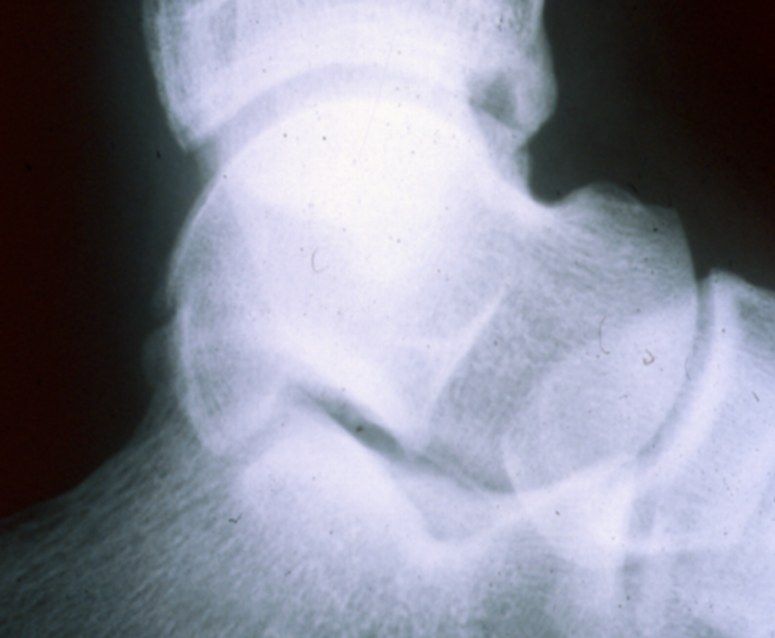
- Bony spur at the anterior distal tibia and dorsal aspect of the talar neck
- Anterior ankle pain on dorsiflexion with limited dorsiflexion: anterior ankle impingement
Q2What causes anterior and posterior ankle impingement?▸
- Anterior: overuse and repeated trauma with osteophyte formation at the anterior ankle
- Common in athletes playing on grass or turf, footballers and dancers
- Posterior: overuse and repeated plantarflexion, common in ballet dancers
- Posterior impingement may cause FHL tendinopathy; X-ray may show an os trigonum
Q3What is an os trigonum and how is it managed?▸
- Accessory ossicle of the separated posterolateral talar tubercle
- Usually asymptomatic; symptomatic in ballet dancers from repeated extreme plantarflexion
- May associate with FHL tendinitis
- Ddx: Shepherd's fracture (fracture of the posterior process of the talus)
- Conservative treatment; excision if it fails
Q4What are the indications for ankle arthroscopy?▸
- OCD
- Impingement
- Removal of loose body
- Debridement of Haglund lesion
Q5What are the ankle arthroscopy portals and the structures at risk?▸
- Anteromedial: primary portal, between tibialis anterior and saphenous vein
- Anterolateral: primary portal, lateral to peroneus tertius (superficial peroneal nerve at risk)
- Posterolateral: 2 cm proximal to lateral malleolus tip, medial to peroneal tendons, lateral to Achilles (sural nerve)
- Posteromedial: just medial to Achilles (posterior tibial artery and tibial nerve)
- Anterocentral: between EDC and EHL (DP artery and deep peroneal nerve)
Q6How is ankle arthroscopy set up?▸
- GA, supine, tourniquet
- Traction strap of the foot and heel
Q7What is tarsal tunnel syndrome and what are the tunnel boundaries?📷▸
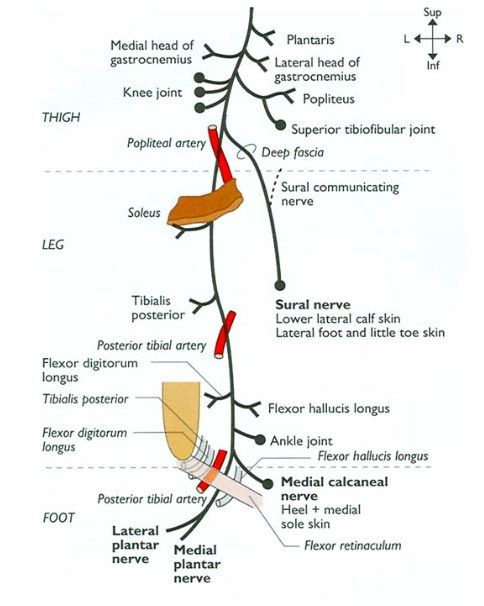
- Compressive neuropathy of the tibial nerve posterior and inferior to the medial malleolus
- Superficial: flexor retinaculum
- Deep: talus, calcaneus, sustentaculum tali
- Inferior: abductor hallucis
Q8What is the usual presentation and what clinical signs do you look for?▸
- Vague medial foot pain exacerbated by prolonged walking or standing, burning sensation
- Tinel sign
- Diminished two-point discrimination
- Wasting of abductor hallucis (medial plantar nerve) or abductor digiti quinti (lateral plantar nerve)
- Look for pes planus which further stretches the nerve
Q9What is the heel pain triad?▸
- PTTD
- Tarsal tunnel syndrome
- Plantar fasciitis
Q10How is tarsal tunnel syndrome investigated and treated?▸
- Dx: NCV better than EMG; MRI for space-occupying lesion
- Conservative: NSAID, vitamin B6, tricyclic antidepressant, physio, massage, desensitization for 3-6m
- Surgical: nerve release +/- excision of SOL
- Release investing fascia, flexor retinaculum, and superficial and deep fascia of abductor hallucis
Q11What is anterior tarsal tunnel syndrome?▸
- Compressive neuropathy of the deep peroneal nerve
- Tunnel formed by the Y-shaped inferior extensor retinaculum
- Superficial boundary: inferior extensor retinaculum
- Deep boundary: fascia overlying the talus and navicular
- Contents: deep peroneal nerve and branches, EHL, EDL, dorsalis pedis artery
Q12What are the symptoms of anterior tarsal tunnel syndrome?▸
- Burning pain and paresthesias or vague dorsal foot pain
- Worse at night as the ankle assumes a plantarflexed posture
Q13Describe the course and branches of the deep peroneal nerve at the ankle.▸
- Passes medial to EHL proximal to the ankle, then laterally between EHL and EDC
- Divides into lateral motor and medial sensory branches within the tunnel
- Accompanied by the dorsalis pedis artery
Q14How is anterior tarsal tunnel syndrome treated?▸
- Conservative: NSAID, night splints, footwear
- Surgical release: incise the inferior extensor retinaculum
- Protect the DP artery and release both branches of the nerve
- Remove SOL and repair the capsule to protect the nerve from bleeding bone
Q15What is tarsal tunnel syndrome?📷▸
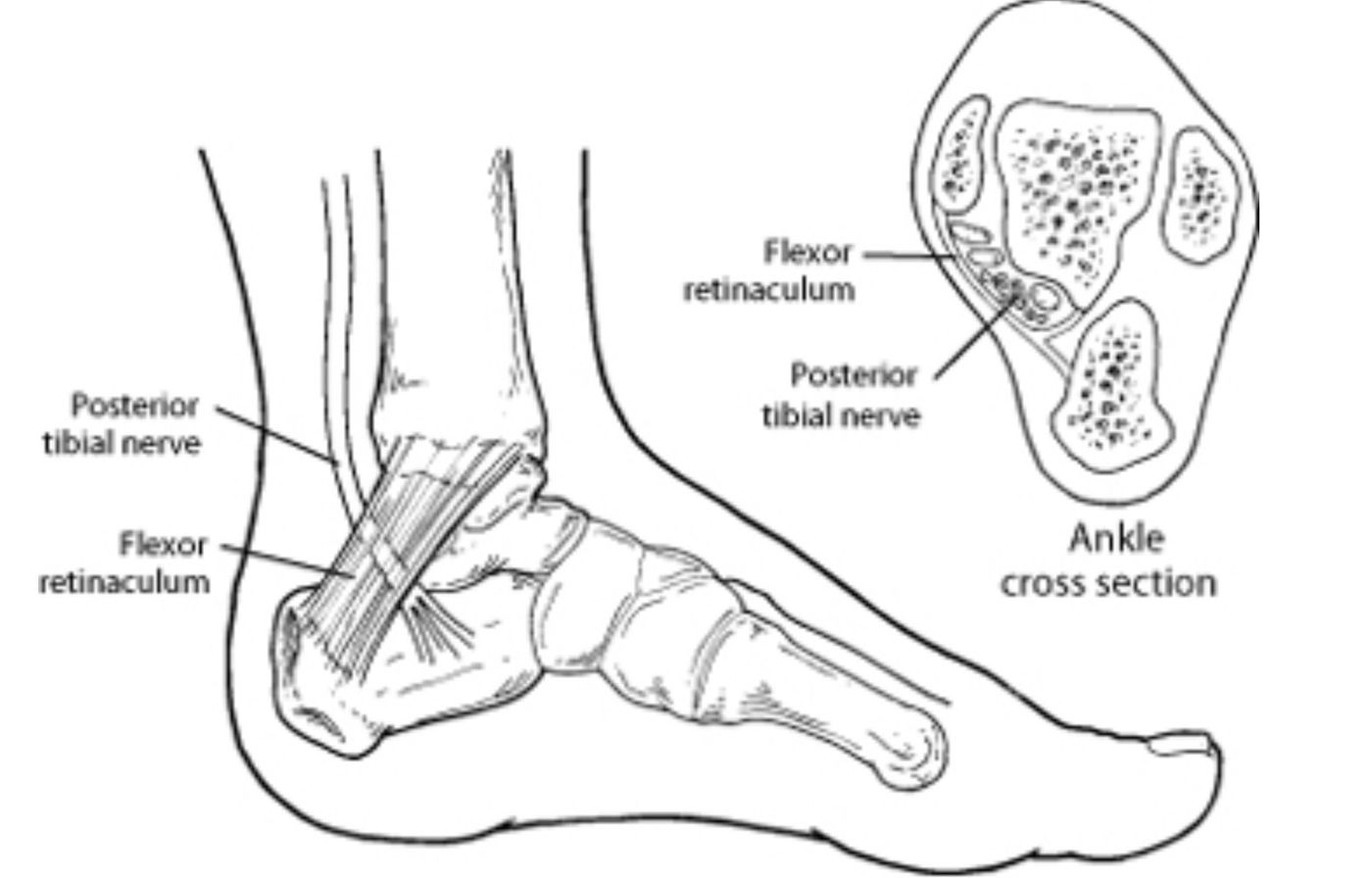
- Compressive neuropathy of the tibial nerve or its terminal branches (medial and lateral plantar nerves) in the tarsal canal
- Impingement within the fibro-osseous tunnel or as it passes into the abductor hallucis muscle
Q16Describe the anatomy and contents of the tarsal tunnel.▸
- Roof: flexor retinaculum (laciniate ligament)
- Floor (medial): superior calcaneus, medial wall of talus, distal-medial tibia
- Inferior: abductor hallucis
- Contents: TibP, FDL, FHL, tibial nerve, posterior tibial A&V
Q17Where does the tarsal tunnel begin and end?▸
- Begins a few cm proximal to the tip of the medial malleolus, where the crural fascia condenses to form the unyielding roof - the flexor retinaculum (laciniate ligament)
- Ends where the medial and lateral plantar nerves enter or pass deep to the abductor hallucis
Q18What are the causes of tarsal tunnel syndrome?▸
- Space-occupying lesion: lipoma, nerve sheath tumour, ganglion, varicose vein, bony prominence, exostosis
- Valgus hindfoot
Q19What is the differential diagnosis of tarsal tunnel syndrome?▸
- Peripheral neuropathy
- HMSN
- S1 radiculopathy
- Plantar fasciitis
- Lateral plantar nerve compression neuropathy
- Heel pad atrophy/hypermobility
Q20How does tarsal tunnel syndrome present?▸
- Vague foot pain
- Commonly confused with plantar fasciitis
Q21What are the signs of tarsal tunnel syndrome?▸
- Atrophy of intrinsics
- Numbness in the sole
- Tinel sign posterior to the medial malleolus
- Aggregated numbness upon eversion and dorsiflexion
Q22What is the workup of tarsal tunnel syndrome?▸
- XR and MRI
- NCT/EMG: latency to abdH and abdDM, slow velocity, decreased amplitude
Q23What is the conservative treatment of tarsal tunnel syndrome?▸
- Steroid injection
- PT for stretching
- Orthosis in plantarflexion + varus
Q24What are the indications and options for surgery in tarsal tunnel syndrome?▸
- Indications: space-occupying lesion or failed conservative treatment
- Decompression - open or arthroscopic
Q25What is Baxter's nerve?▸
- First branch of the lateral plantar nerve
- Implicated as one of the cause of heel pain, which can be similar to plantar fasciitis
- Provides motor innervation for the abductor digiti minimi