Statistics
Osteosarcoma case - assessment and staging
Describing an osteosarcoma case: staging systems, pathological features, disease factors.
45 questions
8 source pages
1 images
1 fact-check flags
Images appear with the first question taken from each source page — tap a question to open it.
Q1What does the lecturer advise about these tumour revision notes?▸
- Refer to Orthobullets for more details
- These notes are not comprehensive
- Remembering all Orthobullets tumours may only gain 1-2 more MCQs
Q2Which staging classification is used for bone and soft tissue tumours?▸
- Bone benign/malignant: Enneking
- Soft tissue sarcoma: AJCC
- STC: AJCC
Q3What do AJCC stages I-IV mean?▸
- I: low grade
- II: high grade
- III: deep to fascia
- IV: lymph node/metastasis
Q4What are the Enneking stages for malignant bone tumours?▸
- I: low grade
- II: high grade
- III: metastasis
- A: intra-compartmental, B: extra-compartmental
Q5What is the Enneking classification for benign bone tumours?▸
- 1: latent
- 2: active
- 3: aggressive
Q6Describe the X-ray findings of this skeletally immature knee.📷▸
- Lytic lesion in the metaphyseal region of the distal femur with destruction of the lateral cortex
- Wide zone of transition with periosteal reaction medially
- Matrix is osseous and does not cross the physis
- Associated soft tissue swelling
Q7What is your impression and what X-ray do you request next?▸
- Aggressive left distal femoral lesion; concerned about osteosarcoma
- I want XR of the whole femur to look for obvious skip lesions
- Other DDx: Ewing sarcoma, haematological (e.g. lymphoma), infection/osteomyelitis
Q8What are the poor prognostic factors in osteosarcoma?▸
- Advanced stage of disease (most predictive)
- Age >40 at diagnosis; male sex
- <90% necrotic index; positive surgical margins
- Tumour site and size; vascular involvement
- Expression of p glycoprotein (P-glycoprotein); high ALP and LDH
Q9How would you investigate this lesion?▸
- Aims: establish the diagnosis and stage the disease
- Bloods: Hb, WBC, platelets, clotting, ALP (bone turnover), LDH (cell turnover), ESR, CRP
- Local imaging: whole-bone X-ray 2 views, MRI with contrast (skip lesions, joint/physis involvement, NV bundle proximity)
- Systemic staging: CT thorax + bone scan
- Image-guided biopsy at a tertiary tumour centre - representative tissue with minimal contamination
- Discuss the case at the MSK oncology MDT
Q10What is the management principle and neoadjuvant chemotherapy plan?▸
- Oncologic clearance with preservation of the limb and function if possible: save life (systemic control), save limb (local control)
- Principle: Margin free excision (resect all inflammatory zone and go through cuff of normal tissue)
- Neoadjuvant chemotherapy (4 reasons; no proven survival effect vs post-op chemo alone)
- 2 cycles pre-op MAC: methotrexate, adriamycin, cisplatin; 4-week cycles
- Restaging MRI, then OT; continue adjuvant chemo and amend by necrotic index
- Good responder (90-100%): 3 more cycles; poor responder: VP16 + ifosfamide with 5 cycles (EURAMOS1 2016 does not support this - toxicity without EFS benefit)
Q11What are the relative contraindications to limb salvage and the allograft 'terrible triad'?▸
- Major NV encasement
- Pathological fracture with haematoma violating compartment boundary
- Inappropriately performed biopsy
- Severe infection in surgical field; immature skeleton with predicted LLD >8cm
- Extensive muscle/soft tissue involvement; poor response to chemo
- Allograft terrible triad: fracture, infection, non-union (15% each); host bone ingrowth only 1-2mm/year
Q12What history and examination findings are relevant in suspected osteosarcoma?▸
- History: PMHx, constitutional symptoms
- Local PE: soft tissue status, NV status, LLD, any knee effusion
- Systemic PE: listen to lungs
Q13What are the prerequisites for limb salvage and the principle of reconstruction?▸
- Prerequisites: clear margins, durable and useful limb, limited morbidity, equal oncological outcome
- Reconstruction principle: stable, painless, durable, mobile limb
Q14What are the options for reconstruction after tumour resection?▸
- Biological: autograft or allograft
- Metallic implant: modular or custom-made
- Combined reconstruction
Q15How is a biopsy taken and how does percutaneous compare with incisional biopsy?▸
- Options: percutaneous image-guided, incisional, excisional; most people now do percutaneous image-guided biopsy
- True-cut biopsy x3 vs FNAC: architecture obtained 70% vs 9%
- Incisional: GA, bigger/deeper wound with more bleeding, but a better chunk of tissue
- Percutaneous may be inconclusive (reactive zone, central necrosis) - radiologically representative tissue may not be histologically representative
- Better performed by the surgeon who will do the final excision
Q16What are the intra-operative and post-operative principles of biopsy?▸
- Pre-op: bloods + imaging
- Intra-op: tourniquet without exsanguination, longitudinal incision, cross the least compartments, avoid NV structures, aim at representative tissue
- Oval shape if bone; send for frozen section + microbiology
- Careful haemostasis, drain in line, suture with small bites
- Post-op: bed rest +/- protection, Abx (antibiotics)
Q17When is an excisional biopsy appropriate?▸
- Clinically benign lesion: small, superficial to fascia
- Incisional and excisional biopsy margins are similar to the definitive surgery (1-2cm)
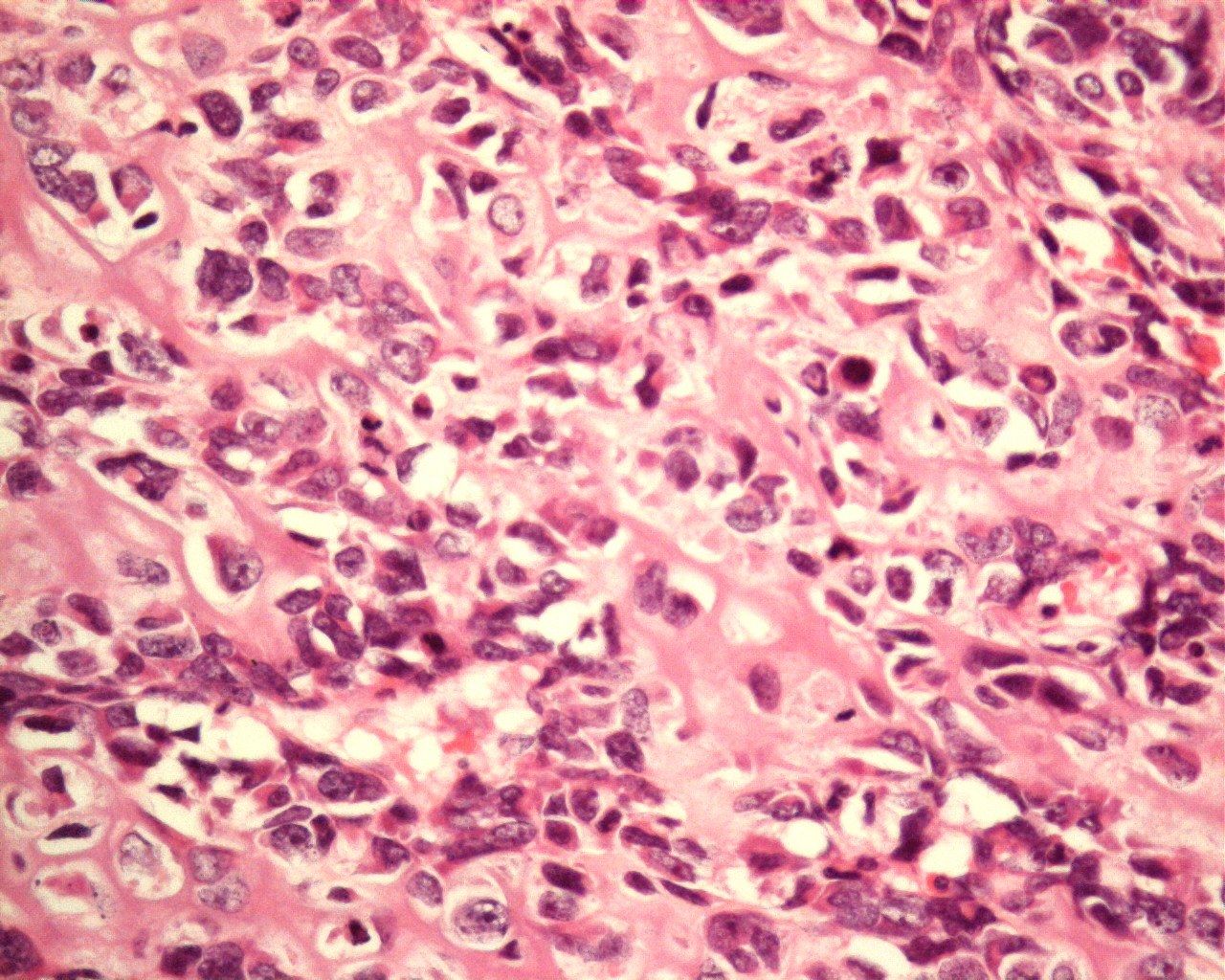
Q18What histological features suggest osteosarcoma on H&E?▸
- Pleomorphic spindle cells with lacey osteoid
- high nuclear cytoplasmic ratio (high nuclear-to-cytoplasmic ratio), cellular atypia
- Multiple mitotic bodies
Q19How is limb length discrepancy approached in tumour patients?▸
- Key considerations: growth potential and articular involvement
- Options: growing prosthesis, lengthening, growth plate transfer, amputation, Van Nes rotationoplasty
- Van Nes indication: major bone/soft tissue involvement without NV involvement
- Used to change a high AKA to a BKA
Q20What novel treatments are being studied for metastatic osteosarcoma?▸
- Almost half of current trials evaluate immunotherapies such as mifamurtide, IL-2, PD-1 inhibitors
- Tyrosine kinase inhibitors including regorafenib
Q21What are the properties of allograft reconstruction?▸
- Host bone grows into donor bone slowly: 1-2mm/year
- Strength decreases by 50% at 10 years
- Worse with allograft arthrodesis
- APC usu in prox humerus and proximal tibia (tendon attachment to prosthesis difficult)
Q22What is the prognostic significance of a pathological fracture in osteosarcoma?▸
- Pathological fracture itself increases local recurrence and decreases survival
Q23What does the Scully case series show regarding limb salvage in osteosarcoma with pathological fracture?▸
- Limb salvaging surgery does not decrease survival in carefully selected patients
Q24What does the JBJS 2014 meta-analysis show regarding local recurrence after pathological fracture in osteosarcoma?▸
- Metanalysis JBJS 2014 - no statistical difference in local recurrence
Q25What makes a pathological fracture in osteosarcoma amenable to limb salvage?▸
- Respond to chemo
- # healing
- MRI confirmed salvageable
Q26What are the types of osteosarcoma?▸
- Primary: intramedullary, telangiectatic, parosteal, periosteal
- Secondary: Paget's disease, fibrous dysplasia, post-irradiation
Q27What is the classical X-ray appearance and DDx of osteosarcoma?▸
- Distal femur medullary region, wide transitional zone with bone formation and excessive periosteal reaction
- Codman's triangle and sunburst appearance
- DDx: infection, Ewing (young), metastasis (old), haematological malignancy
Q28What is the management plan and chemotherapy regime for osteosarcoma?▸
- Principle: oncological clearance with limb preservation if possible, without sacrificing tumour margin
- Systemic control (chemo) + local control (surgery); regime neoadjuvant chemo / OT / chemo
- 2 cycles pre-op (MTX, vincristine + cisplatin); reassessment (clinical, MRI, PET-CT); OT at week 10
- Good response: 4 more cycles; poor response: change regime, 3w x 8 cycles
Q29What are the indications for amputation in osteosarcoma?▸
- Surgeon factor: not competent for limb reconstruction surgery
- Patient factor: not fit for prolonged/multiple surgery or not fit for rehab
- Disease factor: cannot achieve margin-free excision, or infection
Q30What is the necrotic index and its prognostic value?▸
- Percentage of necrosis in the excised specimen
- Good response >90%: 80% of patients, 5-year survival 70-80%
- Bad response: 5-year survival 40-50%
- Guides the adjuvant chemotherapy regime
Q31How is a pathological fracture in osteosarcoma managed?▸
- Amputation is safe but not a must
- Reassess with MRI to see whether margin-free wide local excision is achievable
- Scully case series: pathological fracture has higher local recurrence and decreased survival, but limb salvage does not increase recurrence/death in carefully selected patients
- Prognosis better if healing present
Q32What are the options for managing a bone defect after tumour resection?▸
- Amputation (soft tissue + bone + NV involvement)
- Van Nes rotationoplasty (soft tissue + bone involved, NV intact)
- Reconstruction: biological (autograft/allograft), metallic implant (modular/custom made), or combined
Q33What determines the choice between limb salvage and limb sacrifice for local control?▸
- Limb salvage possible if it does not affect oncological outcomes, there is a functional limb, and the risk of surgery is acceptable
- Options include joint/physis-preserving surgery
- Local control is achieved by surgery: limb salvaging vs limb sacrificing
Q34What disease factors determine prognosis?▸
- Stage, location, size, grade, type, pathological fracture
- Assessed alongside biochemical and treatment-response factors
Q35What biochemical and treatment-response factors determine prognosis?▸
- Biochemical: ALP, LDH
- Response to treatment: chemoresponse
Q36What is the effect of a pathological fracture on recurrence in osteosarcoma?▸
- Associated with an increased recurrence rate
- Also associated with worse prognosis
Q37Does limb salvage affect survivorship after a pathological fracture?▸
- No - limb salvage surgery does not affect survivorship
- Therefore pathological fracture is not an absolute contraindication to limb salvage
Q38What radiographic features of this pelvic lesion suggest a chondroid origin?▸
- Sclerotic, well-defined lesion adjacent to the pubic symphysis
- Associated flocculent calcification (chondroid matrix)
- No cortical erosion, scalloping or periosteal reaction
- Overall suspicious for chondrosarcoma
Q39What is the DDx for a chondral lesion at the pubic rami?▸
- Chondroblastic osteosarcoma
- Enchondroma
- Fracture callus
- Synovial chondromatosis
- Fibrous dysplasia with cartilaginous differentiation
Q40How do you differentiate a benign from a malignant chondral lesion?▸
- Clinical: growth after puberty, new symptoms e.g. pain
- Imaging: cartilage cap >2cm, soft tissue component, cortical breakage/erosion
- Histology: enlarged chondrocytes with multinucleated lacunae, high N:C ratio, disorganization, hypercellularity
- Diagnosis requires clinical + histological correlation (same histology may be benign in the hand but malignant in long bones)
Q41How is treatment of chondrosarcoma decided?▸
- Treatment depends on grading
- Grade 1 in pelvis: intralesional curettage or wide excision
- Grade 2-3: wide local excision
- Chemotherapy is useful only in mesenchymal chondrosarcoma
Q42What is the prognosis of chondrosarcoma by grade?▸
- Grade 1: 90%
- Grade 2: 70%
- Grade 3: 30%
- Undifferentiated: 10%
Q43Which benign lesions can progress to chondrosarcoma?▸
- Exostosis/enchondroma: 1%
- MHE: 10%
- Ollier's disease: 25-40%
- Maffucci: 100%
Q44What history, examination and investigations are needed for a chondral lesion of the pubic rami?▸
- Hx/PE: other masses, duration and progress of symptoms
- Ix: blood test, MRI with contrast (soft tissue extension, cartilage)
Q45Why are PE and X-ray important in enchondroma?▸
- Enchondroma: PE is important to differentiate - the difference between PE and X-ray is cartilage cap size
- Important to X-ray the pelvis (cannot see otherwise)
Fact check
Neoadjuvant chemotherapy for osteosarcoma is MTX + vincristine + cisplatin (2 cycles pre-op) — erroneous regimen — Standard neoadjuvant regimen is MAP: high-dose methotrexate, doxorubicin (Adriamycin) and cisplatin; vincristine is not part of standard osteosarcoma regimens (source 118 correctly lists methotrexate, adriamycin, cisplatin) — source