Basic Science Trauma
Acute compartment syndrome
Pathophysiology, diagnosis, treatment and late sequelae of acute compartment syndrome
13 questions
2 source pages
1 images
1 fact-check flags
Images appear with the first question taken from each source page — tap a question to open it.
Q1What is compartment syndrome?▸
- A state of reduction in perfusion to tissue contained within a confined space
- Can be due to intra-compartmental or extra-compartmental causes
Q2What are the first sign and the late signs of compartment syndrome?▸
- First sign: pain disproportional to the condition, exacerbated by passive stretching of muscles in that compartment
- Late signs are the 6 Ps: pain, paresthesia, paralysis, pale, pulselessness, perinsishingly cold
Q3What is the ischaemia time window in compartment syndrome and how is it managed?▸
- Orthopaedic emergency - fasciotomy is indicated
- >8 hours of ischaemia causes irreversible skeletal muscle damage and nerve axonotmesis
Q4What pressure measurements indicate compartment syndrome?▸
- Within 30mmHg of diastolic pressure, or 33mmHg absolute pressure
- 30mmHg as an absolute cutoff, beyond which nerve will have ischaemia
- Whiteside method, indicated when the patient is unconscious
- Need manometer, syringe and water tube connected by a 3-way stopcock; measure at the level of the compartment, look at the meniscus, measure all compartments
Q5Describe the fasciotomy for thigh compartment syndrome.▸
- Lateral incision +/- medial (adductor compartment seldom involved)
- Incise the fascia lata to decompress the anterior compartment, then retract vastus lateralis
- Incise the lateral intermuscular septum to decompress the posterior compartment
Q6Describe the double incision fasciotomy of the leg.▸
- Medial incision 2cm medial to the tibia decompresses the posterior compartments (saphenous vein and nerve at risk)
- Enter superficial posterior compartment, reflect soleus posteriorly to enter the deep posterior compartment
- Lateral incision midway between tibia and fibula decompresses anterior and lateral compartments (superficial peroneal nerve at risk)
- Look for the anterior intermuscular septum, transverse incision, enter lateral and anterior compartments 1cm anterior and posterior to the septum
- Extensive longitudinal incision of the whole leg length
Q7How many compartments are in the foot and how are they decompressed?▸
- 9 compartments: 4 interosseous, lateral, medial, central deep, middle and superficial
- 3 incisions: 2 dorsal along the 2nd and 4th metatarsals, plus one medial
Q8How is fasciotomy performed in the arm and forearm?▸
- Arm: lateral incision from the deltoid insertion to the lateral epicondyle
- Forearm: decompress the mobile wad, anterior and posterior compartments
- Anterior wound: lateral proximally to expose the mobile wad, curved medially to allow more skin coverage for median nerve and tendons
- Release the carpal tunnel at wrist level without crossing the skin crease perpendicularly
- Posterior wound: from the lateral epicondyle to the DRUJ
Q9How many compartments are in the hand and how are they decompressed?▸
- 10 compartments: 4 dorsal interosseous, 3 volar interosseous, adductor, thenar and hypothenar
- Incisions: hypothenar, thenar, and dorsal 2nd and 4th metacarpals, plus mid-axial blind side of the finger
Q10What is the post-fasciotomy management?▸
- Assess muscle viability
- Leave open
- Monitor circulation and rhabdomyolysis
- Plan wound coverage
Q11What is the classical sequela of untreated acute compartment syndrome of the forearm?📷▸
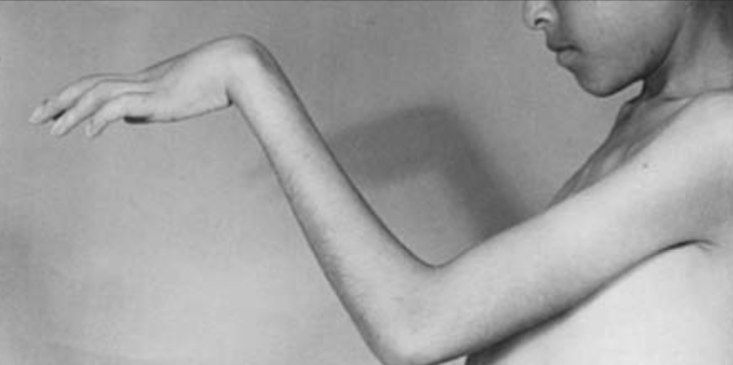
- Develops from advanced myonecrosis and muscle fibrosis of the forearm
- FDP and FPL muscles are most vulnerable
Q12Describe the classical posture of the forearm sequela of compartment syndrome.▸
- Insensate hand
- Flexed elbow, pronated forearm, flexed wrist, adducted thumb
- Extended MCPJ with flexed IPJ
- Intrinsic minus hand
Q13How is this sequela classified and treated (Tsuge classification)?▸
- Mild (finger flexor): dynamic splint, tendon lengthening
- Moderate (finger and wrist flexor): excision of necrotic muscle, neurolysis, tendon transfer (BR to FPL, ECRL to FDP)
- Severe (extensor): free muscle transfer
Fact check
An absolute compartment pressure of 33mmHg (or 30mmHg) diagnoses compartment syndrome — contested/imprecise — Contemporary guidance uses the delta pressure (diastolic minus compartment pressure) of 30mmHg or less; absolute pressure thresholds alone are not recommended and may cause unnecessary fasciotomies — source