Basic Science Trauma
Plates and pedicle screws - biomechanics
Plate effects on fracture healing, tension-side placement, DCP and LC-DCP, bridge plate length, pedicle screws
37 questions
6 source pages
3 images
1 fact-check flags
Images appear with the first question taken from each source page — tap a question to open it.
Q1What is the effect of a plate on cortical bone?▸
- Stress shielding with transient osteopenia under the plate
- Implant contact -> cortical bone blood supply affected
- First: necrosis upon contact
Q2Describe the remodelling sequence under a plate.▸
- Second phase: remodelling
- At 1 week (1/52): transient osteopenia under the plate (Ocl)
- Intramembranous ossification from the plate ends towards the centre
Q3Compare titanium and stainless steel plates for fracture fixation.▸
- Titanium: less stress shielding, less infection, less stiff, less MRI artifact
- Stainless steel: high yield strength, high ultimate tensile strength, high toughness, cheaper
Q4What is the clinical picture and concern on this day 1 post femoral fracture fixation?📷▸
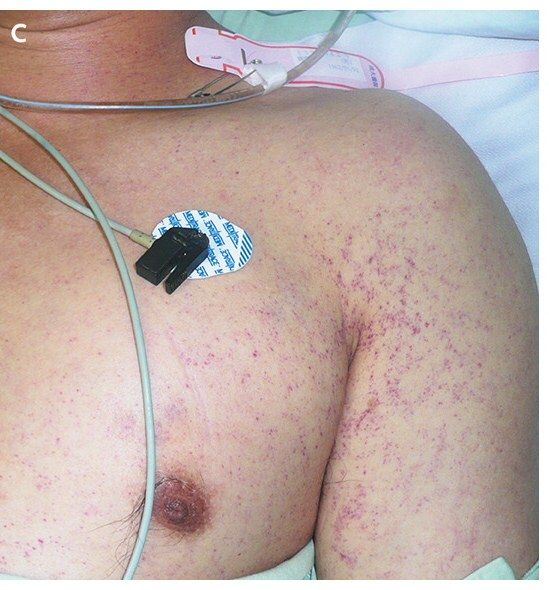
- Clinical photo showing petechiae over the axillary region
- History of recent femoral fracture fixation, likely nailing with reaming done
- Worry: fat embolism
Q5What is the quoted incidence and mortality of fat embolism?▸
- 30% of polytrauma patients
- 10% mortality
Q6What is fat embolism syndrome?▸
- A systemic inflammatory response to embolised fat
Q7How is fat embolism syndrome diagnosed?▸
- Gurd's criteria: 2 major criteria, or 1 major + 4 minor criteria
Q8What are the MAJOR Gurd's criteria and their timing?▸
- Cerebral involvement - 6-12 hrs before respiratory signs
- Respiratory compromise - 12-72 hrs
- Petechiae - 24-36 hrs, non-blanchable, over the upper trunk
Q9What are the MINOR Gurd's criteria?▸
- Fever
- Tachycardia
- Retinal involvement
- Jaundice
- Renal involvement
- Fat macroglobulinaemia
Q10What is the mechanical pathophysiology of fat embolism?▸
- Fat from disrupted bone marrow or adipose tissue is forced into the torn venule in the area of trauma
Q11What is the metabolic pathophysiology of fat embolism?▸
- Stress -> fat hydrolysed -> fatty acids
- Fatty acids cause endothelial damage
- Fatty acids are directly toxic to pneumocytes
Q12What laboratory finding is described in fat embolism?▸
- Chyle in urine
Q13How is fat embolism syndrome managed?▸
- Preventive and supportive
- MV + high PEEP +/- steroid
Q14How is fat embolism prevented?▸
- Early long bone stabilisation
- Reaming precautions
Q15Where is a plate most effective and what is the working length of a plate?▸
- A plate is a load-bearing device most effective when placed on the tension side
- Working length = distance between the two screws closest to the fracture on each end
Q16How are plates classified by function?▸
- Neutralization plate - neutralizes bending and rotational force
- Compression plate
- Bridging
- Buttress - placed at 90 degrees against the deforming force
- Tension band
Q17How are plates classified by design?▸
- Tubular
- Reconstruction plate
- DCP
- LC DCP
- Locking
Q18How do you exert compression with a plate?▸
- Lag screw through plate
- Compression plate
- Prebend plate - screws from central to peripheral for straight/convex bone, and peripheral to central for concave
- Tensioning device
Q19Describe how compression is exerted by a 'compression plate'.▸
- One screw inserted in neutral, so plate and bone become one unit
- Hole drilled eccentrically on the other side of the fracture
- Screw inserted, head slides down the edge of the screw hole like an inclined cylinder
- Relative movement of bone on this side towards the fracture; gives ~1mm compression
Q20What affects the rigidity of a plating construct?▸
- Material (stainless steel vs titanium)
- SMA (bH3/12)
- Mode of application (principles of plating, quality of reduction, working length)
- Design of plate and screws (locking, design of screw)
Q21What are the beam formulas relevant to plate constructs?▸
- Bending rigidity = BH3/12 x Young's modulus
- Deflection (bending strain) proportional to length^3
- Simple terms: plate construct rigidity is proportional to the 3rd power of thickness; the amount of bending is proportional to length^3
Q22What are the rod formulas relevant to plate constructs?▸
- Bending rigidity = pi r4/4 x Young's modulus
- Torsional rigidity = pi r4/2 x shear modulus
Q23What are the advantages of the LC DCP?▸
- Less contact (smaller footprint) with bone - preserves blood supply, less necrosis, less bone resorption and stress shielding
- Stiffness evenly distributed (DCP tends to bend at the level of the screw hole)
- Trapezoid cross section leaves an area for bone growth (broad based bone bridge after removal of plate, less prone to refracture)
- 'Combi hole' symmetrical on both sides allows compression in both directions
Q24What is a locking plate?▸
- A plate with a threaded screw hole used with screws with a threaded screw head
- Becomes a fixed angle device with angular stability, compared with conventional plating which depends on friction between plate and bone
- Can be used in compression mode, buttress mode, or bridging mode as an internal external fixation
Q25What are the biological and mechanical pros of locking plates?▸
- Biologically: less disruption to blood supply, less dissection, can be MISS
- Does not rely on direct contact/friction of the plate to bone
- Mechanically less likely to fail by screw pullout (bending and torsional stress shared amongst the entire single beam construct)
- Larger polar and 2nd moment of inertia when considering the whole construct; fixed angle device especially useful for osteoporotic bone
Q26What are the cons of locking plates?▸
- Do not aid reduction
- Technically demanding
- Expensive
- Construct can become too rigid if improperly applied
- Less tactile feedback when inserting screws
Q27What are the contraindications to locking plates?▸
- Simple fracture
- Unreduced intra-articular fracture
Q28What is the mode of failure of a locking plate?▸
- The shearing/ bending/ torsional load is shared amongst the screws. The implant will fail in one unit rather than sequential failure
- The implant fails as one unit rather than by sequential failure
- LCP is a single beam construct - screws must shear through bone simultaneously
Q29How does conventional plating fail compared with LCP?▸
- Conventional plating: when subjected to bending force, strength depends on the pull out strength of the individual screw closest to the fracture site
- LCP: single beam construct, screws must shear through bone simultaneously
Q30What design features give a pedicle screw high pull-out resistance?📷▸
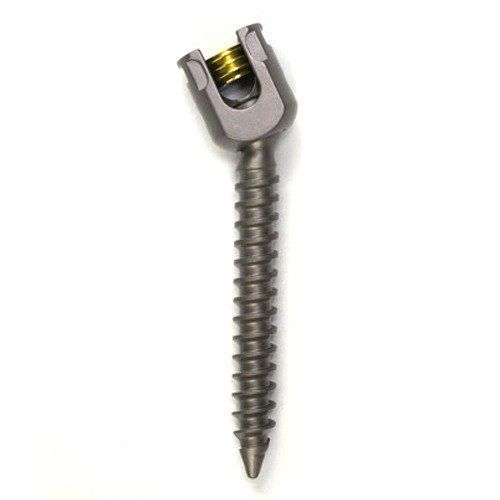
- Dual core design with bone specific anchorage
- Double lead (lead = 2 x pitch)
- Proximal cortical and distal cancellous thread designs
Q31What type of screw head does a pedicle screw have?▸
- Polyaxial screw head
Q32Describe the proximal (pedicle) portion of a pedicle screw.▸
- Cortical screw design: large core, low and broad thread
- Gives high strength and tight grip in dense cortical bone
Q33Describe the distal (vertebral body) portion of a pedicle screw.▸
- Cancellous screw design: small core, high and thin thread
- Large surface area allows even load distribution
Q34What is meant by a double lead (double start) design in a pedicle screw?▸
- Double lead (double start) = lead is 2 x pitch
- This contributes to the screw's high pull-out resistance
Q35What is the transition zone between the proximal and distal screw designs?▸
- Short transition zones between the two designs
- A smooth link between the cortical and cancellous portions
Q36What are the handling features of a pedicle screw?▸
- Self-tapping and self-centering
- Blunt tip without a sharp cutting edge for safe handling
Q37What is the ideal working length of a bridge plate?📷▸
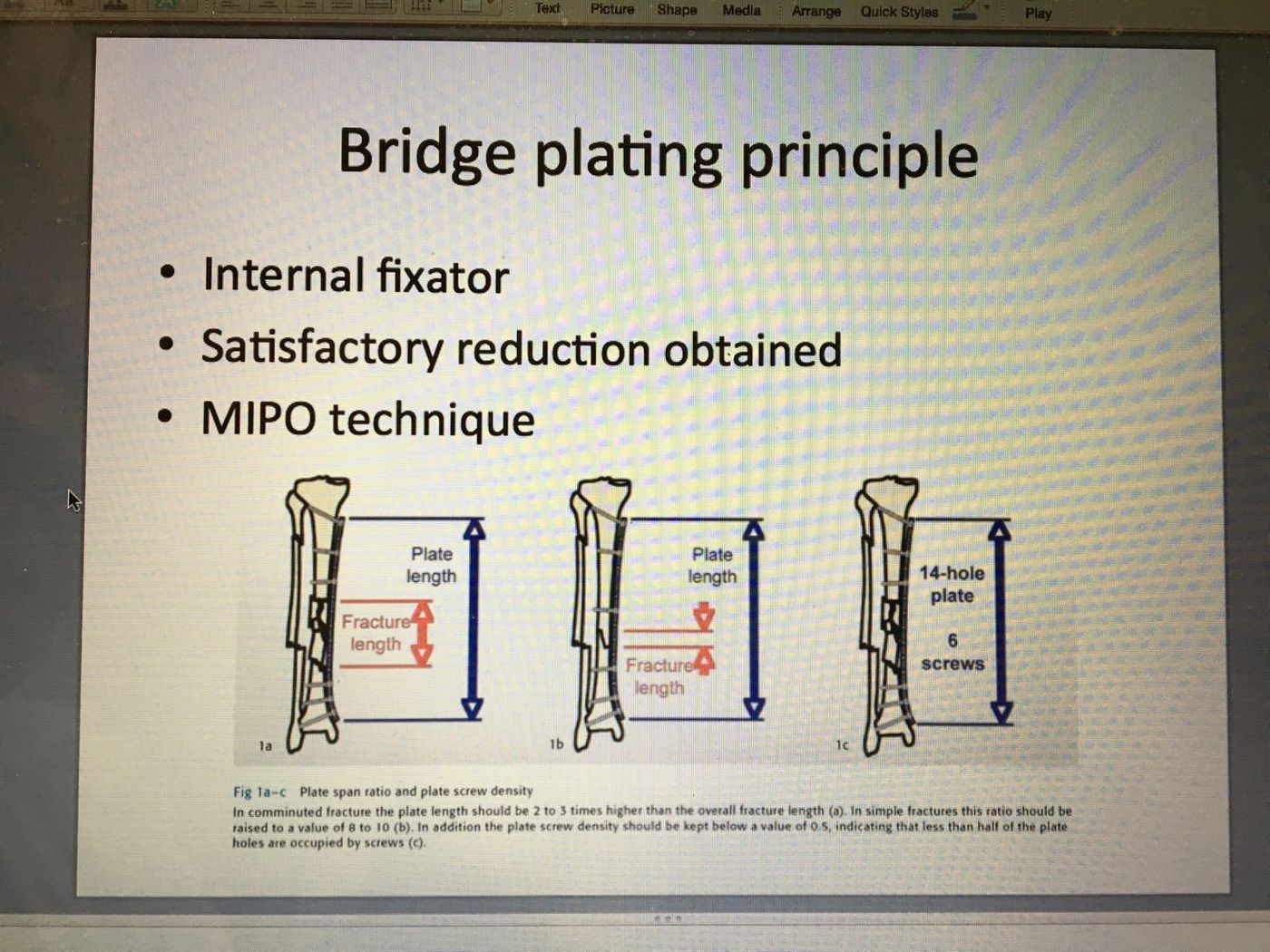
- At least twice the length of the fracture
- Working length : fracture length ratio of at least 2:1
Fact check
Fat embolism occurs in 30% of polytrauma patients with 10% mortality — misleading/outdated — Rates as high as 30% reflect historic fat embolism (fat globules) rather than the clinical syndrome; with early fracture fixation the incidence of fat embolism syndrome is now ~1-11%, while mortality of ~10% remains accepted — (medium confidence) — source