Basic Science Trauma
Screws, K-wires and interference screws
Screw and K-wire biomechanics, screw types, and biodegradable interference screws for ACL repair
39 questions
4 source pages
1 images
1 fact-check flags
Images appear with the first question taken from each source page — tap a question to open it.
Q1What is a cable and when is it used?▸
- Device used to exert a circumferential force
- For long spiral or oblique fractures
Q2What materials are used for cables?▸
- Stainless steel / vitallium alloy
- Vitallium alloy = 65% cobalt, 30% chromium, 5% molybdenum
Q3What neurovascular and reduction complications can occur with cables, and how are they prevented?▸
- Neurovascular injury - keep the cable passer close to bone
- Loss of reduction intraoperatively or postoperatively - avoid weight bearing / use external bracing
Q4What mechanical complications can occur with cables, and how are they prevented?▸
- Loosening of cable - tension each cable before locking
- Iatrogenic fracture - do not over tension, use a plate to support the cable, gentle reduction especially with rotation
Q5Which implants and complications are listed on the source?▸
- Implants: screw, plate, locking plate, DHS, nail, CMN, external fixator
- Considerations: fat embolism, compartment syndrome and removal of screws
Q6What are K-wires made of and what tip/end designs exist?▸
- Materials: stainless steel or nitinol (nickel titanium)
- Tips: threaded or plain
- Ends: trocar / diamond / round
Q7What are the functions of a K-wire?▸
- Fracture fixation: IM splintage / temporary reduction
- Used as a guide wire
Q8What are the features of a threaded K-wire tip?▸
- Minimises migration
- Higher chance of breakage
- Better holding than a trocar tip
Q9What are the features of a trocar K-wire tip?▸
- Worse holding power than threaded
- More head generated than threaded (generates more heat than threaded)
Q10What are the features of a diamond K-wire tip?▸
- Creates larger holes with worse circumferential fit and holding to the bone
- Requires less thrust force for bone penetration and generates less heat
Q11What is a screw and what is the mechanism of action?📷▸
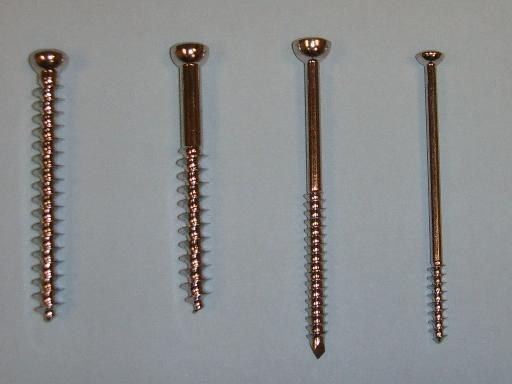
- A device which converts rotational motion into linear motion (torque -> linear force)
Q12What are the functions of a screw?▸
- Compression (interfragmentary / plate to bone)
- Positional
- Buttress
- Polar
- Locking bolt / screw
Q13What are the features of the head of a screw?▸
- (1) Recess engages the screwdriver: hexagonal / star shape / cruciate / Philips / slotted
- (2) Arrest forward motion
- Threaded (for locking)
Q14What other head features are described?▸
- Countersink
- Runoff
Q15What are the features of the shaft of a screw?▸
- A core with a spiral surface wrapping around it
- Thread may be partial or full
- May be cannulated
- Root/crest
Q16Define lead and pitch.▸
- Lead = length the screw travels with a 360 degree turn
- Pitch = distance between adjacent threads
Q17What are the described thread designs?▸
- V-shaped - with shear + compression force
- Buttress - resists pull out
- Reversed buttress - resists cut out
- Thread angle is also described
Q18State the relationships for screw bending and pullout strength.▸
- Bending strength is proportional to inner (minor) radius ^4
- Pullout strength is proportional to outer (major) diameter ^2
- Major (outer) diameter determines resistance to pull out
Q19What tip designs are available for screws?▸
- Standard round tipped
- Self tap (fluted)
- Self tap self drill
- Corkscrew
- Trocar
Q20Compare cortical and cancellous screws.▸
- Cortical: increased core to thread ratio; fine pitch, more threads engaged in cortex, greater pullout resistance (needs more turns)
- Cancellous: self-tapping corkscrew tip pushes spongy bone aside to thread its way into bone
- Cancellous: increased pitch increases torque needed for insertion; fully or partially threaded
Q21What is a lag screw?▸
- A screw that gains purchase only over the far cortex
Q22Describe the design of a cannulated screw.▸
- Replaced the malleolar screw
- Low-profile head; Rev-cutting flute (reverse-cutting flute); cancellous thread + self tap; full or half threaded
Q23What are the advantages and disadvantages of a cannulated screw?▸
- Advantage: precise insertion
- Disadvantages: decrease bending and torsional rigidity. Decrease pull out strength (core to thread ratio increased as the core accommodates the guide pin)
Q24Describe the malleolar screw and its pros and cons.▸
- Trephine tip, smooth shaft and partially threaded
- Advantage: trephine tip means no need for tapping
- Disadvantages: V shaped screw thread profile (poor holding power), large head and diameter
Q25What happens when bone is heated during drilling?▸
- Once heat reaches 45 degrees, the mechanical property of bone is altered irreversibly - osteocyte necrosis, ALP deactivation, collagen-HA bone degradation
Q26What drill design and drilling technique are recommended?▸
- Drill: sharp, straight, with three flutes at 70 degrees (70deg)
- Technique: clean tip, drill sleeve, start gradually, maintain angle, use water
Q27What is tapping and what are its pros and cons?▸
- Tapping: create threads in bone that the screw can enter
- Pros: decreases torque to overcome friction, increases torque for holding +/- axial load -> increases pull out strength; less toggling, more precision
- Cons: takes longer
Q28How can screw head pressure be reduced?▸
- Washer
- Countersink
- Insertion through plate
Q29What factors affect pull out resistance of a screw?▸
- Screw design: thread diameter (proportional to square of thread diameter) and thread profile
- Technique of placement: number of threads engaged (>5 in cortical bone), bicortical purchase, placement parallel to trabeculae pattern
- Augmentation with PMMA
- Shear load on bone (most important factor)
Q30What is an interference fit and what are biodegradable interference screws made of?▸
- An interference fit is achieved by shaping the two mating parts so one or both slightly deviate in size from the nominal dimension
- Usually made of polylactic acid (PLA) and polyglycolic acid (PGA)
- PLA mainly uses the L isomer as it is more stable
Q31Compare the properties of PLA and PGA.▸
- PLA is hydrophobic and more crystallic (crystalline)
- PLA has a longer degradation time (6 months vs 6 weeks for PGA)
Q32What is the glass transition temperature of PLA and what does it mean?▸
- 57 degrees
- Below it PLA is rigid and brittle; above it PLA is malleable and rubber-like
Q33What are the advantages of biodegradable interference screws?▸
- Load to failure similar to stainless steel
- No need for removal of implant (ROI)
- No artifacts on MRI
- Paediatric fracture - can be used as a transphyseal screw
- Antibiotics eluting; carrier for growth factors (BMP2/7)
Q34What load-to-failure values were quoted for bioabsorbable screws versus stainless steel?▸
- PGA/PLLA: 320/300 vs SS 280N (PGA/PLLA 320/300N vs stainless steel 280N)
Q35What are the disadvantages of biodegradable screws?▸
- Delayed sterile inflammatory foreign body reaction
- Expensive
Q36Describe the delayed sterile inflammatory foreign body reaction to biodegradable screws.▸
- Occurs ~months afterwards, presenting with fluid accumulation / sinus
- Culture negative; X-ray shows osteolysis
- Consider removal if infected or implant failure
Q37How do biodegradable screws degrade?▸
- Hydrolysis of ester bonds into small particles, phagocytosed by macrophages and polymorphs
- Polymers to monomers, entering the Krebs cycle to CO2 and H2O
- Lost mechanical property
Q38What factors affect the degradation of biodegradable implants?▸
- Crystalline / hydrophobic polymers degrade slower than amorphous / hydrophilic ones (less contact with water)
- Starting molecular weight
Q39What is the composition of Biosure Regenesorb and the role of each component?▸
- 65% PLGA
- 15% beta tricalcium phosphate - sustained bone formation
- 20% calcium sulfate - early healing
Fact check
Bone heated to 45 degrees undergoes irreversible alteration of its mechanical properties — imprecise — The widely accepted threshold for thermal osteonecrosis is 47 degrees Celsius for 1 minute (or 50 degrees for 30 s); 45 degrees is used in some studies only as a conservative safety margin — (medium confidence) — source