Knee
Revision TKR and infection strategy
Revision arthroplasty principles and single-stage versus two-stage infection management.
14 questions
2 source pages
1 images
Images appear with the first question taken from each source page — tap a question to open it.
Q1What is the main concern in deciding one versus two stage revision?📷▸
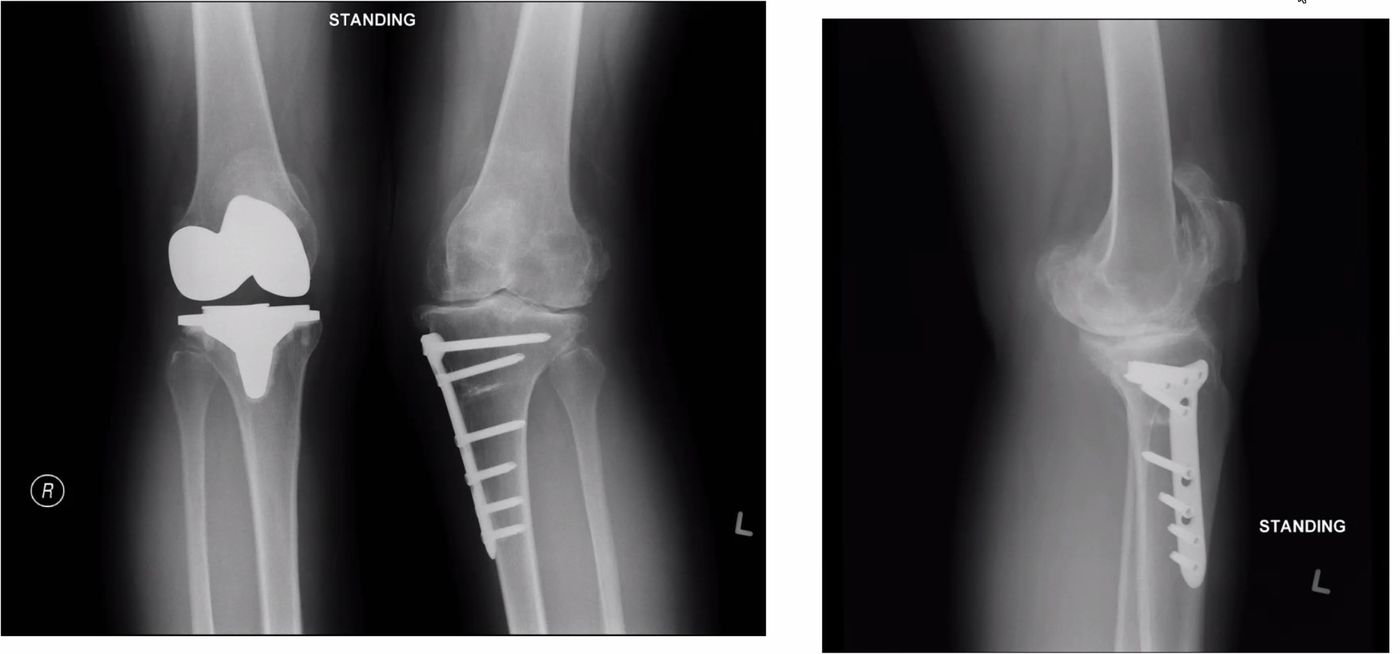
- Whether 1. bone stock 2. soft tissue difficulties can be dealt with in one go
Q2What are the advantages of one stage revision for a failed HTO?▸
- One GA session
- Shorter rehab
- Only one extra-articular deformity; CORA is close to the joint
- Long stem bypasses the screw hole - less stress riser
- Decreased infection and wound problems
Q3What are the anticipated difficulties with approach and exposure in one stage revision?▸
- Use previous/most lateral incision, maintain a thick fasciocutaneous flap
- Medial parapatellar approach (give reason and cons)
- Removal of implant - prepare screwdrivers/broken screw set, protect the MCL
- Inspect osteotomy healing/infection, take samples for c/st
- Retropatellar scar: prepare rectus snip, quadricepsplasty, TT osteotomy
Q4What are the key steps of reconstruction in one stage revision?▸
- Femur: TEA + Whiteside line, expect lateral condyle erosion, less VCA
- Tibia: extramedullary guide, reference off lateral 2mm or medial 5mm, Beware of large tibial slope from index operation
- Obtain balance of the extension gap; PS implant, standby constraint; 2/3 zones of fixation; cemented fixation for poor bone
- Tibia stem bypasses screw hole by 2 cortical widths, prepare offset stem
- Patellar tracking: lateral release, medialised button; ensure no femoral/tibial ER; monitor peroneal nerve
Q5How do you choose between osteotomy and TKR?▸
- TKR ideal: old, less active, tricompartmental, more soft tissue imbalance, larger deformity
- Osteotomy ideal: young fit non-smoker, good bone stock/range/skin, isolated compartment disease, deformity not severe
Q6What are the advantages of UKA over HTO?▸
- Faster recovery, no reliance on bone healing, early weight bearing
- Smaller incision, less pain, shorter length of stay
- Easier conversion; less blood loss and morbidity
- HTO: preserves bone stock, wider indication (ACL deficiency), Better kinematics, ?ROM better; Cao 2018 - HTO for higher activity
Q7What are the survival figures for UKA and HTO?▸
- UKA: 21.4% revision rate at 15 years (Australian joint registry)
- HTO: Kunze AJSM 2020 86% at 6 years; Insall series 70% at 10 years
Q8What history and examination findings are important before revision TKR?▸
- Hx: preop, intraop (trace OT record) and postop course
- Recent infection (skin, dental, UTI); nature of pain
- Local PE: soft tissue envelope, ligamentous laxity, ROM, pulses
- Systemic PE: signs of active infection e.g. ulcer, dirty toes
Q9What investigations are required before revision TKR?▸
- Bloods - inflammatory markers
- Joint aspirate
- XR + scannogram
- CT
Q10What are the aims of revision TKR and when is a constraint implant indicated?▸
- General: stable, painless, mobile knee
- Specific: restore joint line and mechanical axis, balance coronal and sagittal gaps
- Constraint because of loss of collateral function
- Indications: flexion instability with largest femoral component + thickest insert
- Extension instability (recurvatum)
- ML instability upon full knee extension
Q11What must be prepared preoperatively for revision TKR?▸
- Counsel patient re survival and complication rate; know previous implant, contact sales on standby
- Implant removal devices: oscillating saw, flexible osteotome, burr, Gigli saw
- Inform pathology lab for intraop frozen section; prepare cement spacer in case of infection
- Bone loss: prepare augment, wedge, cone, long stem
- Varus-valgus constrain, rotating hinge prosthesis
Q12Describe the intraoperative approach and implant removal in revision TKR.▸
- Previous approach, most lateral incision (6 cm skin bridge; blood supply to skin from medial side); full thickness flap
- Evert patella, partial lateral release to lateral gutter; careful not to disrupt extensor mechanism
- Prepare extensile approach: quadricepsplasty, TT osteotomy, rectus snip
- Remove femur first, then tibia using stacked osteotome or K wire technique
- Remove all cement, take representative sample x5 for c/st, also frozen section (x5 samples for C/S); assess bone loss (AORI)
Q13What is the bone reconstruction ladder and AORI classification in revision TKR?▸
- Ladder: cement +/- screw, bone graft (structural or morselized), modular augmentation (wedges/blocks), custom made/tumour/hinge prosthesis
- Identify joint line (meniscal scar, fibular head, epicondyles, tibial tuberosity); do tibia first to restore gaps; aim 2/3 zones fixation (long cementless stem = short cemented stem, Jones BJJ 2012)
- AORI 1: contained minor defects, intact metaphyseal bone, implant stable
- AORI 2: uncontained defect, damaged metaphyseal bone requiring reconstruction for stability
- AORI 3: deficient metaphyseal segment compromising major portion of femoral condyle/tibial plateau, +/- collateral or patellar tendon detachment
Q14What are the postoperative instructions after revision TKR?▸
- Tell the patient to maximise rehab to avoid stiffness
- Rehab: weight bear as tolerated
- Insert drain
- Antibiotics til c/st is back