Knee
Knee osteoarthritis - assessment and indications
Non-operative OA treatment, Kellgren-Lawrence grading and weight-bearing film assessment.
31 questions
5 source pages
1 images
1 fact-check flags
Images appear with the first question taken from each source page — tap a question to open it.
Q1What does the AAOS 2021 guideline strongly recommend for knee OA?▸
- Rehabilitation, education and wellness activities (strong)
- NSAID (strong)
Q2What does the AAOS 2021 guideline say about weight loss, HTO and IA steroid in knee OA?▸
- Weight loss - moderate
- HTO - limited
- IA steroid is listed on the source (grade not clearly stated)
Q3What does the AAOS 2021 guideline say CANNOT be recommended for knee OA?▸
- Acupuncture
- Viscosupplement
- Glucosamine
- Arthroscopic lavage
- IA HA
Q4What is the guideline evidence on intra-articular hyaluronic acid injection for knee OA?▸
- AAOS 2021: cannot recommend
- NICE 2014: cannot recommend
- ACR 2012: may recommend (2020 ACR recommends against)
- EULAR 2020: may recommend
- AMSSM: can use in KL grade II or III
Q5What did the 2022 BMJ Pereira meta-analysis conclude about viscosupplementation?▸
- Small reduction in knee OA pain compared with placebo
- Difference is less than the clinically important difference
- Does NOT support broad use of viscosupplementation
Q6What is the evidence for oral viscosupplementation?▸
- BMJ 2010 Wandel meta-analysis: no evidence
Q7What are the Kellgren-Lawrence grades for knee OA?▸
- Grade 0: normal appearances
- Grade 1: osteophytes with normal joint space
- Grade 2: less than 50% joint space reduction
- Grade 3: more than 50% joint space reduction
- Grade 4: bone-on-bone contact
Q8What are the Xray classification criteria for OA at each Kellgren-Lawrence grade, as printed on the source?▸
- Grade1: doubtful narrowing and possible osteophytic lipping
- Grade2: definite osteophytes, definite narrowing
- Grade3: moderate multiple osteophytes (page wording: 'osterophyte'), definite narrowing, some sclerosis and possible deformity
- Grade4: large osteophytes, marked narrowing, severe sclerosis and definite deformity
Q9What radiographic finding defines Kellgren-Lawrence grade 4?▸
- Bone-on-bone contact
- page criteria: large osteophytes, marked narrowing, severe sclerosis and definite deformity
Q10How is joint space reduction used in Kellgren-Lawrence grading?▸
- Grade 2 = less than 50% joint space reduction
- Grade 3 = more than 50% joint space reduction
Q11What does the standing X-ray of the right knee show?▸
- Osteoarthritis mainly over the medial compartment
- Lateral compartment preserved
- Slightly varus alignment
Q12How would you assess a patient with medial compartment OA of the knee?▸
- Hx: age, functional demand, occupation, symptom onset/progression, previous treatment, Inflammatory arthritis, infection, trauma
- P/E: BMI, FFC, deformity, range, ACL, instability, NV, varus thrust, skin
- X-ray: scannogram, lateral, skyline
Q13What is the management algorithm for isolated medial OA of the knee?▸
- Conservative management according to AAOS guideline
- Consider HTO, UKR, TKR
- Needs an individualized approach: age, functional demands, bone and soft tissue integrity, ACL status
Q14What are the indications for HTO?▸
- Patient: <60 years old, active
- Joint: unicompartmental OA, FFC < 5 degree, ROM > 90, correctable varus <5 degrees, no instability
- Aim: unload medial compartment, shift mechanical axis, overcorrection 3-6deg
Q15What are the indications for UKA and TKA in isolated medial OA?▸
- UKA: Kozin and Scott criteria, aim to undercorrect
- TKA: absolute indication if ACL insufficient, deformity too large, or poor range
- TKA may consider CR for theoretical advantages
Q16What are the pros and cons of UKA versus HTO?▸
- HTO pros: preserve bone stock, wider indication (ACL deficiency), Better kinematics and ROM
- HTO cons: union problems, cosmesis (valgus knee), longer rehab
- Cao 2018 meta-analysis: UKA less revision/complications/post-op pain, HTO better ROM; HTO may be better for high activity level
Q17What are the options for HTO?▸
- Medial open wedge
- Lateral closing wedge
- Dome osteotomy
Q18What are the contraindications and advantages of medial open wedge HTO?▸
- C/I if patella baja as it will elevate the joint line
- Advantages: higher corrective power, no fibular osteotomy with decreased peroneal nerve injury, less tibial offset, less scarring leading to less patella baja
Q19What are the disadvantages of medial open wedge HTO?▸
- Non-union leading to implant failure (plate and screw)
- Lateral cortex fracture
- Increase posterior slope
- Bone graft donor site morbidity (may use calcium phosphate wedge graft)
Q20What is the Nakamura classification of lateral cortex fracture in open wedge HTO?▸
- Type1, along osteotomy
- Type2, go down
- Type3, go intraarticular region
Q21What are the pros and cons of lateral closing wedge HTO?▸
- Advantage: fewer non-unions
- Disadvantages: peroneal nerve palsy, short limb, Distort anatomy, truncated making TKR harder, scarring leading to patella baja
Q22What did the JBJS 2014 RCT show about open versus closing wedge HTO?▸
- No clinical or radiological difference between open and closing wedge
Q23How do you differentiate the HTO types on X-ray?▸
- Fibular osteotomy = closing wedge or dome (closing wedge shows a step on the lateral side)
- Open wedge usually has a plate; dome may have 2 staples
Q24What are the outcomes of HTO?▸
- 65% at 10 years (Insall); most HTOs eventually require TKR
- Best results: younger, moderate varus; obesity, undercorrection and excessive overcorrection are adverse
- Ideal correction: hip-knee-ankle angle between 2° & 6° (overcorrection); plan with Miniaci method, Fujisawa point; the overall preoperative state of the knee is the most important determinant
Q25How does UKA compare with TKR?▸
- UKA preserves both cruciates: better knee function, better joint forgettability, quicker rehab, less blood loss and morbidity
- Good survival data come from high volume centres; overall survival 90% at 10 years (Swedish joint registry)
- Long term survival still inferior to TKR: 3.2x higher revision rate in the UK joint registry (possible selection bias)
- BMJ 2019 Andrew Price meta-analysis: both viable for isolated unicompartmental OA; UKA better in several outcome domains but TKA has lower revision risk
Q26What are Scott's indications for UKA?📷▸
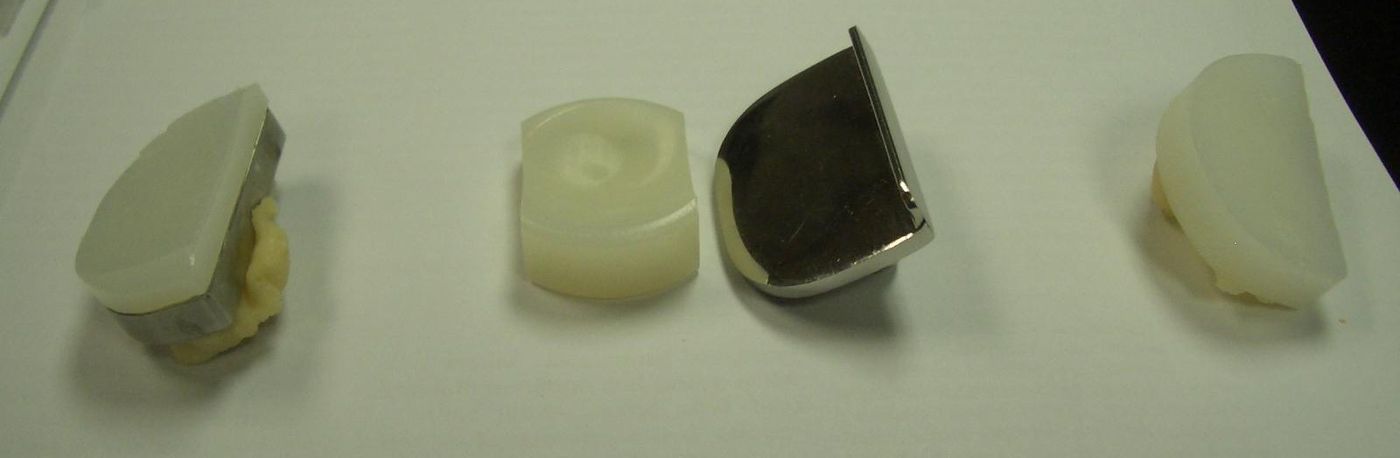
- Intact ACL
- Flexion arc >90
- Contracture <5
- Varus deformity <10, passively correctable to neutral
- Generally age >60, weight <82kg, not a manual worker
Q27What are the contraindications to UKA?▸
- Multicompartmental involvement
- Inflammatory arthritis
- Significant fixed deformity (FFC >10 degrees)
- Previous meniscectomy on the other side
- ACL deficiency (in mobile bearing UKA)
Q28What are the complications and failure mechanisms of UKA?▸
- Stress fracture (always tibial) with heavy weight/activity
- Fixed-bearing implants: fail with mechanical loosening
- Mobile-bearing implants: fail from disease progression
- Patella impingement may need revision to TKR
Q29What coronal and sagittal deformity thresholds are quoted for osteotomy vs TKA?▸
- Coronal: femur >20, tibia >30
- or >20 in the sagittal plane
- Then consider severity --> soft tissue --> LLD --> nail/plate
Q30What are the prerequisites, advantages and disadvantages of TKA with intraarticular correction?▸
- Prerequisite: not to violate the collateral ligament (+ minimal malrotation)
- Advantages: less extensive, easy and fast rehab, avoid osteotomy
- Disadvantages: soft tissue imbalance, malrotation of the ankle joint
Q31What are the advantages and disadvantages of extraarticular correction then TKR?▸
- Greater surgical flexibility (open vs closing wedge osteotomy, technically easier)
- Allows healing of the osteotomy (no risk of cement extrusion from TKR)
- Improve knee alignment – might alleviate symptoms and delay TKA
- Disadvantages: 2 surgeries, 2 anaesthetics, longer rehab
Fact check
Kellgren-Lawrence grade 1 = osteophytes with normal joint space; grades 2/3 defined by 50% joint space reduction — non-standard definitions — Original KL: grade 1 doubtful joint space narrowing with possible osteophytes; grade 2 definite osteophytes with possible narrowing; grade 3 definite narrowing with moderate osteophytes; grade 4 marked narrowing with sclerosis and bone end deformity — source