Arthritis
Knee alignment and intra-articular bodies
Whiteside alignment method and interpretation of loose bodies on imaging
13 questions
2 source pages
1 images
1 fact-check flags
Images appear with the first question taken from each source page — tap a question to open it.
Q1What is the pathophysiology of compartment syndrome?📷▸
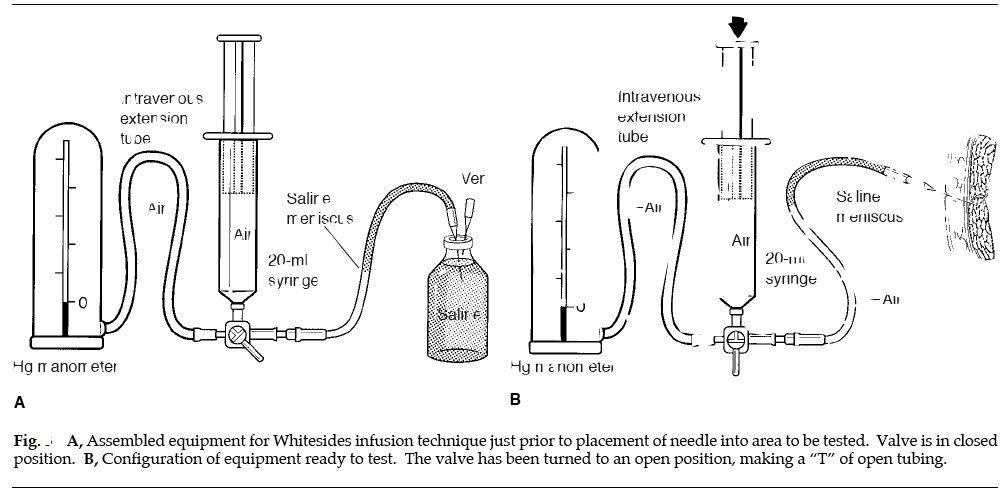
- Increased tissue pressure within an enclosed anatomical space
- Causes can be extra-compartmental or intra-compartmental
Q2What are the steps of fasciotomy?▸
- Extensile longitudinal full-thickness skin incision
- Release all compartments, protect NV bundles
- Debride necrotic tissue
- Wound coverage at 7-10 days
Q3What are the consequences of delaying fasciotomy beyond 12 hours?▸
- Infection 50%
- Amputation 20%
- Supportive care for acute renal failure plus late reconstruction
Q4What equipment and technique does the Whiteside method use to measure compartment pressure?▸
- 18-gauge needles and a 20 ml syringe
- The portion of the tube containing the top of the column of saline to be observed is placed carefully at the same level as the tip of the needle in the patient
- Record measurements from the manometer when the saline meniscus is flat - that is, when the pressure in the tissue at the tip of the needle and the pressure in the column of air behind the saline are equal
Q5Define force.▸
- Load acting on a subject, with magnitude and direction - thus a vector
Q6What is a free body diagram?▸
- A diagram to illustrate the various forces acting on an object, e.g. a joint
Q7What are the assumptions of a free body diagram?▸
- The system is in equilibrium
- Bones are rigid levers
- Joints are (1) frictionless hinges and (2) joint reaction forces are assumed to be only compressive
- Muscles only act in tension, there is no antagonistic muscle action, and they act along the centre of muscle mass
- Weight of the body is concentrated at the exact centre of body mass (leg in single leg stance)
Q8Define moment.▸
- Force applied at a distance from the pivot
Q9Define a lever.▸
- A rigid bar that turns about an axis of rotation or fulcrum
Q10What are the joint reaction forces in normal walking, running and straight leg raise?▸
- Normal walking = 3 times body weight
- Running = 7 times body weight
- SLR = twice body weight
Q11How can the hip joint reaction force be reduced non-surgically?▸
- Decrease weight
- Walk in Trendelenburg position
- Hold a stick on the contralateral side (helps the moment of the abductor)
Q12How can the hip joint reaction force be reduced surgically?▸
- Increased offset
- Medialize cup
Q13Which joints and applications are listed on the free body diagram page?▸
- Hip - how to decrease JRF
- Knee - tibiofemoral joint and PFJ
- Ankle - how to decrease ankle joint reaction force after subtalar fusion
- Shoulder - reverse shoulder arthroplasty
Fact check
Delayed fasciotomy beyond 12 hours carries a 50% infection rate and 20% amputation rate — specific figures not supported by current literature — Published rates after fasciotomy are infection up to about 30% and amputation 15-31% in delayed groups; the 50%/20% figures lack a clear source — (medium confidence) — source