Bone and Joint
Bone anatomy and bone types
Overview of bone as an organ: functions, types, gross shape and structural organisation
13 questions
2 source pages
1 images
Images appear with the first question taken from each source page — tap a question to open it.
Q1What is the theme of this section?▸
- Bone and joint
- Title of this section divider page
Q2List the bone and joint topics covered in this section.▸
- Not covered in the speaker notes
- Topics are covered in the following sections
Q3What is bone?📷▸
- A solid organ
- A specialised connective tissue with several main functions
Q4What are the functions of bone?▸
- Haematopoiesis
- Calcium reservoir
- Skeletal framework for locomotion
Q5What types of bone are seen macroscopically and where are they found?▸
- Lamellar bone (mature) is divided into cortical and cancellous bone
- Woven bone (primitive, immature) is found in fracture callus and distraction histiogenesis
Q6What are the microscopic components of bone?▸
- Comprises cells (10%) and ECM (90%)
- Cells: osteoblasts, osteoclasts, osteocytes, bone lining cells, osteoprogenitor cells
Q7What are the organic and inorganic components of bone ECM?▸
- Organic 40%: type 1 collagen, proteoglycans, matrix proteins (osteocalcin, osteonectin, osteopontin), growth factors and cytokines
- Inorganic 60%: HA (hydroxyapatite)
Q8What mnemonic summarises the lamellar vs woven bone differences?▸
- DLC OBT – Daniel's little cafe offers best tea
- Description, Location, Composition, Organisation, Biomechanics, Turnover
Q9Differentiate lamellar and woven bone.▸
- Lamellar: mature, less cellular, ordered stress-oriented collagen, anisotropic, more stiff/less ductile, low turnover
- Lamellar is formed by enchondral or intramembranous ossification
- Woven: primitive/immature, more cellular, dense collagen fibres, no lamellae, isotropic, less stiff/more ductile, high turnover
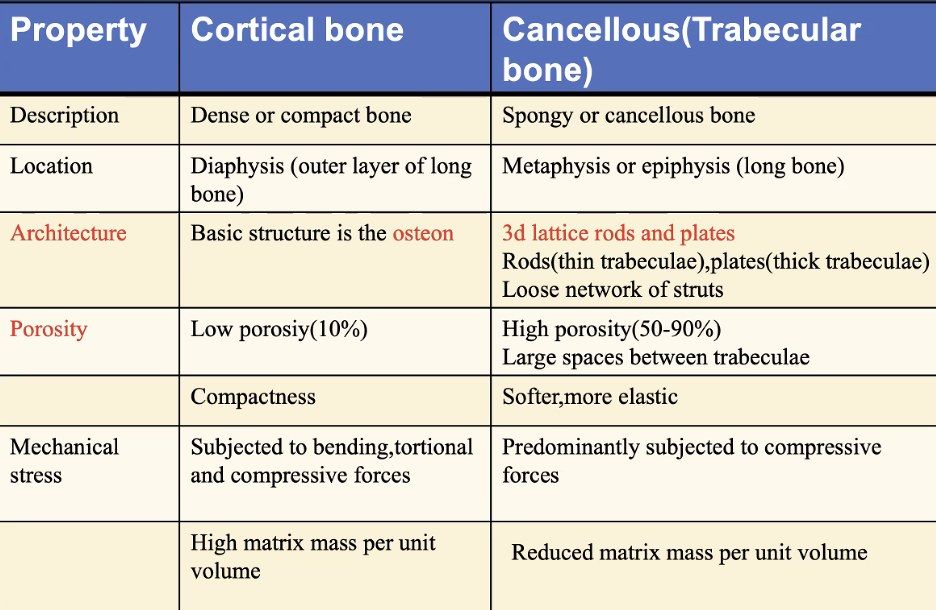
Q10Differentiate cortical and cancellous bone.▸
- Cortical (compact): diaphysis, osteon/Haversian system along the longitudinal axis, low porosity, higher Young's modulus, low turnover
- Cancellous (spongy): metaphysis, 3D lattice of trabeculae, porosity 50-90%, lower Young's modulus, compressive forces, high turnover
Q11Describe the structure of the Haversian system.▸
- Central neurovascular channel enclosed within concentric lamellae
- Each osteon has 5-7 concentric rings; collagen arranged in a herringbone pattern
- Separated by a cement line where canniculi and collagen do not cross, an area of relative weakness and fracture propagation
- Interstitial lamellae lie between osteons
Q12What is the role of Volkman canals?▸
- Run perpendicular to the long bone axis
- A low pressure system
- Make blood flow in the long bone centrifugal (in to out)
Q13What is Wolff's law?▸
- Bone models and remodels in response to the mechanical stresses it experiences
- resulting in a minimal weight structure that is adapted to its applied stresses